
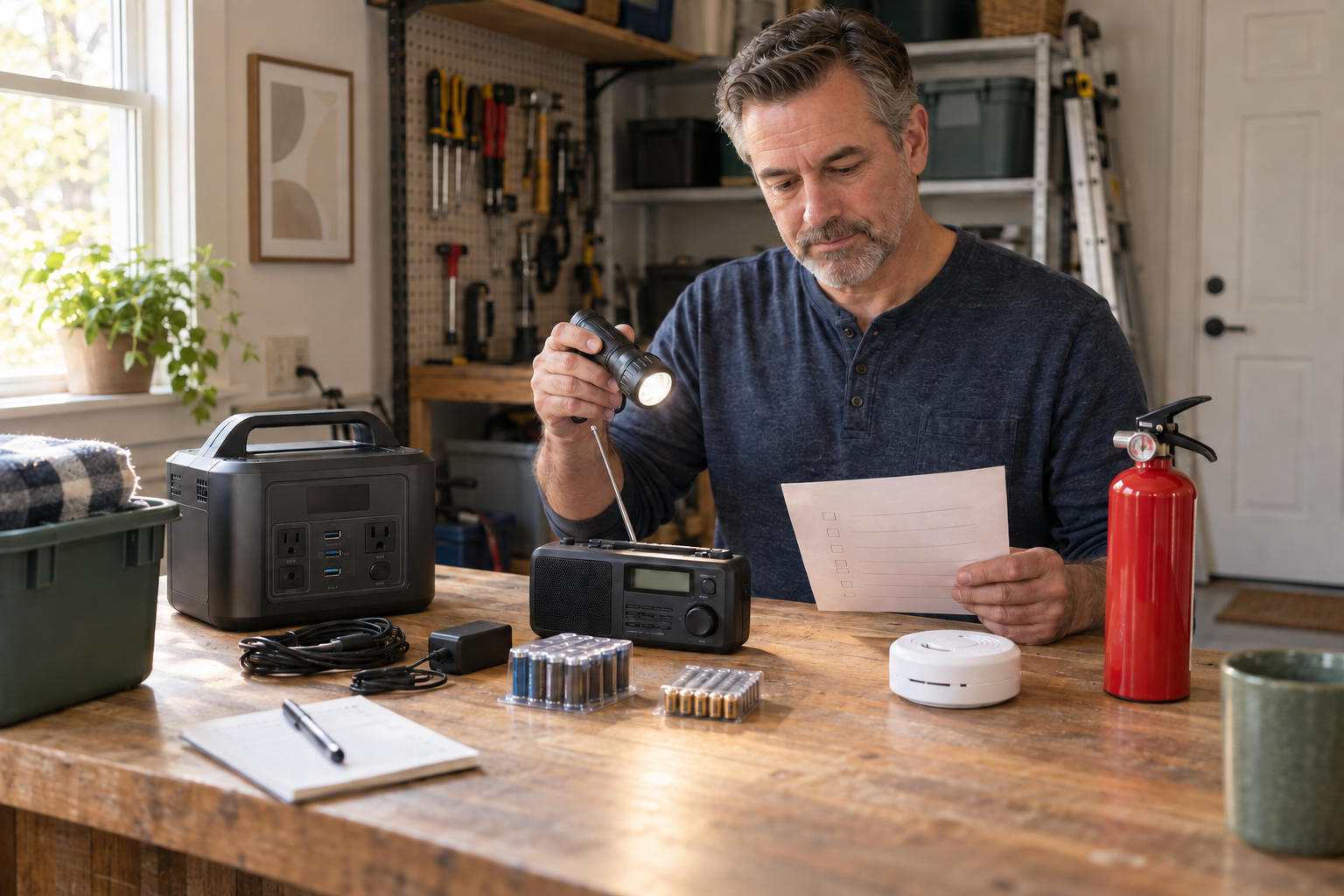
Emergency equipment has one bad habit: it can stop working while no one is looking.
A flashlight can sit in a drawer with leaking batteries. A weather radio can lose its programming. A portable power station can slowly discharge in the back of a closet. Even a generator that worked perfectly last year may not be ready when the next outage begins.
You do not need to test everything every weekend. You do need a routine that catches problems before an emergency does.
The easiest approach is to divide the work into monthly, quarterly, six-month and annual checks. Add a short check before a predictable threat, such as hurricane season or a winter storm, and inspect equipment again after you use it.
Quick Answer
Test smoke and carbon monoxide alarms every month. Check stored power, lighting, radios and battery supplies at least every three months. Review emergency kits every six months, and complete a full household equipment review once a year.
Those are practical default reminders—not universal manufacturer requirements. The manual for your exact equipment, its maintenance schedule and any medical guidance always take priority.
Testing, Inspecting and Maintaining Are Not the Same Thing
It is easy to call every check “maintenance,” but three different jobs are involved.
Inspection means looking for trouble. You check for cracks, corrosion, swelling, leaks, missing parts, blocked vents, damaged cords or an expired service date.
Testing means confirming that the equipment performs its intended function. A flashlight turns on. A radio receives the local station. A smoke alarm sounds when its test button is pressed. A backup power source carries a small, familiar load.
Maintenance means doing the work required to keep the equipment dependable. That might include charging a battery, changing generator oil, rotating stored fuel or arranging professional service.
A useful calendar includes all three, but it does not turn the homeowner into a repair technician. If a test reveals damage, a safety warning or a problem you cannot address confidently, stop using the equipment and follow the manufacturer’s instructions.
The Ready Chateau Emergency Equipment Schedule
Monthly
- Test every smoke alarm using its test button.
- Test every carbon monoxide alarm using its test button.
- Visually inspect household fire extinguishers.
- Confirm that any automatic standby-generator exercise occurred without a warning.
- Complete any portable-generator exercise required by its manual.
- Check medically necessary backup equipment according to the schedule provided by the manufacturer and health-care team.
Every Three Months
- Check and service portable power stations according to their manuals.
- Turn on flashlights, headlamps and emergency lanterns.
- Check rechargeable lights, USB power banks and spare batteries.
- Turn on the weather radio and verify its station, alert settings and backup power.
- Inspect emergency charging cables, adapters and extension cords.
- Check manufacturer notices and recalls for important equipment.
Every Six Months
- Review home, evacuation and vehicle emergency kits.
- Replace expired or damaged supplies and account for changing household needs.
- Check stored fuel and fuel stabilizer against the storage plan and product directions.
- Update seasonal clothing, pet supplies, medications and contact information.
- Confirm that everyone in the household knows where the equipment is stored.
Once A Year
- Complete a full equipment inventory.
- Review manuals, model numbers, serial numbers and replacement dates.
- Replace alarm batteries when required.
- Review generator maintenance by both operating hours and calendar time.
- Check whether aging batteries still provide enough useful runtime.
- Practice a short outage routine with the household.
Before A Seasonal Threat Or Expected Outage
- Charge rechargeable equipment for emergency readiness.
- Test the devices and loads you realistically expect to use.
- Confirm that fuel, cables, adapters and other supporting supplies are available.
- Check local alert sources and weather-radio programming.
- Move buried or hard-to-reach equipment where it can be used safely.
After Each Use
- Inspect equipment for heat, damage, leaks or unusual behavior.
- Recharge, refuel, clean or store it according to its manual.
- Replace supplies that were consumed.
- Record any problem that must be corrected before the next emergency.
Safety Warning: A Test Should Not Create a New Hazard
Do not run a portable generator indoors or in a garage, shed or other enclosed or partially enclosed space. Do not test a smoke or carbon monoxide alarm with a flame, smoke or engine exhaust. Do not intentionally disconnect critical medical equipment from power without approved instructions and a safe backup already available.
Do not charge or operate a lithium-ion battery that is swollen, leaking, unusually hot, damaged or producing an unfamiliar odor or sound. Stop any test that produces smoke, sparks, leaking fuel, rapidly increasing heat or repeated fault warnings.
Use the equipment’s built-in test function, a small controlled load or the exact procedure in its manual. The goal is to confirm readiness, not to prove how far the equipment can be pushed.
What to Check Every Month
Smoke And Carbon Monoxide Alarms
Life-safety alarms belong on the shortest schedule because waiting six months to discover a dead alarm is too long.
The U.S. Fire Administration recommends testing smoke alarms every month. The Consumer Product Safety Commission gives the same monthly guidance for smoke and carbon monoxide alarms.
Use the test button and follow the alarm manufacturer’s directions. Do not use a flame, vehicle exhaust or another source of smoke or carbon monoxide to test an alarm.
Replace removable alarm batteries at least annually unless the manufacturer specifies a different schedule. Do not try to open or replace the battery in an alarm sold with a sealed long-life battery. Replace smoke alarms at 10 years, and replace carbon monoxide alarms according to the manufacturer’s end-of-life instructions.
Fire Extinguishers
Give each household fire extinguisher a quick visual inspection every month. Make sure it is where it belongs, easy to reach and not blocked by stored items. Check the pressure indicator if the unit has one, and look for a missing pin or seal, corrosion, leakage, a damaged hose or other visible damage.
Do not discharge an extinguisher merely to see whether it works. Follow the label for inspection, professional service and replacement requirements. If an extinguisher has been used—even briefly—have it recharged or replace it as directed.
Generators
There is no single exercise schedule for every generator. Some portable-generator manufacturers recommend a monthly run, while standby generators may perform an automatic exercise weekly, every two weeks or monthly.
Follow the schedule for the exact model. Our guide to how often you should run your generator explains how to perform a useful exercise without treating a brief engine start as proof that the entire backup-power setup is ready. Use the portable generator maintenance checklist to track the inspections and service that a test run cannot replace.
Never move a generator into a garage, shed or other enclosed or partially enclosed space for a convenient test. Review our portable-generator safety guide before operating one.
Medically Necessary Equipment
Do not place electrically powered medical equipment on a generic household schedule.
Work with the equipment supplier, manufacturer and health-care team to determine how its batteries, alarms and backup power should be tested. Do not create a power failure by unplugging critical equipment unless the approved instructions specifically call for that test and a safe backup is already available.
Ready.gov recommends identifying equipment that depends on electricity and making backup plans, including model and serial numbers and any special operating instructions. Treat this part of the household plan as essential, not optional.
What to Check Every Three Months
Portable Power Stations And Power Banks
A three-month reminder is a practical starting point for stored rechargeable power because several major power-station manufacturers use that interval. The exact charging or storage percentage is not universal.
Turn the unit on, inspect the case, ports, cables and vents, and check the remaining charge. Follow the manufacturer’s directions for recharging or cycling the battery. Then connect a small, familiar device and confirm that the expected outlet works.
Our complete guide to portable power station maintenance explains the model-specific storage differences and the warning signs that mean you should stop using the unit.
Do not run a lithium-ion battery to zero simply because the calendar says it is time for a test. Do not charge or use a unit that is swollen, leaking, unusually hot, damaged or producing an unfamiliar odor or sound.
Flashlights, Headlamps And Lanterns
Turn on every emergency light and let it run long enough to reveal a weak battery, loose switch or flickering connection. Check each brightness setting that you expect to use.
Recharge built-in batteries as directed. Inspect removable batteries for corrosion or leakage, and confirm that your spare batteries are the correct size and have not expired. Store at least one dependable light where you can reach it without crossing a dark house.
The U.S. Fire Administration recommends flashlights instead of candles during a power outage. That advice only helps if the flashlight works.
Weather Radios
Turn on the radio and confirm that it receives the nearest National Weather Service broadcast clearly. Check the clock, location codes, alert types, volume and battery backup according to the radio’s manual.
National Weather Service offices normally transmit a routine test each week, although the test may be postponed during threatening weather. The NOAA Weather Radio page explains the national alert network, and your local National Weather Service office publishes the test schedule for its transmitters.
You do not need to stand beside the radio every Wednesday. During the quarterly check, confirm that the radio has received or recorded a recent test and that it has not been left in silent, travel or demonstration mode.
Cables, Adapters And Extension Cords
The power source is only half of a backup-power system. Inspect the cables, chargers and adapters required to connect the equipment you intend to use.
Look for cracked insulation, bent or missing prongs, loose connectors, corrosion and heat damage. Confirm that generator extension cords are outdoor-rated and sized for the load. Replace damaged cords rather than wrapping them in tape and returning them to the emergency bin.
What to Review Every Six Months
Twice a year, widen the check beyond equipment and review the supplies that make the equipment useful.
The Federal Emergency Management Agency’s preparedness guide recommends reviewing household needs and emergency kits every six months. The American Red Cross also advises checking emergency supplies every six months so expired food, water and medications can be replaced.
Use the six-month review to check:
- Home, evacuation and vehicle kits
- Food, water and medication dates
- First-aid supplies
- Pet food, records, carriers and medications
- Clothing that no longer fits or matches the coming season
- Fuel age, storage condition and stabilizer directions
- Printed contacts, insurance information and evacuation details
- Changes in the household, including new medical, mobility or dietary needs
Use the complete home emergency preparedness checklist for the broader household review. Our guide to the things people forget in an emergency kit can help uncover less obvious gaps.
Do not automatically throw away every dated item. Follow the label, storage guidance and household policy for each product. The purpose of the review is to make a decision while replacement supplies are easy to obtain.
The Annual Whole-House Test
Once a year, stop looking at each device as a separate object and test whether the pieces work together.
Choose a safe time when the household is not facing severe weather. Walk through a short imaginary outage:
- Find the flashlights without using normal room lighting.
- Turn on the weather radio and locate other trusted alert sources.
- Confirm that phones and essential devices can be charged.
- Set up backup power outdoors or in its approved location without connecting it to the house.
- Power one or two realistic loads with the equipment intended for them.
- Locate the emergency kit, medications, pet supplies and printed contacts.
- Confirm that everyone knows the safest meeting place and how to leave if necessary.
This does not require shutting off power to the house. It is a short function check designed to reveal missing cords, dead batteries, inaccessible equipment and forgotten instructions.
Use the annual review to record model and serial numbers, download missing manuals and check the CPSC recall database. Note replacement dates for alarms, batteries, extinguishers and any other equipment with a stated service life.
When to Test Outside the Calendar
A calendar is the baseline, not a reason to ignore changing conditions.
Test or inspect equipment again:
- Before hurricane, tornado, wildfire or winter-storm season in your area
- When severe weather or a planned utility outage is forecast
- After equipment has been dropped, flooded, overheated or exposed to unusual conditions
- After lending equipment to someone else
- After a firmware update or major configuration change
- After any use during an outage
- When the display, runtime, sound, smell or behavior changes
- When a manufacturer or safety agency publishes a notice affecting the model
If you discover a problem shortly before a storm, do not rush into an unsafe repair. Use the manufacturer’s support process, arrange qualified service or change the household plan around the equipment that remains dependable.
Keep the Record Simple
The best maintenance record is the one you will actually use.
Write the next-check month on a tag attached to the equipment, add four recurring reminders to a digital calendar or keep one printed page with the emergency supplies. Record only what helps:
- Equipment name and location
- Model and serial number
- Last inspection or test date
- Result or problem found
- Next required action and date
Do not build a complicated system that takes longer to update than the equipment takes to test. A checkmark and a short note are usually enough.
The Bottom Line
Emergency equipment does not become dependable simply because you bought it and found a place to store it.
Test life-safety alarms monthly. Check stored power, lighting, radios and supporting cables every three months. Review household kits every six months, and bring the entire system together once a year.
Use those reminders as a starting point, then follow the manual for each product. Fifteen quiet minutes on the calendar is much easier than discovering a dead battery, missing cord or silent alarm after the lights have already gone out.