
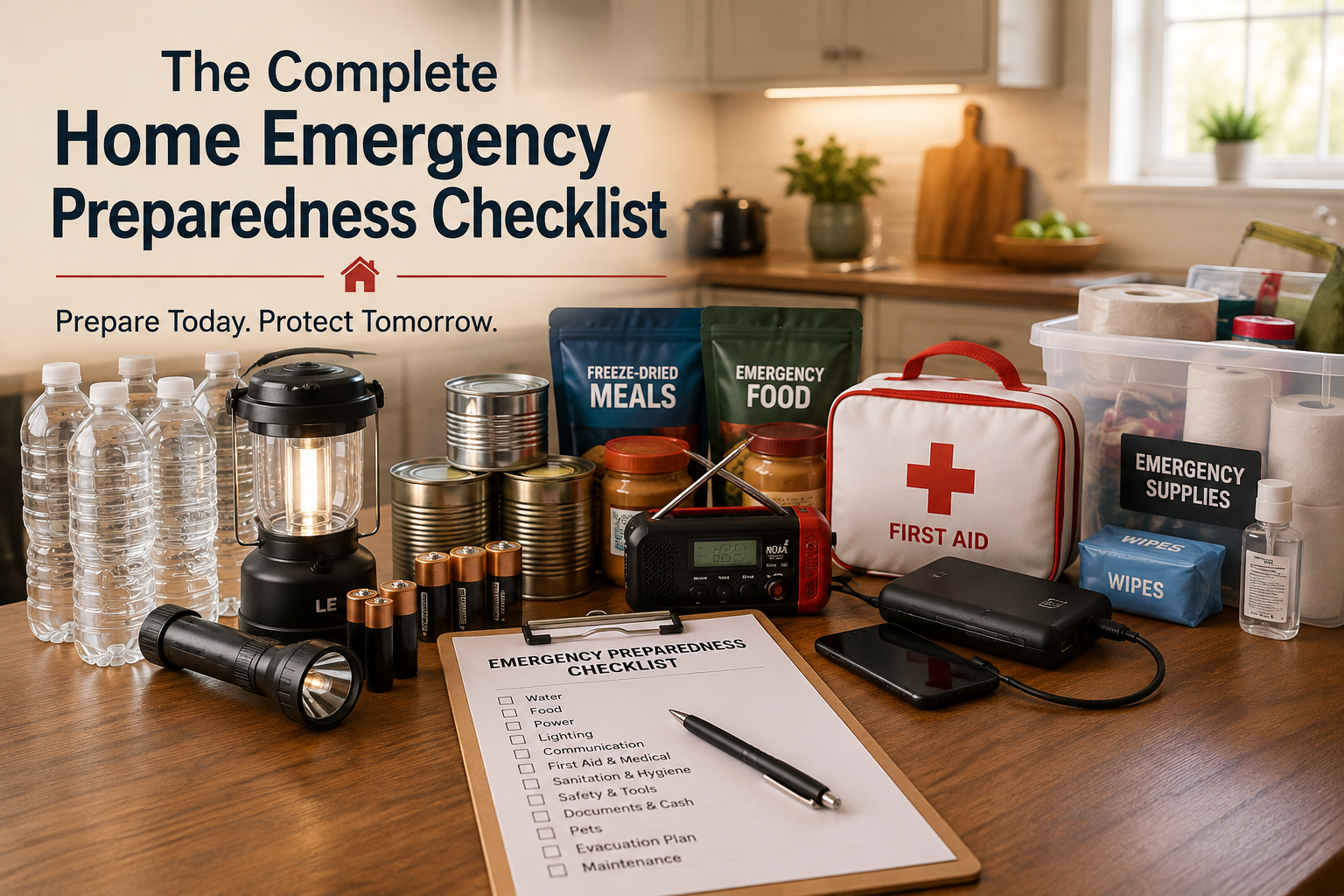
Emergencies rarely happen at a convenient time.
Want a printable version? Download the free Ready Chateau Home Preparedness Checklist and review your household’s preparations at your own pace.
A storm can knock out power overnight. A water-main break can interrupt service. Severe weather can make roads unsafe. An evacuation order can mean leaving home with little notice.
Being prepared doesn’t mean trying to anticipate every possible disaster. It means making sure your household can handle the basic problems emergencies tend to create.
If you’ve already read Start With the Basics: A Practical Guide to Household Preparedness, you know the Ready Chateau approach:
People → Risks → Inventory → Essentials → Gaps → Maintenance
This checklist takes the next step.
Use it to evaluate what your household already has, identify what’s missing, and build a practical preparedness plan without turning the process into a shopping spree.
FEMA’s emergency-supply guidance is a useful starting point, but FEMA also emphasizes that a basic supply list is only a starting point and should be adapted to the unique needs of your household, including pets.
You don’t have to complete everything today.
Start with what matters most, work through the checklist, and improve your preparedness over time.
1. Start With the People in Your Household
Before thinking about equipment or supplies, think about the people who will depend on them.
An emergency plan for one healthy adult will look very different from a plan for a family with young children, an older adult, someone who depends on refrigerated medication, or a person who uses electrically powered medical equipment.
CDC preparedness guidance specifically emphasizes individual needs such as prescription medications, medical devices, mobility equipment, eyeglasses and specialized foods.
Household Checklist
- List everyone who normally lives in your household.
- Identify infants, young children or older adults who may need additional help.
- Identify mobility, accessibility or other functional needs.
- Identify prescription medications household members depend on.
- Identify medical equipment that requires electricity, batteries or refrigeration.
- Account for prescription glasses, hearing aids, mobility equipment and other essential devices.
- Identify food allergies, dietary restrictions and specialized nutritional needs.
- Include pets and service animals in your planning.
- Identify anyone outside your household who may depend on you during an emergency.
Ready Chateau Tip: Don’t build a generic emergency plan and then try to fit your household into it. Build the plan around the people who will actually use it.
2. Know Your Risks
You don’t need to prepare equally for every disaster imaginable.
Start with events that are realistic where you live.
Depending on your location, those might include:
- Power outages
- Hurricanes
- Tornadoes
- Flooding
- Winter storms
- Extreme heat
- Wildfires
- Water interruptions
- Local evacuation events
Some problems can occur almost anywhere. A prolonged power outage, communications failure or temporary interruption in water service doesn’t require a major natural disaster.
Risk Checklist
- Identify the severe-weather hazards common to your area.
- Know whether your home is in a flood-prone, wildfire-prone or evacuation area.
- Consider how a prolonged power outage would affect your household.
- Consider what would happen if your normal water supply became unavailable.
- Know where you would shelter during the hazards most likely to affect your area.
- Know which circumstances could require you to evacuate.
The goal isn’t to predict the next emergency.
It’s to avoid being surprised by problems you could reasonably have anticipated.
3. Emergency Water
Water belongs near the top of every preparedness checklist.
CDC recommends storing at least 1 gallon of water per person per day for 3 days and, when possible, trying to maintain a 2-week supply. Additional water may be necessary for people who are pregnant or sick, pets, or households in hot climates.
Water Checklist
- Store at least 1 gallon of water per person per day for a minimum of 3 days.
- Work toward a 2-week household supply when practical.
- Include additional water needed for pets.
- Account for health, climate and other circumstances that may increase water needs.
- Use appropriate food-grade water-storage containers if you fill your own containers.
- Store water away from harmful chemicals and in an appropriate location.
- Observe manufacturer expiration dates on commercially bottled water.
- Replace water stored in home-filled containers every 6 months.
- Have a reliable backup method for making water safe if your stored supply becomes insufficient.
- Make sure everyone who may need the water knows where it is stored.
CDC identifies unopened commercially bottled water as the safest and most reliable emergency water source. For water stored in containers filled at home, CDC recommends food-grade containers and replacement every six months.
We’ll cover quantities, storage methods and treatment options in greater detail in Ready Chateau’s dedicated emergency-water guides.
4. Emergency Food
Emergency food should be food your household can realistically eat and prepare under emergency conditions.
It’s easy to buy specialty emergency food without considering allergies, preparation requirements, available cooking methods or whether anyone in the household actually likes it.
Food Checklist
- Keep several days of nonperishable food available.
- Choose foods your household normally eats when practical.
- Account for allergies, dietary restrictions and medical diets.
- Include infant formula or specialized nutrition products when needed.
- Include foods that require little or no cooking.
- Consider how food will be prepared if electricity or gas service is unavailable.
- Keep a manual can opener if any emergency food requires one.
- Monitor expiration or best-quality dates.
- Rotate appropriate foods into normal household use rather than allowing them to be forgotten.
CDC includes emergency food and specialty foods for infants, people with dietary restrictions, food allergies and certain medical conditions among important personal emergency needs.
Preparedness food doesn’t have to be exotic.
For many households, the most practical emergency pantry begins with ordinary shelf-stable foods they already use.
5. Lighting and Backup Power
A power outage becomes much easier to manage when you can see, communicate and keep essential small devices operating.
Start with basic capability before worrying about large backup-power systems.
Lighting & Power Checklist
- Have working flashlights where household members can find them easily.
- Have a way to provide safe area lighting.
- Keep the correct spare batteries for battery-powered equipment.
- Have at least one way to recharge mobile phones during an outage.
- Keep power banks charged if they’re part of your plan.
- Identify medical devices or other essential equipment that cannot tolerate an extended outage.
- Determine whether essential equipment requires a larger backup-power solution.
- Know how your backup-power equipment is supposed to be used safely before an emergency occurs.
FEMA includes flashlights, extra batteries, and an extra cellphone battery or charger among basic emergency supplies.
A generator or portable power station may eventually make sense for your household, but backup power should solve an identified need—not simply add another piece of equipment to the garage.
6. Stay Informed and Connected
A charged phone is useful, but it shouldn’t be your entire emergency communications plan.
Cellular networks can become congested. Internet service can fail. Power outages can interrupt charging.
The National Weather Service recommends having multiple ways to receive warnings, including a method capable of alerting you during the night.
Communications Checklist
- Make sure Wireless Emergency Alerts are enabled on compatible phones.
- Know how your local government distributes emergency notifications.
- Have multiple ways to receive severe-weather warnings.
- Include a warning method capable of waking you at night.
- Consider a NOAA Weather Radio with battery backup.
- Keep important telephone numbers somewhere besides your phone’s contact list.
- Establish an out-of-area contact household members can reach.
- Choose household meeting locations.
- Make sure children and other household members understand the basic communication plan.
- Keep charging cables and backup charging equipment accessible.
The important principle is redundancy.
No single warning or communication method should be expected to work perfectly under every circumstance.
7. First Aid, Health and Medications
An emergency can make routine healthcare harder to access even when nobody is injured by the emergency itself.
Pharmacies may close. Roads may be blocked. Electricity may be unavailable. Normal appointments may be disrupted.
Health Checklist
- Keep an appropriate household first-aid kit.
- Know where it is stored.
- Review its contents periodically and replace used or expired items.
- Maintain a current list of prescription medications.
- Record dosage, frequency, medical needs and allergy information.
- Talk with your physician or pharmacist about an appropriate emergency supply of necessary medications.
- Plan for medications that require refrigeration.
- Keep essential medical-device supplies available.
- Include prescription glasses, contact-lens supplies, hearing-aid supplies and other essential personal items.
- Have a backup-power plan for essential electrically powered medical equipment.
CDC recommends discussing emergency medication supplies with a physician or pharmacist and maintaining current information about prescriptions, dosage, medical needs and allergies.
Medication planning is one area where a generic checklist cannot replace individualized medical advice.
8. Sanitation and Personal Needs
Emergencies don’t eliminate ordinary human needs.
If water, electricity or normal retail access is interrupted, basic hygiene and sanitation supplies become much more important.
Sanitation Checklist
- Toilet paper
- Soap and hand-cleaning supplies
- Personal hygiene products
- Feminine hygiene products where needed
- Diapers and infant-care supplies where needed
- Older-adult or incontinence supplies where needed
- Garbage bags and ties
- Moist towelettes or other appropriate cleaning supplies
- Basic household disinfecting and cleaning supplies
- A plan for sanitation if normal water or sewer service is interrupted
This isn’t the glamorous side of preparedness, but it can quickly become one of the most important.
9. Home Safety and Basic Tools
Preparedness also means knowing how to keep an emergency from becoming worse.
Home Safety Checklist
- Confirm that smoke alarms are installed and working.
- Confirm that carbon-monoxide alarms are installed and working where appropriate.
- Keep an appropriate fire extinguisher accessible.
- Make sure household members know basic fire-safety procedures.
- Know where your home’s utility shutoffs are located.
- Learn the correct procedures for your home’s utilities before an emergency.
- Keep basic household tools accessible.
- Keep sturdy work gloves available.
- Have a whistle or another simple means of signaling for help.
- Keep local maps available in case normal navigation services are unavailable.
FEMA’s basic emergency-supply guidance includes a whistle, local maps, and a non-sparking wrench or pliers for utility shutoff.
Important: Don’t shut off gas or other utilities simply because an emergency has occurred. Follow instructions from your utility provider and local authorities and understand the correct procedures for your home before an emergency happens.
10. Documents and Emergency Cash
Some emergencies create paperwork problems long after the immediate danger has passed.
Having essential information organized beforehand can make evacuation, insurance claims, medical care and recovery much easier.
Documents & Money Checklist
- Identification documents
- Insurance policies and contact information
- Medical and prescription information
- Emergency contact information
- Property ownership or lease information
- Vehicle information
- Pet records
- A basic household inventory
- Photographs or video documenting important household property
- Secure physical or digital backups of critical information
- Some emergency cash in an appropriate secure location
Store sensitive documents securely and protect them from unauthorized access as well as physical damage.
CDC’s preparedness program identifies paperwork—including insurance information, personal identification and emergency plans—as a core part of personal health preparedness.
You don’t need to carry your entire filing cabinet during an evacuation.
You do need a way to access information that would be difficult to replace when you need it most.
11. Don’t Forget Your Pets
Pets are part of the household preparedness plan, not an afterthought.
If conditions aren’t safe for you, they may not be safe for your animals either.
Pet Preparedness Checklist
- Keep a 2-week emergency supply of food for each animal.
- Keep a 2-week emergency supply of water for each animal.
- Keep a 2-week supply of necessary pet medications when applicable.
- Keep feeding and medication instructions.
- Have leashes, harnesses and collars with identification.
- Keep appropriate carriers readily available.
- Maintain veterinary and vaccination records.
- Keep recent photographs and ownership information.
- Maintain microchip information where applicable.
- Include appropriate sanitation and cleaning supplies.
- Identify pet-friendly evacuation destinations.
- Identify someone who could care for or evacuate your animals if you cannot.
CDC’s pet disaster checklist recommends two weeks of food and water for each animal, two weeks of applicable medications, veterinary records, identification, carriers and other animal-specific supplies.
Practice matters here, too.
A carrier isn’t much help during an evacuation if you can’t get a frightened animal into it.
12. Can You Shelter at Home?
Many emergencies don’t require evacuation.
Instead, you may need to remain home while utilities, transportation or normal services are disrupted.
Walk through these questions realistically.
Shelter-at-Home Checklist
- Could your household manage several days without normal electrical service?
- Could you safely light the areas you need after dark?
- Could you keep phones and essential communications equipment operating?
- Could you manage if tap water became temporarily unavailable?
- Could you prepare food without your normal cooking appliances?
- Could you manage household sanitation during a utility interruption?
- Could you safely maintain necessary medications and medical equipment?
- Could you manage extreme heat or cold if normal heating or cooling failed?
- Do you have a safe location in your home for the severe-weather hazards common to your area?
- Does everyone in the household know where that location is?
This exercise often reveals preparedness gaps more clearly than a shopping checklist does.
13. Could You Leave Quickly If Necessary?
Preparedness also means being able to leave.
Wildfires, flooding, chemical incidents and other emergencies can make evacuation safer than staying home.
Evacuation Checklist
- Know where you would go if you had to leave home.
- Identify more than one possible evacuation destination.
- Know the primary routes out of your area.
- Identify alternate routes.
- Keep your vehicle reasonably prepared if it’s part of your evacuation plan.
- Decide which essential supplies would go with you.
- Keep critical medications and medical supplies accessible.
- Make important documents or copies accessible.
- Include pets in transportation and destination planning.
- Establish a household meeting or reunification plan.
- Make arrangements for household members who may need transportation or assistance.
- Know how you would receive changing instructions while traveling.
CDC recommends involving the entire household in planning how to remain informed and connected during an emergency.
Don’t wait for an evacuation order to decide where you’re going.
14. Preparedness Requires Maintenance
Buying emergency supplies is not the end of preparedness.
Water ages. Food expires. Batteries discharge. Phone numbers change. Children grow. Prescriptions change. Equipment that worked last year may not work today.
That’s why maintenance is part of preparedness.
Maintenance Checklist
- Review emergency food dates and condition.
- Replace water stored in home-filled containers every 6 months.
- Check flashlights and replace weak batteries.
- Recharge power banks and rechargeable equipment.
- Test radios and warning equipment.
- Inspect first-aid supplies.
- Review medications and medical requirements.
- Update emergency contacts.
- Update important-document copies when necessary.
- Review pet supplies and records.
- Test emergency equipment according to manufacturer recommendations.
- Revisit household risks and evacuation plans.
- Replace anything that has been used, damaged, expired or outgrown.
A practical approach is to give your overall preparedness supplies and equipment a thorough review about every six months, while following any shorter expiration, medication, manufacturer or maintenance schedule that applies.
Put the review on your calendar.
Preparedness that isn’t maintained gradually becomes the illusion of preparedness.
You Don’t Have to Finish Everything Today
If this checklist revealed a lot of gaps, don’t let that discourage you.
That’s what the checklist is supposed to do.
You now know where to begin.
Start with the needs that would affect your household most quickly:
Water. Food. Medication. Lighting. Communications. Safety.
Then work outward.
You may discover that you already own much of what you need. Some gaps may require nothing more than organizing supplies, writing down information, charging equipment or making a family plan.
Other improvements can happen gradually.
The goal isn’t to build the perfect emergency kit this weekend.
The goal is to make your household more capable, more resilient and easier to manage when normal life is disrupted.
Your Next Step
If you haven’t already, read Start With the Basics: A Practical Guide to Household Preparedness. It explains how to evaluate your household, understand your realistic risks, inventory what you already have and prioritize the gaps that actually matter.
Then return to this checklist and work through it one section at a time.
As Ready Chateau’s preparedness library grows, we’ll add detailed guides covering emergency water, food, power outages, backup power, severe weather, emergency equipment and equipment maintenance.
You don’t need to prepare for everything.
You need a practical plan for your household, supplies that meet your needs, and equipment you can depend on when you actually need it.
That’s what being ready means.