
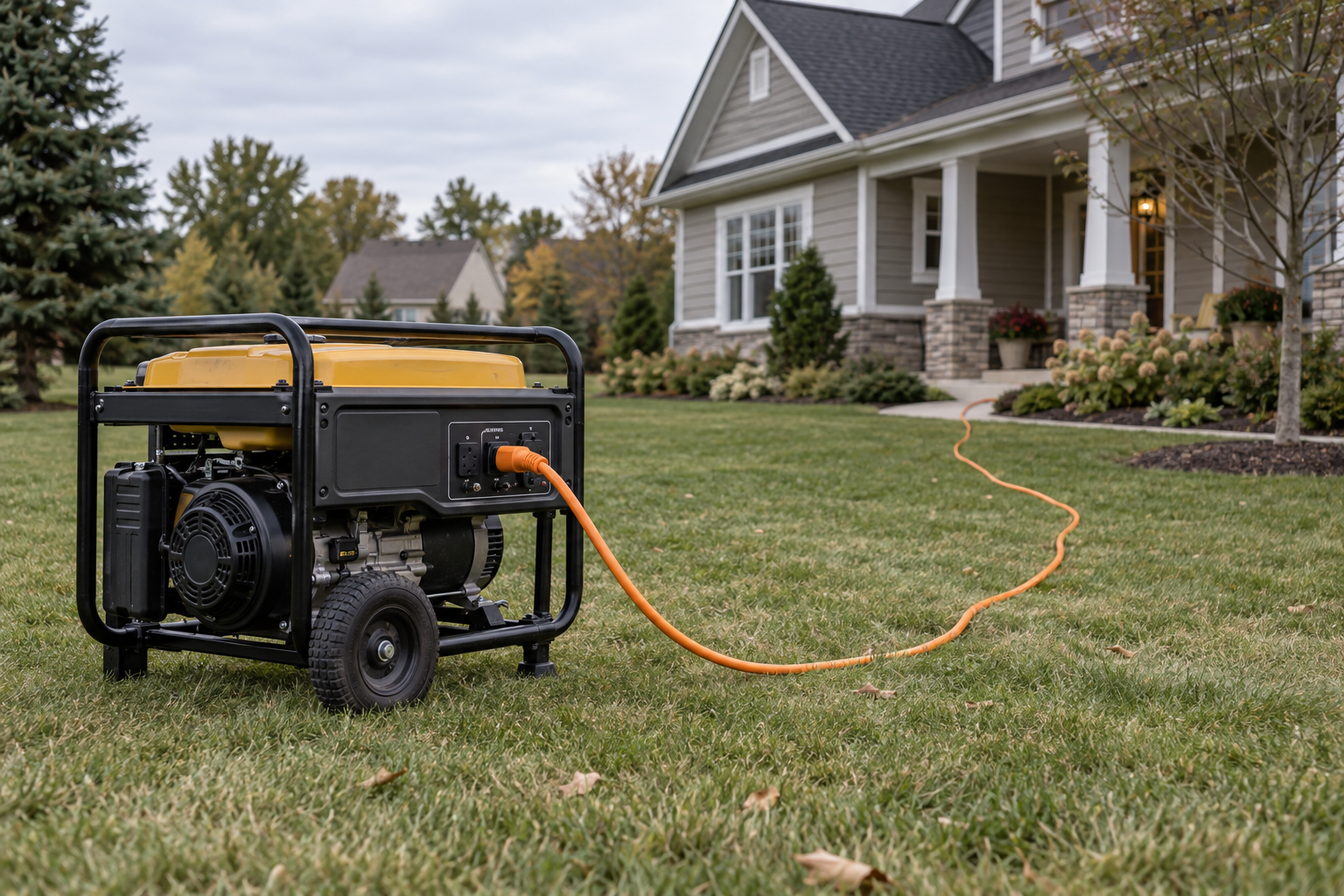
A portable generator can make a power outage far more manageable. But the extension cord between the generator and the appliance is not just an accessory. It is part of the electrical system you are building for the duration of the outage.
That means the cord has to do more than reach. It must be rated for outdoor use, heavy enough for the electrical load, long enough to keep the generator safely away from the house and in good enough condition to use without creating a shock or fire hazard.
The good news is that you do not need to become an electrician to make a sensible choice. You do need to check a few details instead of grabbing the first orange cord in the garage.
Quick Answer
For most direct-to-appliance generator use, choose a heavy-duty, outdoor-rated, three-wire grounded extension cord. Its amp or watt rating must be at least as high as the connected appliance’s demand, and the cord must be appropriately sized for its length. Shorter is generally better, provided the generator still remains at least 20 feet from the home.
Before every use, inspect the entire cord, plug and connector. Do not use a damaged cord, a cord with a missing grounding pin or a male-to-male cord. Never plug a portable generator into a household wall outlet.
Safety First
Operate a portable generator outdoors only, at least 20 feet from the home, with the exhaust pointed away from the building. Never run one in a garage, shed, basement, porch or other enclosed or partly enclosed space—even if doors or windows are open.
The extension cord should help you maintain that safe distance. A short cord is not a reason to move the generator closer. If the cord cannot reach safely, it is the wrong cord for the setup.
If you are new to generator use, review Ready Chateau’s portable generator safety guide before planning what to connect.
Why an Ordinary Household Cord May Not Be Enough
A light-duty extension cord may work perfectly well for a lamp indoors. That does not make it a safe choice for a refrigerator, freezer, sump pump or other important appliance during an outage.
As electricity moves through a cord, the cord resists some of that flow. A longer, thinner cord has more resistance than a shorter, thicker one. Under a substantial load, an undersized cord can experience excessive voltage drop and heat buildup. The appliance may not receive the voltage it needs, and the cord can become dangerously warm.
A generator cord also lives in a harder environment. It may cross a damp yard, cold pavement or a route where people are carrying fuel, food or supplies. Its jacket, plugs and connections need to be suitable for outdoor use and protected from damage.
Start With What You Plan to Power
Do not choose a cord by generator size alone. Start with the appliance that will be connected to it.
Look for the appliance nameplate or manual and record its voltage, amps and watts. Many common generator outlets provide 120-volt power, but you should confirm the actual outlet you intend to use. If a 120-volt appliance lists watts but not amps, a simple estimate is:
Amps = watts ÷ volts
A 1,200-watt load at 120 volts is about 10 amps. That does not automatically mean any cord labeled for 10 amps is the best choice. Motors and compressors may draw additional current when they start, and the equipment manual may specify a heavier cord or a maximum length.
Think of the system as a chain: generator receptacle, extension cord and appliance. Every part must be compatible, and the lowest-rated part limits the setup. A 20-amp generator outlet does not make a 13-amp cord capable of carrying 20 amps.
If you are still deciding what your generator should support, first list the essential loads and use Ready Chateau’s generator sizing guide. That prevents buying cords for a power plan the generator cannot safely deliver.
Understand Gauge Before You Shop
Extension-cord thickness is commonly described by American Wire Gauge, or AWG. The numbering feels backward at first: a smaller gauge number means a thicker conductor.
For example, a 12-gauge cord is heavier than a 14-gauge cord, and a 10-gauge cord is heavier than a 12-gauge cord. Thicker is not always necessary, but a cord must be heavy enough for the current and distance involved.
The Electrical Safety Foundation International provides this general length-and-amperage guidance:
- For a 25- to 50-foot cord: 16 gauge for 1–13 amps; 14 gauge for 14–15 amps; 12 or 10 gauge for 16–20 amps.
- For a 100-foot cord: 16 gauge for 1–10 amps; 14 gauge for 11–13 amps; 12 gauge for 14–15 amps; 10 gauge for 16–20 amps.
- For a 150-foot cord: 14 gauge for 1–7 amps; 12 gauge for 8–10 amps; 10 gauge for 11–15 amps.
Treat those numbers as a practical screening tool, not permission to ignore the cord label or equipment manuals. A generator or appliance manufacturer may require a heavier cord, a shorter maximum length or a particular connector.
When two suitable cords are available, the shorter one usually reduces voltage drop and is easier to protect. But generator placement comes first: the cord still has to reach from a generator at least 20 feet outside the home to the appliance without being stretched tight.
Check the Cord’s Markings
A proper cord should tell you what it is designed to do. Check the jacket, tag or packaging for:
- Outdoor rating. The letter W in a cord designation indicates outdoor use. Do not assume that color alone tells you where a cord may be used.
- Wire gauge. Look for a size such as 16 AWG, 14 AWG, 12 AWG or 10 AWG.
- Number of conductors. A grounded household-style cord is commonly marked with three conductors, such as 12/3.
- Electrical rating. Confirm the listed amps, volts or watts are adequate for the connected load at the cord’s length.
- Grounded plug and connector. All three prongs must be present, including the round grounding pin.
- Independent certification. Look for a mark from a recognized testing laboratory such as UL, ETL or CSA.
If the markings are missing or unreadable, you cannot reliably confirm what the cord can carry. Retire it from generator duty rather than guessing.
Match the Plug to the Generator Outlet
Portable generators may have several receptacles: familiar 120-volt household-style outlets, locking 30-amp outlets or other configurations. Use a cord designed for the specific receptacle and the intended load.
Do not force a plug, remove a grounding pin or stack adapters until something fits. The plug shape, voltage and amperage are part of the safety design.
A high-capacity generator cord with a locking plug and multiple household-style connectors can be useful when it is designed for that generator outlet. Its total connected load still cannot exceed the cord, connector or generator-receptacle rating. Several outlets on the far end do not create additional capacity.
For a 30- or 50-amp connection to a power inlet box or transfer switch, use the cord type and configuration specified for that equipment. This is different from running an ordinary extension cord directly to a refrigerator.
Set Up the Cord Safely
Once you have the right cord, route it as carefully as you chose it.
- Keep plug-and-connector points dry. Do not leave a connection where water or snow can collect.
- Avoid puddles, wet grass and low spots whenever possible.
- Protect the cord from vehicle traffic, sharp edges and places where it will be crushed or cut.
- Do not run a cord through walls, ceilings or floors, and do not hide it under rugs or other coverings that trap heat.
- Avoid pinching the cord in a tightly closed door or window. A flattened jacket can conceal conductor damage.
- Do not stretch the cord tight. Leave enough slack to prevent strain on plugs and receptacles.
- Do not daisy-chain extension cords or power strips to gain length or outlets.
- Fully uncoil the cord during use so heat can dissipate, especially under a substantial load.
- Keep children and pets away from the generator, cord route and electrical connections.
Check the cord during operation. If it feels hot, smells scorched, crackles, sparks or causes the generator breaker to trip, shut down the load and investigate. Do not keep resetting a breaker without finding the cause.
Inspect Before Every Use
A cord can look fine from several feet away and still have a damaged plug or a crushed section. Before starting the generator, unplug the cord and examine it from end to end.
Look for:
- Cuts, tears, cracks or exposed wire
- Flattened, crushed or sharply kinked areas
- Burn marks, melted insulation or discoloration
- Loose plug blades or a loose connector
- Bent prongs or a missing grounding pin
- Corrosion, moisture or debris in the connector
- A jacket that has become brittle with age
Do not wrap electrical tape around a seriously damaged section and put the cord back into emergency service. Replace the cord. A power outage is the wrong time to depend on a questionable repair.
Also inspect cords when you put them away. That gives you time to replace a damaged one before the next storm instead of discovering the problem in the dark.
One Cord, One Planned Load
ESFI advises using an extension cord for one appliance. That is a clean rule for household generator planning because it makes the load easier to understand and reduces the temptation to keep adding devices.
If a manufacturer-approved generator cord provides several connectors, plan the combined load before plugging anything in. Add the running watts and account for startup demand. Do not assume an unused socket means unused electrical capacity.
Some appliances should not be run from an extension cord at all. Follow the appliance manufacturer’s instructions. For example, CPSC advises plugging electric space heaters directly into a wall outlet, never an extension cord or power strip.
What Never to Do
- Never use a male-to-male extension cord. These cords have exposed prongs that can become energized, creating a severe shock or electrocution hazard.
- Never plug a generator into a wall outlet. This practice, often called backfeeding, bypasses important safety protections and can cause electrocution or fire.
- Never remove a grounding pin or force an incompatible connection.
- Never use an indoor-only, damaged or undersized cord outside with a generator.
- Never move the generator closer to the house because the available cord is too short.
- Never assume a cord is safe because the appliance turns on. Excess heat and voltage drop may develop under load.
CPSC has specifically warned consumers to stop using and dispose of male-to-male cords sold for generator backfeeding. If you find one in your supplies, do not save it for a future emergency.
When a Transfer Switch Is the Better Answer
Extension cords are useful when you are powering individual plug-in appliances directly from a portable generator. They are not a substitute for a proper connection to the home’s wiring.
If you want to power hardwired equipment or selected household circuits—such as a well pump, furnace controls or several fixed lights—talk with a qualified electrician about a properly rated transfer switch or other approved transfer equipment. The installation must match the generator, the home’s electrical system and applicable codes.
A transfer setup can make outage power easier to manage, but it does not change the generator’s outdoor operating requirements. The generator still belongs outside, at least 20 feet from the home, with exhaust directed away.
A Practical Buying Checklist
Before buying a generator extension cord, confirm all of the following:
- The generator outlet voltage, amperage and receptacle type
- The appliance’s running load and any startup demand
- The shortest practical length that still preserves safe generator placement
- Adequate wire gauge for the load and length
- Outdoor rating and a durable jacket
- A three-prong grounded configuration where required
- Compatible plugs and connectors without improvised adapters
- A clear electrical rating and recognized testing-laboratory certification
- No cuts, loose parts, heat damage or missing prongs
- Compatibility with the generator and appliance manuals
Buying the right cord once is usually less expensive than replacing an appliance damaged by poor power delivery—or dealing with an overheated cord during an outage.
Once you know your generator’s outlet type, the equipment you need to power and the full cord distance, see our Best Extension Cords for Generators guide for connection-specific recommendations.
Prepare the Cord Before the Outage
Do not wait until the lights go out to work through these details. Match each essential appliance to a cord, label the cord if helpful and test the setup in daylight while following the generator manual.
Then store cords loosely coiled in a clean, dry place where they will not be crushed. Keep them with your other generator supplies and include them in your regular generator maintenance check.
That small amount of preparation removes one more decision from an already stressful day. When an outage happens, you will know which cord belongs with which load—and which shortcuts are off limits.
Bottom Line
The safest generator extension cord is not simply the thickest or the most expensive. It is the cord that matches the load, length and outlet; is rated for outdoor use; remains in sound condition; and lets the generator stay safely away from the home.
Check the numbers, respect the cord’s limits and never use an improvised connection to power household wiring. A generator can be a useful temporary tool. The cord is part of using that tool responsibly.
Sources Consulted
- U.S. Consumer Product Safety Commission — portable generator safety and placement guidance
- U.S. Consumer Product Safety Commission — male-to-male extension cord warning
- National Fire Protection Association — Generator Safety tip sheet
- Electrical Safety Foundation International — Extension Cord Safety Tips
- Occupational Safety and Health Administration — Using Portable Generators Safely
- Honda Power Equipment — generator connection and transfer-switch guidance
- Generac — portable-generator power-cord and extension-cord selection guidance