
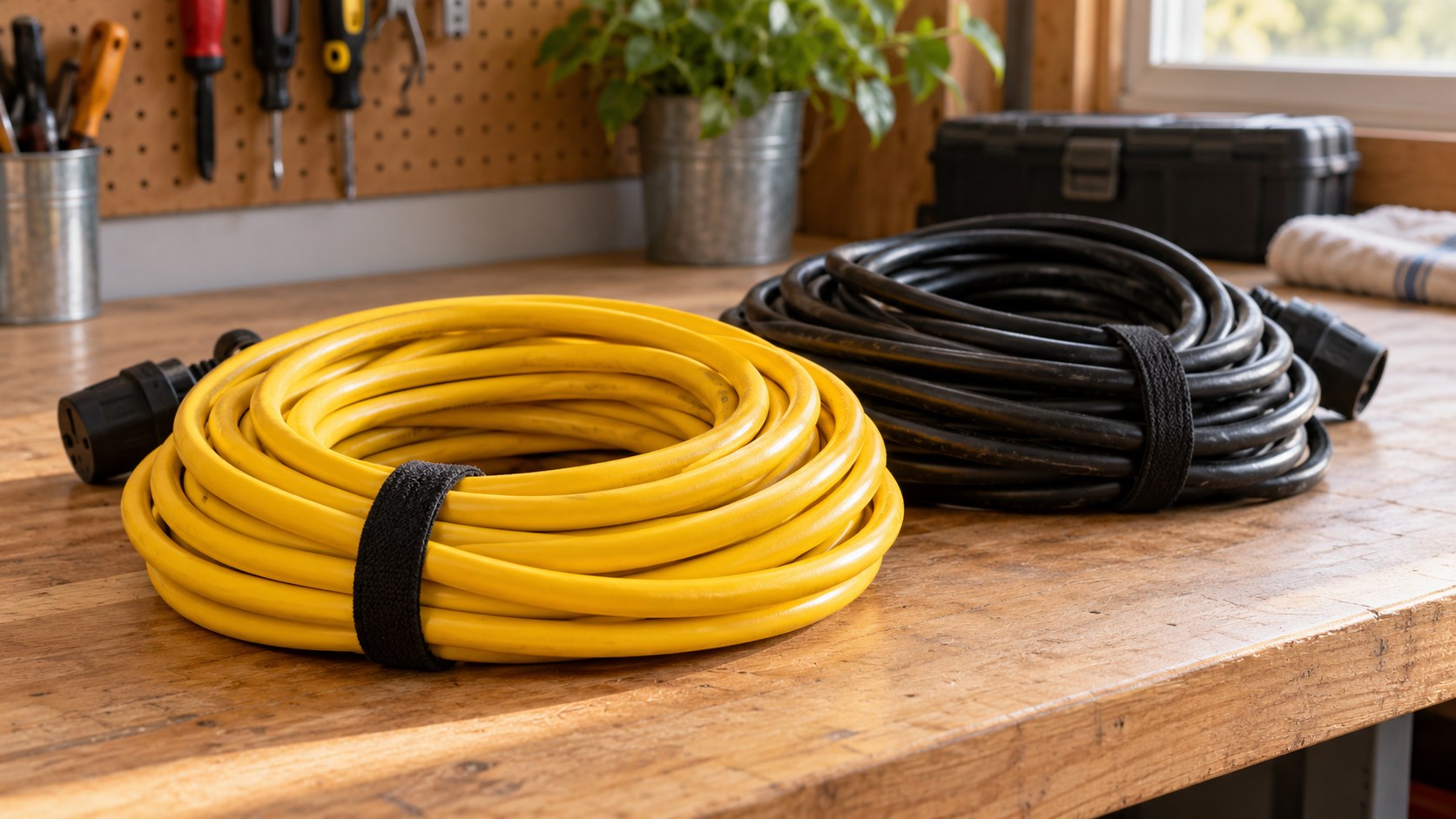
A portable generator can be powerful enough to run your essential equipment and still be connected with the wrong cord. The outlet on the generator, the equipment at the other end, the electrical load and the distance all matter.
These recommendations are based on manufacturer specifications and practical fit; Ready Chateau has not completed hands-on testing of these cords. Verify the current product listing and your generator manual before buying.
This guide recommends three different kinds of cord for three different jobs. They are not interchangeable. If you have not identified the outlet on your generator, start with our guide to extension cords for generators before choosing a product.
Quick Answer
For a standard 120-volt generator outlet and one appliance, start with a properly rated, grounded, outdoor-use extension cord long enough for the entire route. Our 50-foot, 15-amp candidate is the Southwire 2588SW0002.
For a generator’s four-prong L14-30R outlet, first decide whether you are supplying individual appliances or connecting to a matching, professionally installed power inlet. The appliance connection needs a distribution cord with household receptacles. The installed inlet needs an L14-30 power cord with a locking connector at each end. Buying one in place of the other will not solve the problem.
The U.S. Consumer Product Safety Commission advises operating a fuel-burning generator outdoors at least 20 feet from the home, with exhaust directed away from doors, windows and vents. Measure the whole cord route from that location. Never move the generator closer to make a short cord reach.
Identify the Connection Before You Shop
| Generator outlet | Where power is going | Cord type to consider |
|---|---|---|
| Standard 120V 5-15R or 5-20R | Directly to a compatible appliance | Grounded outdoor extension cord, rated for the appliance and full route |
| 120/240V L14-30R | Individual 120V appliances | Matching L14-30P distribution cord with household receptacles |
| 120/240V L14-30R | Matching installed inlet and transfer equipment | L14-30P-to-L14-30R generator power cord |
Read the actual outlet marking and the generator manual. A cord’s plug must match the outlet without improvised adapters. Other outlet types, including L5-30, TT-30 and 14-50, call for different equipment. The cord recommendations below do not cover those outlets.
Our Generator Cord Recommendations
Ready Chateau affiliate disclosure: As an Amazon Associate, I earn from qualifying purchases. There is no additional cost to you.
Best for a Standard Household-Style Outlet: Southwire 2588SW0002, 50 Feet
Southwire’s 50-foot 12/3 SJTW cord is a practical starting point when you are using a standard 120-volt generator receptacle to supply one compatible appliance. Southwire lists it for outdoor use, with grounded NEMA 5-15 fittings, a 15-amp maximum and a bright yellow jacket that is easier to see along the route.
We favor the 50-foot length because the generator must remain well away from the house. The extra length may allow the cord to reach an appliance without compromising placement. It does not mean every 50-foot route is suitable: measure yours and confirm the connected appliance and generator manual permit the arrangement.
Best for: A 5-15R or compatible 5-20R generator outlet supplying one appliance whose load is within the cord’s 15-amp rating.
Main limitation: The 12-gauge conductors do not turn its 5-15 plug and connector into a 20-amp cord. Do not treat the generator’s larger outlet or total wattage as permission to exceed this cord’s rating.
Check price and availability on Amazon (paid link)
View Southwire’s specifications.
Best L14-30 Distribution Cord When 25 Feet Truly Reaches: Champion 48043
If your generator has an L14-30R locking outlet and you want to run several individual 120-volt appliances, Champion’s 48043 is a 25-foot, 10-gauge outdoor-rated cord. Its L14-30P plug connects to the matching generator outlet. The other end provides four 5-20R household receptacles with circuit breakers for the outlet groups.
This is a connection-specific choice, not a universal cord for every generator. Add the loads you plan to use, observe each receptacle’s limits and the generator’s output limits, and follow both manuals. Four receptacles do not mean four appliances can each draw 20 amps at once.
The length is a serious constraint. With the generator at least 20 feet from the building, a 25-foot cord might not reach the intended distribution point. We would recommend this model only after measuring a safe, workable route. Do not place a generator inside a garage, on a porch or closer to an opening to make it fit.
Best for: A measured, compatible L14-30-to-appliance arrangement where 25 feet is sufficient.
Main limitation: Too short for many home layouts. If it does not reach, select a verified longer product designed for this same connection rather than joining cords or compromising generator placement.
Check Price and Availability on Amazon (paid link)
View Champion’s specifications.
Best for a Matching Installed Power Inlet: AC WORKS L1430EX, 50 Feet
Some homes have a power inlet and transfer equipment installed by a qualified electrician. For a system with a matching L14-30 inlet and a generator with an L14-30R outlet, the 50-foot AC WORKS L1430EX is a candidate. The manufacturer lists a 10/4 STW cord rated at 30 amps, with an L14-30P plug for the generator and an L14-30R connector for the inlet.
This cord supplies the inlet; it does not end in household receptacles for individual appliances. Confirm the generator’s output, inlet, transfer equipment and required cord specifications with the electrician who installed or verifies the system. A matching plug shape alone does not establish that the complete setup is suitable for your loads.
Best for: A compatible, professionally installed L14-30 inlet and transfer arrangement needing a measured 50-foot route.
Main limitation: It does not replace an inlet or transfer equipment. Never plug a generator into a normal wall outlet or use a male-to-male cord to feed household wiring.
Check price and availability on Amazon (paid link)
View the AC WORKS specifications and select the 50-foot version.
Why There Is No One Cord for Every Generator
The generator’s running wattage is not the cord’s rating. A generator may have several outlets with different voltage, amperage and plug configurations. The appliance or installed inlet sets another limit. Every part of the connection has to fit, and the lowest-rated part limits what that path can carry.
Length matters as well. A cord that is thick enough for a short run is not automatically the right choice for a much longer run. Longer cords can create more voltage drop, particularly under heavier loads. Consult the generator and appliance instructions when choosing the gauge and length, and use the shortest safe and practical route that still preserves generator placement.
An outdoor-use cord is made for the relevant environment; that label does not make exposed connections safe in standing water or give permission to run the generator in rain contrary to its manual. Inspect the entire cord before each use. Replace one with damaged insulation, a loose connector, heat marks or a missing ground prong. Keep the cord visible and away from foot traffic, sharp edges and places where a door or window would crush it. Do not run it under rugs.
Check These Five Things Before Buying
- Outlet: Read the generator receptacle’s NEMA label, voltage and amp rating.
- Destination: Decide whether you are connecting individual appliances or a matching installed inlet.
- Load: Check the appliance’s running and starting requirements and the limits of the generator outlet, cord and connector.
- Route: Put the generator at a safe outdoor location first, then measure the full route to the destination.
- Condition and approval: Confirm the product’s outdoor-use marking, grounded connectors and appropriate safety listing; inspect the cord each time you use it.
If any of these do not match, pause before purchasing. A different plug configuration or an installed household connection is a technical decision, not a reason to improvise an adapter.
Final Recommendation
Most readers should begin by reading the outlet label rather than by shopping for the thickest-looking cord. For one modest appliance on a standard generator outlet, the 50-foot Southwire 12/3 cord is our straightforward candidate, subject to its 15-amp limit. The Champion distribution cord serves a different L14-30-to-appliance setup, but its 25-foot length requires a carefully measured route. A home with a compatible installed inlet needs a cord like the 50-foot AC WORKS L1430EX instead.
Choose the connection first. Then choose a cord that reaches while the generator remains safely outdoors and that carries the planned load within every component’s rating. Our generator safety guide covers placement, carbon monoxide and electrical hazards before the next outage.