
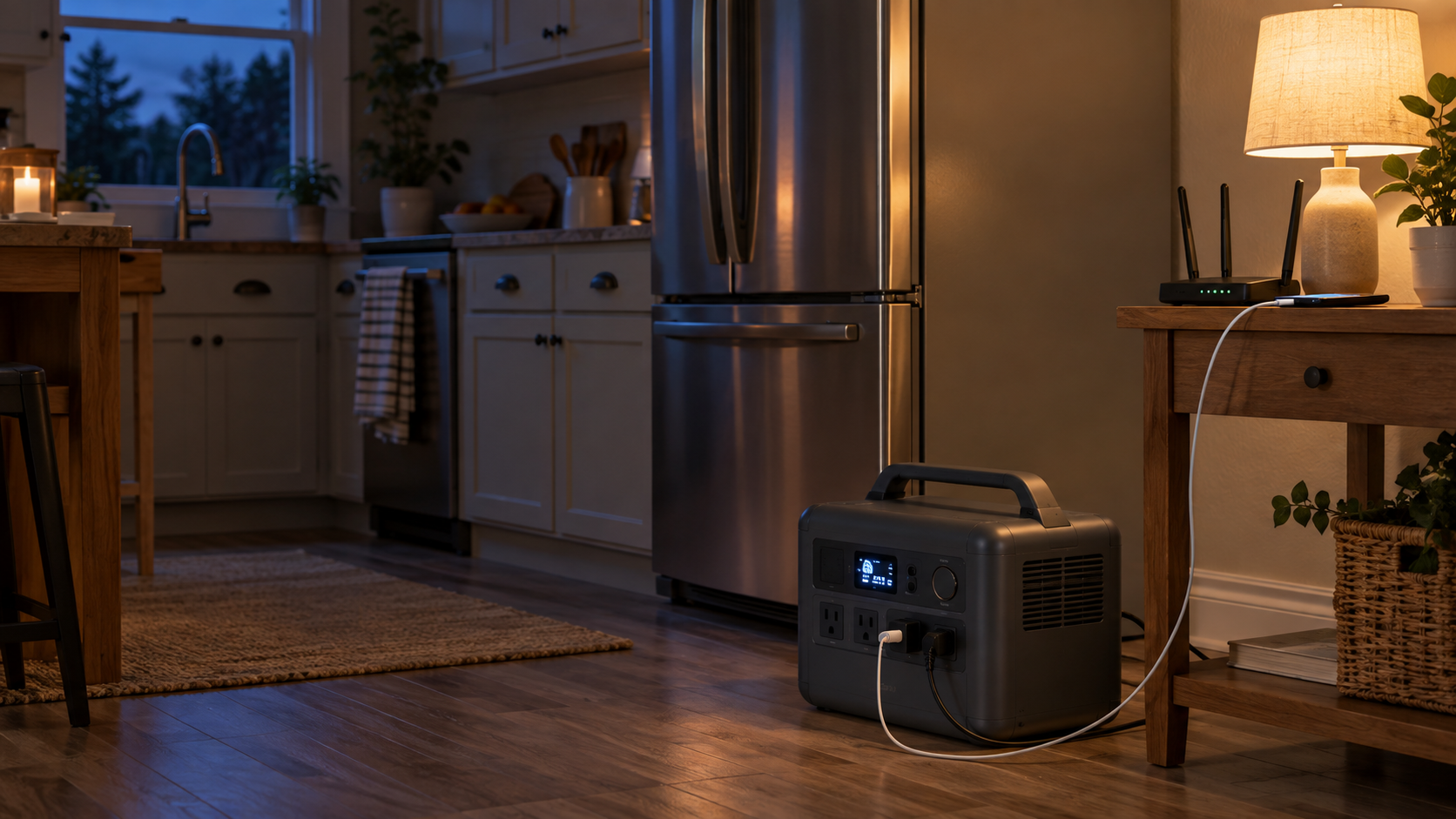
A portable power station can keep a refrigerator cold, charge phones, run lights and maintain internet service without the fuel, exhaust or noise of a gasoline generator. The difficult part is choosing one with enough battery capacity and output for the equipment your household actually needs.
For most homes, a power station in the 1,000-watt-hour class is the practical starting point. It can cover a refrigerator and several smaller essentials during a short outage while remaining light enough for one person to move.
Households preparing for longer outages should consider a 2,000-watt-hour model. A large 4,000-watt-hour system makes sense when the goal includes heavier appliances, 240-volt equipment or connection to selected household circuits. If you are still deciding between battery backup and fuel-powered equipment, begin with Portable Power Station vs. Generator: Which Do You Need?
Affiliate disclosure: Ready Chateau may earn a commission from qualifying purchases made through links on this page, at no additional cost to you.
Our current recommendations are:
- Best overall for most households: Anker SOLIX C1000 Gen 2
- Best lightweight option: Jackery Explorer 1000 v2
- Best for longer outages: BLUETTI Elite 200 V2
- Best high-capacity home-backup option: EcoFlow DELTA Pro 3
This guide compares current manufacturer specifications and practical outage use. Ready Chateau has not completed hands-on testing of every model listed. Prices and specifications can change, so confirm the current warranty, included accessories and operating limits before purchasing.
Quick Comparison
| Recommendation | Capacity | Rated AC output | Weight | Best use |
|---|---|---|---|---|
| Anker SOLIX C1000 Gen 2 | 1,024Wh | 2,000W | 24.9 lb. | Short outages and everyday household essentials |
| Jackery Explorer 1000 v2 | 1,070Wh | 1,500W | 23.8 lb. | Households prioritizing portability |
| BLUETTI Elite 200 V2 | 2,073.6Wh | 2,600W | 53.4 lb. | Longer refrigerator and communications coverage |
| EcoFlow DELTA Pro 3 | 4,096Wh | 4,000W | 113.5 lb. | High-capacity backup and expandable systems |
Capacity tells you approximately how much energy the battery stores. Output tells you how much power it can deliver at one time. A unit can have plenty of stored energy but still be unable to start an appliance if its output or surge rating is too low.
Best Overall: Anker SOLIX C1000 Gen 2
The Anker SOLIX C1000 Gen 2 is the strongest general-purpose choice for most households because it combines useful output, manageable weight and fast recharging in a compact package.
It provides 1,024 watt-hours of capacity, 2,000 watts of continuous output and a manufacturer-listed 3,000-watt peak. At 24.9 pounds, it can be moved between rooms without turning the job into a two-person lift.
That 2,000-watt output gives the C1000 Gen 2 more flexibility than many similarly sized units. It can support a refrigerator along with phones, LED lights, a modem, a television or a fan, provided the combined load remains within its limits.
Anker says the lithium iron phosphate battery should retain at least 80 percent of its original capacity after 4,000 charge cycles. The unit also accepts up to 600 watts of solar input and can recharge from an electrical outlet in as little as 49 minutes when its UltraFast charging mode is enabled in the app. Anker advises using that fastest setting only when necessary to help protect battery life. View the Anker SOLIX C1000 Gen 2 specifications.
Best for: Most households preparing for short outages.
Main limitation: Its capacity cannot be expanded with an additional battery. If you expect outages to last more than a day, a larger system or a separate recharging plan may be more appropriate.
Check the Anker Solix C1000 Gen 2 on Amazon
Best Lightweight Option: Jackery Explorer 1000 v2
The Jackery Explorer 1000 v2 is a good fit for people who want approximately 1,000 watt-hours of backup power in the lightest package among our primary recommendations.
It stores 1,070 watt-hours, provides 1,500 watts of rated AC output and weighs approximately 23.8 pounds. Its folding handle and relatively compact size make it easier to move, store or take with you during an evacuation.
The Explorer 1000 v2 uses lithium iron phosphate battery cells. Jackery lists a battery life of approximately 4,000 cycles before the battery declines to 70 percent of its original capacity. The company also advertises a one-hour emergency charging mode and warranty coverage of up to five years, subject to its registration and warranty terms. View the Jackery Explorer 1000 v2 specifications.
The lower 1,500-watt output is adequate for many outage essentials, but it provides less room for combining appliances than the Anker. Check the starting surge requirements of refrigerators, freezers, pumps and other motor-driven equipment before relying on it.
Best for: Apartments, smaller homes and anyone who expects to carry the unit regularly.
Main limitation: The 1,500-watt output requires more careful load management when using high-wattage appliances.
Check the Jackery Explorer 1000 v2 on Amazon
Best for Longer Outages: BLUETTI Elite 200 V2
The BLUETTI Elite 200 V2 roughly doubles the battery capacity of the 1,000-watt-hour models without moving into the size and expense of a full home-backup system.
It provides 2,073.6 watt-hours of capacity and 2,600 watts of continuous output. That combination makes it better suited to keeping a refrigerator, communications equipment, lights and selected small appliances operating through a longer outage.
BLUETTI uses lithium iron phosphate cells and states that the battery should retain 80 percent of its capacity after more than 6,000 cycles. The manufacturer also provides a five-year warranty. View the BLUETTI Elite 200 V2 specifications.
The tradeoff is weight. At 53.4 pounds, this is technically portable, but many people will want help moving it. Before an outage, decide where it will normally be stored and whether it can reach the appliances you intend to power.
Best for: Longer outages, multiple refrigeration appliances or households wanting more runtime without installing a permanent system.
Main limitation: It is considerably heavier than a 1,000-watt-hour power station.
Check the BLUETTI Elite 200 V2 on Amazon
Best High-Capacity Home-Backup Option: EcoFlow DELTA Pro 3
The EcoFlow DELTA Pro 3 moves beyond basic portable backup and into expandable home-energy territory.
A single unit provides 4,096 watt-hours of capacity, 4,000 watts of continuous output and both 120- and 240-volt connections. EcoFlow lists an 8,000-watt surge rating, a lithium iron phosphate battery and approximately 4,000 cycles before capacity declines to 80 percent.
The base unit can be expanded to approximately 12 kilowatt-hours with two compatible extra batteries. Larger configurations are possible when multiple units and EcoFlow home-backup equipment are used. The DELTA Pro 3 carries a five-year warranty and is listed by EcoFlow as UL 9540 certified. View the EcoFlow DELTA Pro 3 specifications.
At approximately 113.5 pounds, it is better described as movable than easily portable. Built-in wheels help, but stairs, vehicle loading and storage still require planning.
Best for: Larger outage loads, expandable backup and households planning a professionally installed connection to selected circuits.
Main limitation: Its size, weight and cost are more than most households need for basic refrigerator, lighting and communications coverage.
Check the EcoFlow DELTA Pro 3 on Amazon
How Much Capacity Do You Need?
Start with the equipment you actually intend to power. Our guide to what you can run during a power outage can help you separate essential loads from conveniences.
A practical planning formula is:
Estimated runtime = battery capacity in watt-hours × 0.85 ÷ average load in watts
The 0.85 factor provides a rough allowance for inverter losses and other real-world inefficiencies. Actual efficiency varies by power station, temperature, appliance and load.
For example, a 1,024-watt-hour power station supporting an average 100-watt load might provide:
1,024 × 0.85 ÷ 100 = approximately 8.7 hours
A 2,073.6-watt-hour model supporting the same average load might provide approximately 17.6 hours.
These calculations are planning estimates, not guarantees. Refrigerators cycle on and off, and their compressors may draw substantially more power at startup than while running. Opening the door frequently, warm room temperatures and adding other equipment will shorten runtime. For a closer look at that load, see How Long Can a Portable Power Station Run a Refrigerator?
Choose by Outage Plan, Not by the Largest Number
A smaller power station is often the better choice when it can cover the household’s real needs.
Choose approximately 1,000Wh when:
- Your outages are usually short.
- You primarily need refrigeration, phones, lights and internet.
- One person needs to be able to move the unit.
- You have a reliable way to recharge it if the outage continues.
Choose approximately 2,000Wh when:
- Outages commonly last overnight or longer.
- You have both a refrigerator and freezer.
- You need more reserve capacity for communications, fans or small medical equipment.
- You are comfortable handling a unit weighing more than 50 pounds.
Choose 4,000Wh or more when:
- You need heavier appliances or 240-volt capability.
- You want expandable capacity.
- The unit will remain in one primary location.
- You are prepared for the cost and possible electrical installation involved.
A 300- or 500-watt-hour unit can be useful for phones, lights, radios and laptops, but it is generally too small to serve as the main household power source during a prolonged outage.
High-Wattage Appliances Drain Batteries Quickly
Output capacity does not guarantee long runtime.
A 1,500-watt space heater, kettle or hot plate can consume most of the usable energy in a 1,000-watt-hour power station in considerably less than an hour. Microwaves, coffee makers, hair dryers and electric cooking appliances can have a similar effect.
During an outage, battery power is usually better reserved for refrigeration, communication, lighting and other essential needs. If you plan to cook with electricity, use the shortest practical cooking time and check both the appliance’s wattage and the power station’s output rating.
Large central air conditioners, electric water heaters, electric ranges, well pumps and furnace systems may require 240-volt service, substantial starting power or a professionally installed connection. A standard 120-volt portable power station should not be assumed capable of running them.
Features Worth Paying For
Lithium Iron Phosphate Batteries
Lithium iron phosphate, commonly shown as LFP or LiFePO₄, has become the preferred chemistry for many backup power stations. It generally provides a longer cycle life than older lithium-ion formulations and has good thermal stability.
Battery chemistry does not eliminate the need for careful charging, storage and inspection. Follow a routine such as the one in Portable Power Station Maintenance: Make the Battery Last.
Adequate Continuous and Surge Output
Use the continuous AC rating when adding the wattage of equipment you plan to operate at the same time. Check the surge rating separately for refrigerators, freezers, pumps and other appliances with motors or compressors.
Do not treat a manufacturer’s “power lifting” or similar marketing mode as equivalent to normal continuous output. Those modes may reduce voltage or be limited to certain resistive appliances.
Fast AC Recharging
Fast charging is useful when utility power returns briefly or when the unit must be recharged from a generator. The fastest setting may create more heat or place more stress on the battery, so follow the manufacturer’s directions.
Solar Charging
Solar panels can extend an outage plan, but their advertised wattage represents favorable conditions. Clouds, shade, panel angle, temperature and available daylight can substantially reduce production.
Confirm the power station’s supported solar voltage, current and connector requirements before purchasing panels. Do not assume that any panel with the right plug is electrically compatible.
Useful Warranty Coverage
These units contain expensive batteries and power electronics that are not ordinarily homeowner-serviceable. A clear multiyear warranty, established customer support and readily available replacement cables matter more than a long list of app features.
Independent Safety Certification
Look for certification by a nationally recognized testing laboratory and identify the standard involved. UL 2743 applies to portable power packs, while larger installed or integrated energy-storage systems may fall under different standards. A vague statement that a product is “tested” is not the same as a verifiable certification.
Portable Power Station Safety
Portable power stations do not burn fuel and do not produce carbon monoxide during normal battery operation. They can therefore be used indoors, unlike gasoline or propane generators. They still require basic battery and electrical precautions.
- Keep the unit dry and do not operate it in standing water.
- Keep ventilation openings clear.
- Use manufacturer-provided or authorized charging equipment.
- Follow the listed charging, operating and storage temperatures.
- Stop using a unit that becomes abnormally hot, swells, leaks, smokes, changes shape or produces an unusual odor.
- Do not modify the battery or attempt an unqualified internal repair.
- Inspect cords and connectors before use.
- Keep the unit away from direct heat and combustible materials while charging.
The Electrical Safety Foundation International recommends purchasing certified equipment, using authorized chargers and discontinuing use when a lithium-ion battery shows signs of damage or overheating. Read the ESFI lithium-ion battery safety guidance.
Warning: Never Backfeed Household Wiring
Never connect a portable power station to household wiring through a wall outlet or a homemade male-to-male cord. That can energize wiring unexpectedly, damage equipment and expose utility workers or neighbors to electrical hazards.
Any connection to household circuits should use equipment approved for that purpose and be installed according to the manufacturer’s instructions and local electrical requirements. A qualified electrician should handle transfer equipment or home-panel connections.
A power station’s UPS or backup-transfer feature should also not be treated as a guarantee that it is suitable for life-support or other critical medical equipment. Verify compatibility with the medical-device manufacturer and maintain a separate emergency plan.
The Bottom Line
The Anker SOLIX C1000 Gen 2 is the best starting point for most households. It provides strong output, fast recharging and manageable weight in the practical 1,000-watt-hour class.
Choose the Jackery Explorer 1000 v2 when low weight and easy movement are the priority. Step up to the BLUETTI Elite 200 V2 when longer refrigerator and communications coverage matters more than portability.
The EcoFlow DELTA Pro 3 is the more capable choice for high-capacity or expandable home backup, but its weight, cost and installation possibilities put it in a different category from a typical portable unit.
The right power station is not necessarily the one with the largest battery. It is the one that can start your essential equipment, provide the runtime your outage plan requires and still be safely stored, moved and recharged by your household.