
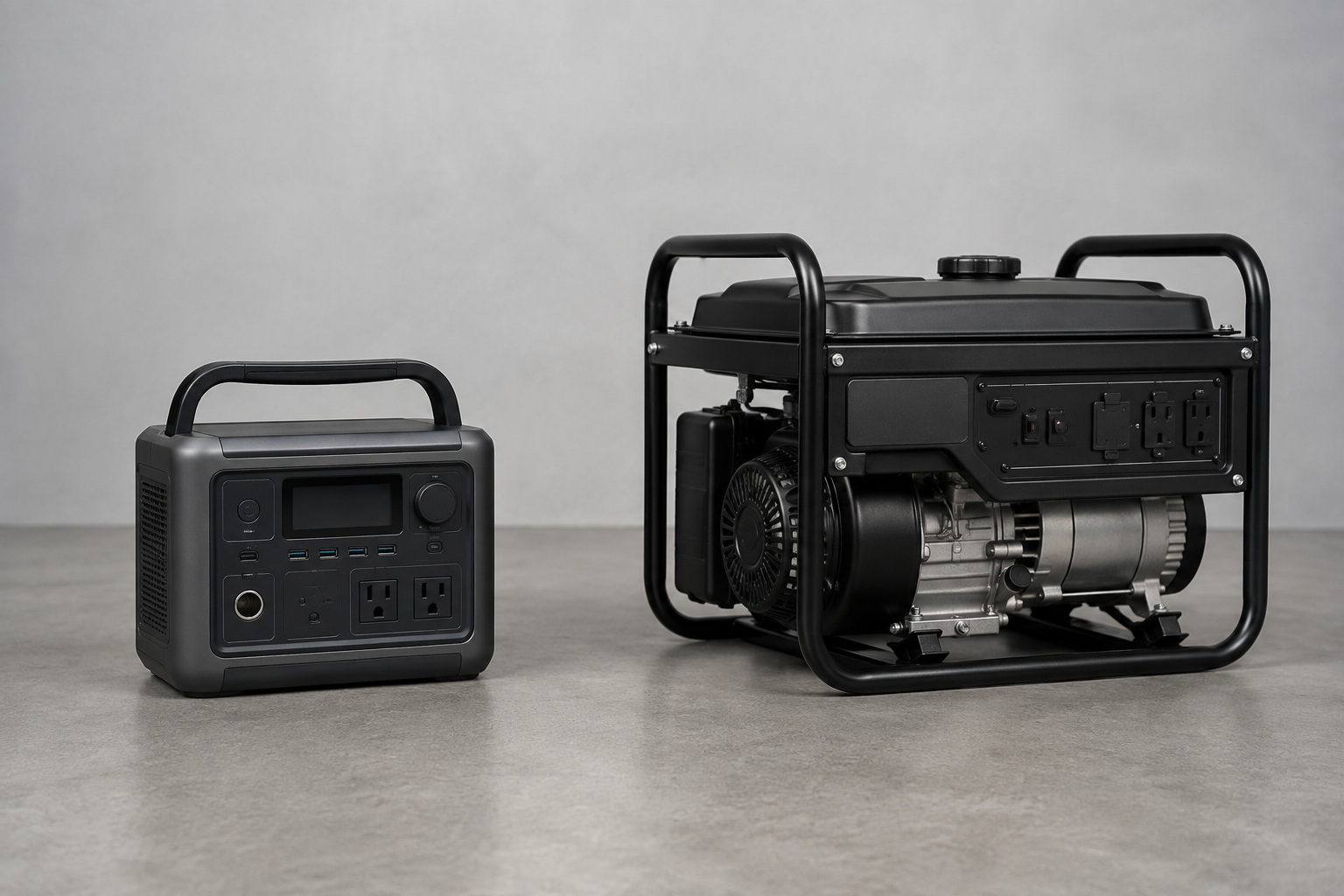
A portable power station and a fuel-powered generator can both keep important equipment running during a power outage, but they solve different problems.
A power station stores a limited amount of electricity in a rechargeable battery. A generator produces electricity as long as it has fuel and can continue operating safely. One is quiet and practical indoors. The other usually provides more power and can operate much longer.
The right choice depends less on which product has the most impressive specifications and more on what your household actually needs to run, where you can safely operate the equipment and how long you expect to be without power.
The Short Answer
A portable power station is usually the better fit when you need quiet indoor power for phones, lights, internet equipment, a television, a compatible CPAP machine or other relatively modest loads. It requires little routine maintenance and produces no exhaust while supplying power.
A portable generator is usually the better fit when you need to operate larger loads, support several appliances or continue producing electricity through a long outage. It requires fuel, maintenance and a safe outdoor operating location.
Some households do not need to choose only one. A power station can handle quiet overnight loads while a generator runs outdoors during selected periods to operate larger equipment and, when the manufacturers’ instructions permit it, recharge batteries. That approach costs more, but it can reduce noise, fuel use and unnecessary generator runtime.
Before buying either one, identify the equipment that truly matters during an outage. The best backup-power system is the one that can safely support those priorities—not the one with the longest feature list.
What Is a Portable Power Station?
A portable power station combines a rechargeable battery, an inverter and several types of electrical outlets in one movable unit. The battery stores direct-current electricity. The inverter converts that stored energy into alternating current for common household devices.
Power stations may be recharged from a household outlet, a vehicle connection or compatible solar panels. Charging options and speeds vary substantially, so the manufacturer’s specifications matter.
You may also see these products called “solar generators.” That name can be misleading. The unit does not create electricity from sunlight by itself. It is a battery power station that can be recharged from compatible solar panels.
What Is a Portable Generator?
A portable generator uses an engine and fuel—commonly gasoline, propane or both—to produce electricity. Unlike a battery, it does not begin with a fixed supply of stored electrical energy. It can continue producing power as long as fuel remains available and the generator is operated, refueled and maintained correctly.
This article compares portable generators with portable power stations. A permanently installed standby generator is a different category with different installation, fuel and cost considerations.
The Two Numbers That Matter Most
Backup-power advertisements include many specifications, but two numbers answer most of the important questions.
Watts tell you how much power the unit can deliver at one time. The combined running wattage of the equipment you connect must remain within the unit’s continuous output rating. Motors and compressors may also require a brief surge of additional power when they start.
Watt-hours tell you how much energy a battery power station can store. A 1,000-watt-hour power station does not necessarily run a 1,000-watt appliance for exactly one hour. The inverter and the power station itself consume some energy, and real appliance use varies. Treat the published capacity as a starting point rather than a guaranteed runtime.
Generators are normally compared by running watts and starting or surge watts. Their operating time depends on the load, fuel type, tank size and manufacturer’s rated runtime. Refueling can extend operation; a battery power station must be recharged from another available energy source.
Portable Power Station Advantages
No combustion exhaust while supplying power
A power station does not burn fuel or produce carbon monoxide while discharging. That makes it practical for bedrooms, apartments and other occupied spaces. The charging source is a separate issue: never bring a fuel-powered generator indoors to recharge it.
Quiet operation
Power stations make little noise beyond possible cooling-fan operation. That matters at night, around children, in apartments and when powering medical or communications equipment.
Simple operation and limited routine maintenance
There is no engine oil, carburetor or stored gasoline to manage. The unit still needs inspection, periodic charging and storage within the temperature and charge-range instructions supplied by its manufacturer.
Immediate power for smaller loads
A charged power station can be brought inside and connected without starting an engine or handling fuel. It is particularly useful for lights, phones, routers, laptops, radios and other modest loads.
Portable Power Station Limitations
The stored energy is finite
Once the battery is depleted, the power station is no longer a power source until it can be recharged. Solar panels may help, but output depends on panel capacity, sunlight, weather, placement and charging limits. Solar charging should not be treated as unlimited or guaranteed.
Large loads use capacity quickly
Heating appliances, cooking appliances, pumps and other high-wattage equipment can overwhelm a smaller unit or drain even a substantial battery quickly. Some devices may also exceed the inverter’s starting-surge capability.
Battery condition matters
Rechargeable batteries gradually lose capacity with age and use. Extreme temperatures, improper storage and unsuitable charging practices can also affect performance and safety. Follow the manufacturer’s charging and storage instructions, use the correct charger and check for applicable recalls.
Portable Generator Advantages
Higher output is commonly available
Portable generators are available with enough output for refrigerators, freezers, pumps and combinations of household loads that would be difficult or expensive to support with a modest power station.
Longer operation is possible
A generator can continue producing electricity when additional fuel is available. That makes it useful during outages lasting several days, particularly when solar charging is unreliable or utility power is unavailable for recharging batteries.
Fuel can restore capacity quickly
Adding fuel after the generator has been shut down and allowed to cool takes far less time than fully charging a large battery. The tradeoff is that fuel must be purchased, transported, stored and rotated safely.
Portable Generator Limitations
It must remain outdoors
A fuel-powered generator produces carbon monoxide. It must never be operated inside a home, garage, basement, crawlspace, shed, porch or carport. Current CPSC and Ready.gov guidance says to operate portable generators outside only, at least 20 feet from the home, with exhaust directed away from the building and its doors, windows and vents.
Noise and fuel are ongoing concerns
Generators create engine noise and require a dependable fuel supply. Fuel may be difficult to obtain during a widespread outage, and local rules may limit how much can be stored or where it may be kept.
Maintenance is required
Engines require inspection, oil service, periodic testing and proper storage. A generator that has been ignored for several years may not be ready when the power fails.
Weather and electrical connections require planning
A generator must remain outdoors but also be protected from rain and wet conditions according to its manufacturer’s instructions. Equipment should be connected with properly rated grounded extension cords, or the generator should connect to household circuits through appropriate transfer equipment installed by a qualified electrician. Never improvise a connection that sends generator power backward through household wiring.
Which One Fits Your Household?
Choose a portable power station when:
- Your priorities are phones, lights, internet equipment, laptops, radios or similar smaller loads.
- You need quiet power inside the home, particularly overnight.
- You live in an apartment or another property without a safe generator location at least 20 feet from the building.
- You want minimal routine maintenance and can keep the battery charged.
- Your expected outages are usually brief, or you have a realistic way to recharge the unit.
Choose a portable generator when:
- You need to support larger loads or several appliances at the same time.
- You may need power for days rather than hours.
- You have a safe outdoor operating location and a plan for wet weather.
- You can store, rotate and obtain the required fuel safely.
- You are willing to test and maintain the engine before an emergency.
Consider both when:
- You want quiet battery power overnight but need generator capacity during the day.
- You want to run the generator periodically rather than continuously.
- You need a generator for large loads and a separate indoor source for communications, lighting or medical equipment.
- You can afford the added cost and will maintain both systems.
Four Common Household Scenarios
1. Phones, lights and internet during short outages
A modest power station may be the simplest solution. These loads are relatively small, and quiet indoor operation is valuable. Confirm the combined wattage and estimate how many hours the stored watt-hours can realistically support.
2. Refrigerator, freezer and basic electronics
Either category may work. The decision depends on appliance starting requirements, the battery’s usable capacity, outage duration and your recharging or refueling plan. Do not assume a refrigerator’s label tells the entire runtime story because compressors cycle rather than run continuously.
3. Well pump, sump pump or several larger loads
A generator will often be the more practical category, but pump starting requirements and electrical connections must be confirmed. Do not purchase from a rough internet estimate. Check the equipment nameplate, manuals and, when household wiring is involved, consult a qualified electrician.
4. Electrically powered medical equipment
Quiet indoor battery power may be useful, but this is not an ordinary appliance calculation. Ask the medical-equipment supplier and healthcare provider what backup source is compatible, how long backup power must last and what to do if power cannot be maintained. Ready.gov specifically advises households to develop a power-outage plan for electrically powered medical devices and refrigerated medicines.
Do Not Overlook Recharging and Refueling
Many comparisons stop after purchase price and output. During an extended outage, the more important question may be how the equipment receives its next supply of energy.
A power station may recharge quickly from the grid—but the grid is unavailable during the outage. A vehicle may provide limited charging, and solar may help when conditions and system size are adequate. Review the unit’s actual input limits rather than assuming that adding more panels will always make it charge faster.
A generator can be refueled, but only if suitable fuel is available. Gas stations may be closed or unable to pump fuel without electricity. Stored gasoline can deteriorate, and every fuel has storage and handling requirements.
Your backup-power plan needs an energy-supply plan. Buying the machine is only the first step.
A Safety Difference That Should Decide the Purchase
Do not buy a fuel-powered generator unless your property provides a genuinely safe place to operate it. “Outside” does not mean in a garage with the door open, beneath a porch, inside a shed or beside an open window. If you cannot maintain the recommended separation from the building, a portable generator may not be a safe option for your home.
Install working carbon monoxide alarms with battery backup on every level of the home and outside sleeping areas. Allow a generator to cool before refueling. Keep it dry without enclosing it, follow its manual and never connect it directly to household wiring unless proper transfer equipment has been installed by a qualified electrician.
Power stations avoid carbon monoxide while supplying power, but they are not risk-free. Lithium-ion batteries can overheat or ignite if damaged, defective or charged improperly. Use the supplied or approved charging equipment, follow storage-temperature instructions, stop using a unit that is damaged, swollen, unusually hot or subject to a safety recall, and follow the manufacturer’s directions for inspection and disposal.
How to Make the Decision Before You Shop
- List only the equipment you truly need during an outage.
- Record each item’s running wattage and any starting or surge requirement.
- Decide how many hours per day each item must operate.
- Confirm that your property has a safe generator location.
- Write down how you would recharge a battery or obtain and store generator fuel during a prolonged outage.
If your list consists mainly of electronics, lights and modest overnight loads, begin by evaluating power stations. If it includes pumps, several major appliances or extended operation, begin by evaluating generators. If the list contains both kinds of needs, a combined system may be more practical than oversizing either device to do everything.
Do not use advertised output alone to make the purchase. Confirm the continuous output, surge capability, stored energy or fuel runtime, outlet types, charging inputs and operating instructions against your actual equipment.
Portable Generators for Home Outages: Our Picks by Power Need
Best Portable Power Stations for Home Power Outages
The Bottom Line
A portable power station is not simply a smaller generator, and a generator is not automatically the better emergency tool because it produces more power.
Power stations are strongest when quiet indoor operation, simple use and smaller essential loads matter most. Generators are strongest when higher output and long-duration operation matter most and the household can meet the fuel, maintenance and outdoor-safety requirements.
Start with the loads, the outage duration and the operating environment. Once those are clear, the right category usually becomes much easier to identify.
Sources
- Ready.gov — Power Outages
- CPSC — Carbon Monoxide Information Center
- OSHA — Electrical Safety During Hurricane Response
- U.S. Department of Energy — Solar Energy and Storage Basics
- U.S. Food and Drug Administration — Design Considerations for Devices Intended for Home Use
- U.S. Environmental Protection Agency — Power Outages and Indoor Air Quality