
Short answer
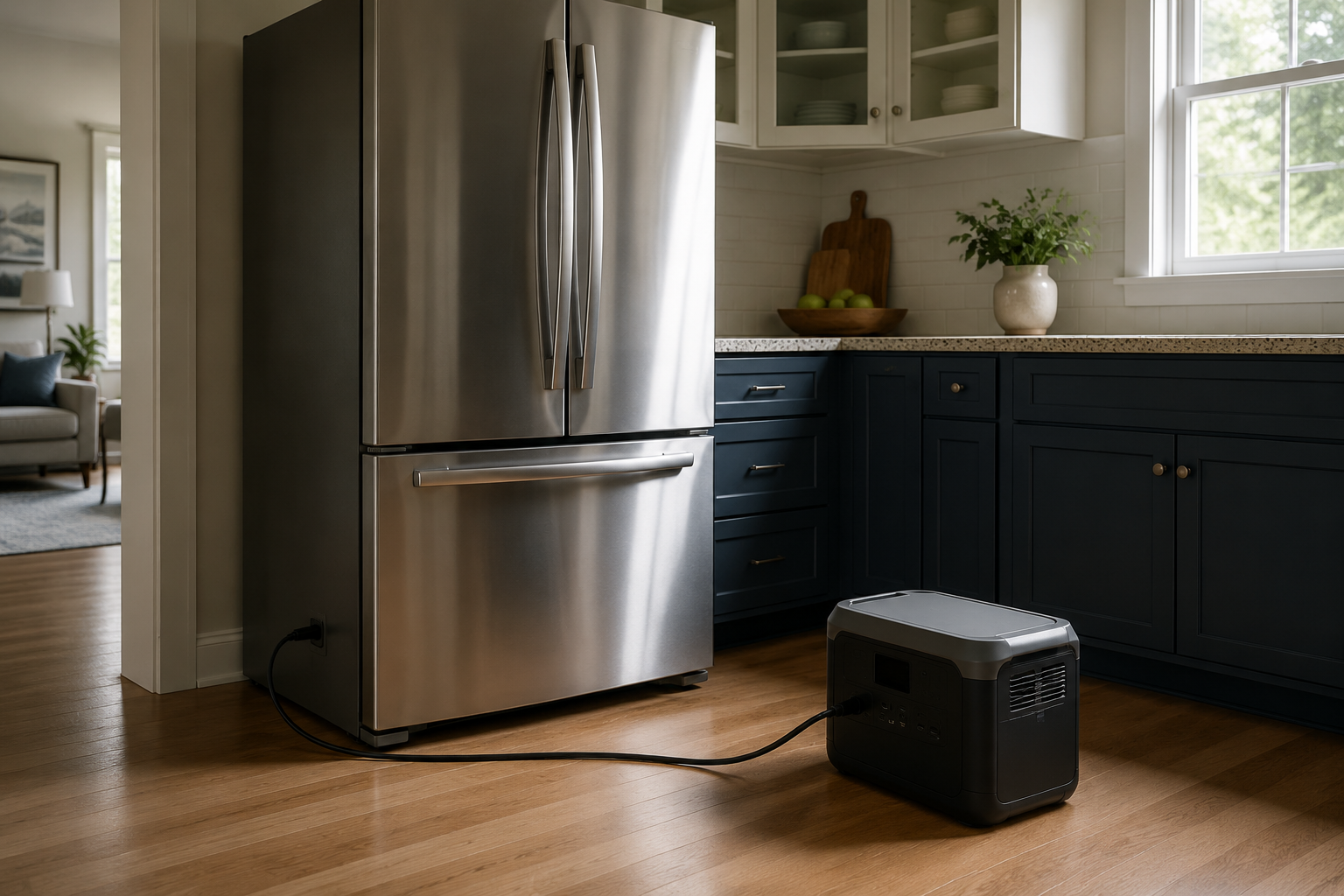
A portable power station can run a refrigerator for a few hours, overnight, or longer than a day. The answer depends on the station’s usable battery capacity and the refrigerator’s actual energy use—not the size of your home or the largest watt number on the appliance label.
For example, a 1,024Wh power station with about 85% usable AC energy is estimated to run a refrigerator rated at 500kWh per year for about 11 hours when the calculation includes a 20% operating allowance and 10W of station idle draw. Your result may be very different.
The safest way to plan is to answer two separate questions:
- Can the power station start and continuously run the refrigerator?
- If it can, how long will the battery last?
First, make sure the station can run the refrigerator
Battery capacity and AC output are not the same thing. Battery capacity is measured in watt-hours, or Wh. It tells you how much energy the station stores. AC output is measured in watts, or W. It tells you how much power the station can deliver at one time.
A station may have enough watt-hours for a long runtime but still shut down when the refrigerator compressor starts. Before relying on it, compare:
- The station’s continuous output with the refrigerator’s running watts.
- The station’s surge output with the refrigerator’s starting watts.
Use ratings from the refrigerator manufacturer, power-station manufacturer, or a meter that can capture startup demand. If you cannot verify starting watts, do not assume the station will handle them. Test the exact combination before an outage.
If a portable battery is not the right fit for the loads you need to cover, review Portable Power Station vs. Generator. If you are considering a fuel-powered generator, use How Much Generator Do I Need? to size it correctly.
Use energy consumption—not maximum watts—to estimate runtime
A refrigerator does not draw the same amount of power all day. Its compressor cycles on and off, and defrost heaters, fans, ice makers, room temperature, and door openings all affect energy use.
That is why a sticker showing running or maximum watts is a poor runtime estimate. It describes power at a moment in time, not the energy used over a full day.
The better starting point is one of these:
- Annual energy use in kWh/year from the yellow EnergyGuide label or the model’s official EPA ENERGY STAR listing.
- Measured energy use in kWh over at least 24 hours. A longer measurement is better when conditions vary.
The annual figure is still an estimate. Actual consumption changes with the refrigerator, room temperature, door openings, settings, age, condition, and how much warm food is added.
Refrigerator runtime calculator
Enter the power station’s battery capacity and your refrigerator’s annual or measured energy use. The calculator also lets you account for usable AC energy, station idle draw, other continuous loads, and a real-world operating allowance.
The result is a planning estimate. It assumes the station is not being recharged by a wall outlet, vehicle, or solar panels while it is operating.
Use your refrigerator’s annual energy use or a measured 24-hour total. The result is a planning estimate, not a guarantee.
1. Estimate Runtime
Your Planning Estimate
2. Optional: Check Whether the Station Can Start the Refrigerator
Runtime capacity and AC output are different. Enter verified ratings below; leave unknown values blank.
This calculator assumes no solar or wall recharging while the refrigerator is running. Do not use refrigerator nameplate or startup watts as a 24-hour energy estimate.
How the calculator works
The calculation starts by converting the refrigerator’s annual energy figure into average daily energy use:
Daily refrigerator energy (Wh) = annual kWh × 1,000 ÷ 365
It then adds the operating allowance you selected and converts daily energy into an average 24-hour load. Station idle draw and any other continuous loads are added before the usable battery energy is divided by the total average load.
Estimated runtime (hours) = usable battery Wh ÷ total average load W
The calculator defaults to 85% usable AC energy as a planning estimate. That value accounts broadly for energy that does not reach the appliance, but it is not universal. Use tested or manufacturer information for your power station when available.
Worked example
Assume the following:
- Power station capacity: 1,024Wh
- Usable AC energy: 85%
- Refrigerator EnergyGuide rating: 500kWh/year
- Extra refrigerator-use allowance: 20%
- Station idle draw: 10W
- Other loads: 0W
The station has about 870Wh of usable energy. The refrigerator’s label works out to about 1,370Wh per day before the allowance and about 1,644Wh per day after it. That is an average refrigerator load of roughly 68.5W. Adding 10W of station idle draw produces a total average load of about 78.5W.
870Wh ÷ 78.5W = about 11.1 hours
This example does not promise that every 1,024Wh station will run every refrigerator for 11 hours. It shows how the inputs change the answer.
What can shorten runtime?
- Hot rooms. A refrigerator in a hot kitchen or garage may run more often.
- Frequent door openings. Every opening lets cold air out and warm, humid air in.
- Warm food. Adding a large amount of unfrozen or warm food increases the cooling load.
- An older or poorly maintained refrigerator. Dirty condenser coils, worn door seals, and mechanical problems can increase energy use.
- Battery temperature and age. Available battery energy can change with condition and operating temperature.
- Station idle draw. The inverter, display, fans, and internal electronics use energy even when the compressor is off.
- Other connected devices. A router, lights, chargers, or another appliance will reduce refrigerator runtime.
How to make the battery last longer
- Keep the refrigerator and freezer doors closed as much as possible. Decide what you need before opening the door.
- Disconnect nonessential loads. Reserve the station for refrigeration and truly necessary devices.
- Start with a fully charged station and verify the battery’s state of charge before severe weather.
- Keep the refrigerator maintained. Follow the manufacturer’s instructions for cleaning coils, checking airflow, and inspecting door seals.
- Test before you need it. Run the refrigerator from the station under supervision and record the battery percentage over several hours. A real test of your equipment is more useful than a generic online estimate.
Food safety still depends on temperature
A runtime number does not tell you whether food is safe. FoodSafety.gov says an unopened refrigerator will keep food safe for up to four hours during a power outage. Keep the door closed as much as possible.
Use an appliance thermometer. If the refrigerator has been without adequate cooling, follow current USDA guidance for food exposed above 40°F. Never taste food to decide whether it is safe.
For a broader outage plan—including lighting, communication, water, and food decisions—see What to Do When the Power Goes Out.
Frequently asked questions
Will a 1,000Wh power station run a refrigerator overnight?
It may, but the battery-capacity number alone cannot answer the question. Use the refrigerator’s annual or measured energy use, include station losses and idle draw, and confirm that the station can handle the compressor’s starting surge.
Is a 2,000W power station the same as a 2,000Wh power station?
No. A 2,000W rating describes output power. A 2,000Wh rating describes stored energy. You need enough output to start and run the refrigerator and enough stored energy for the runtime you want.
Can I run a refrigerator and a router at the same time?
Yes, if their combined running and startup demands stay within the station’s ratings. Add the router and any other continuous loads to the runtime calculator because they reduce how long the battery lasts.
Will solar panels keep the refrigerator running indefinitely?
Not necessarily. Solar production changes with weather, season, shade, panel position, and the station’s charging limits. Treat solar as a possible energy input, not a guarantee of continuous operation.
Bottom line
Do not choose refrigerator backup by watt-hours alone. First verify that the power station’s continuous and surge output can operate the refrigerator. Then estimate runtime from annual or measured energy use, include station losses and idle draw, and test the setup before an outage.
A calculator can give you a useful planning number. Your own refrigerator, power station, room conditions, and usage determine the real result.