Category: Emergency Power

Practical guidance on generators, portable power stations, batteries, backup power, and keeping essential equipment running during an outage.

  • How Long Can a Portable Power Station Run a Refrigerator?

    How Long Can a Portable Power Station Run a Refrigerator?

    Short answer

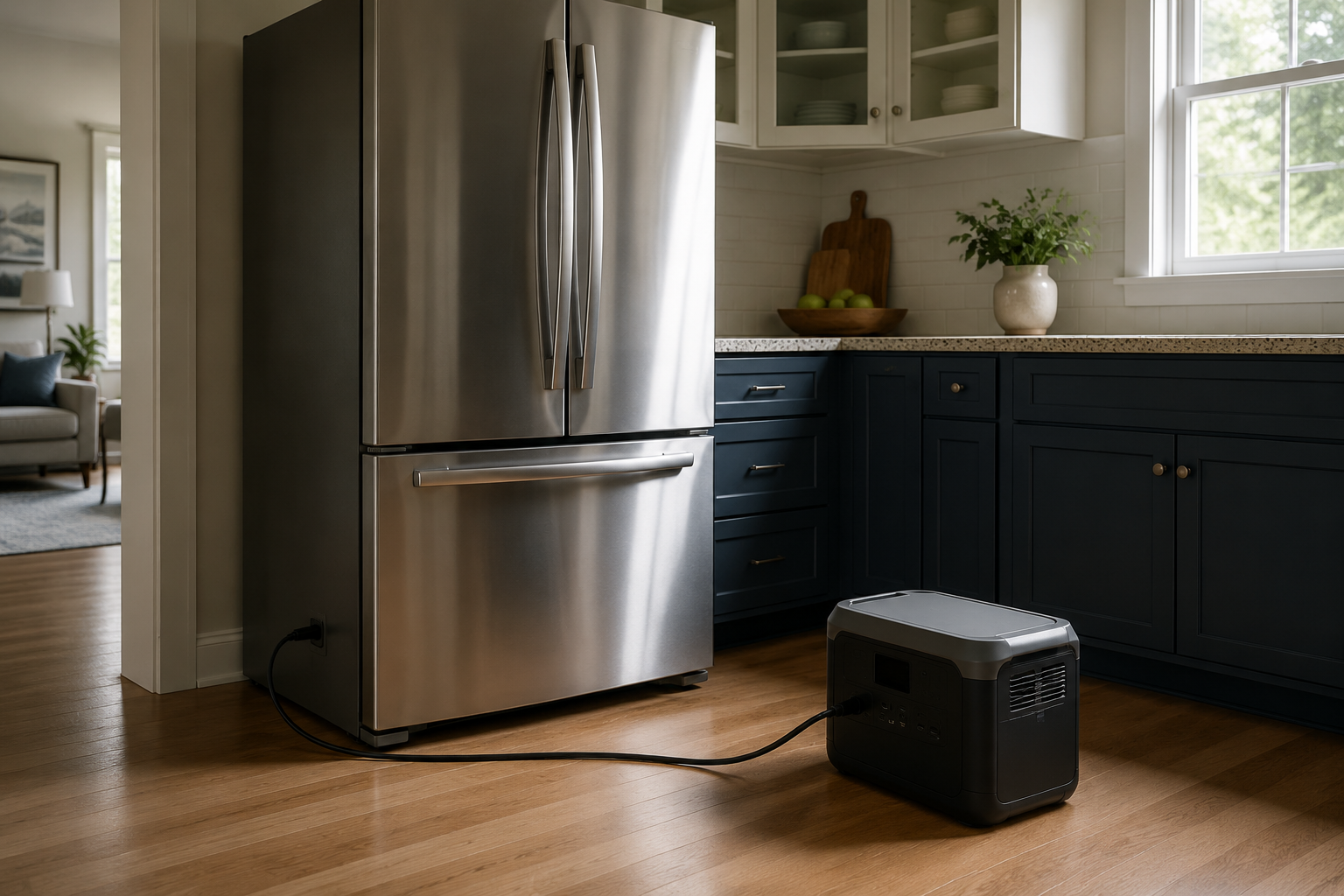
    A portable power station can run a refrigerator for a few hours, overnight, or longer than a day. The answer depends on the station’s usable battery capacity and the refrigerator’s actual energy use—not the size of your home or the largest watt number on the appliance label.

    For example, a 1,024Wh power station with about 85% usable AC energy is estimated to run a refrigerator rated at 500kWh per year for about 11 hours when the calculation includes a 20% operating allowance and 10W of station idle draw. Your result may be very different.

    The safest way to plan is to answer two separate questions:

    1. Can the power station start and continuously run the refrigerator?
    2. If it can, how long will the battery last?

    First, make sure the station can run the refrigerator

    Battery capacity and AC output are not the same thing. Battery capacity is measured in watt-hours, or Wh. It tells you how much energy the station stores. AC output is measured in watts, or W. It tells you how much power the station can deliver at one time.

    A station may have enough watt-hours for a long runtime but still shut down when the refrigerator compressor starts. Before relying on it, compare:

    • The station’s continuous output with the refrigerator’s running watts.
    • The station’s surge output with the refrigerator’s starting watts.

    Use ratings from the refrigerator manufacturer, power-station manufacturer, or a meter that can capture startup demand. If you cannot verify starting watts, do not assume the station will handle them. Test the exact combination before an outage.

    If a portable battery is not the right fit for the loads you need to cover, review Portable Power Station vs. Generator. If you are considering a fuel-powered generator, use How Much Generator Do I Need? to size it correctly.

    Use energy consumption—not maximum watts—to estimate runtime

    A refrigerator does not draw the same amount of power all day. Its compressor cycles on and off, and defrost heaters, fans, ice makers, room temperature, and door openings all affect energy use.

    That is why a sticker showing running or maximum watts is a poor runtime estimate. It describes power at a moment in time, not the energy used over a full day.

    The better starting point is one of these:

    The annual figure is still an estimate. Actual consumption changes with the refrigerator, room temperature, door openings, settings, age, condition, and how much warm food is added.

    Refrigerator runtime calculator

    Enter the power station’s battery capacity and your refrigerator’s annual or measured energy use. The calculator also lets you account for usable AC energy, station idle draw, other continuous loads, and a real-world operating allowance.

    The result is a planning estimate. It assumes the station is not being recharged by a wall outlet, vehicle, or solar panels while it is operating.

    Use your refrigerator’s annual energy use or a measured 24-hour total. The result is a planning estimate, not a guarantee.

    1. Estimate Runtime

    2. Optional: Check Whether the Station Can Start the Refrigerator

    Runtime capacity and AC output are different. Enter verified ratings below; leave unknown values blank.

    Food-safety reminder: An unopened refrigerator keeps food safe for about four hours without power. Keep the door closed, use an appliance thermometer, and follow current USDA guidance if food has been above 40°F.

    This calculator assumes no solar or wall recharging while the refrigerator is running. Do not use refrigerator nameplate or startup watts as a 24-hour energy estimate.

    How the calculator works

    The calculation starts by converting the refrigerator’s annual energy figure into average daily energy use:

    Daily refrigerator energy (Wh) = annual kWh × 1,000 ÷ 365

    It then adds the operating allowance you selected and converts daily energy into an average 24-hour load. Station idle draw and any other continuous loads are added before the usable battery energy is divided by the total average load.

    Estimated runtime (hours) = usable battery Wh ÷ total average load W

    The calculator defaults to 85% usable AC energy as a planning estimate. That value accounts broadly for energy that does not reach the appliance, but it is not universal. Use tested or manufacturer information for your power station when available.

    Worked example

    Assume the following:

    • Power station capacity: 1,024Wh
    • Usable AC energy: 85%
    • Refrigerator EnergyGuide rating: 500kWh/year
    • Extra refrigerator-use allowance: 20%
    • Station idle draw: 10W
    • Other loads: 0W

    The station has about 870Wh of usable energy. The refrigerator’s label works out to about 1,370Wh per day before the allowance and about 1,644Wh per day after it. That is an average refrigerator load of roughly 68.5W. Adding 10W of station idle draw produces a total average load of about 78.5W.

    870Wh ÷ 78.5W = about 11.1 hours

    This example does not promise that every 1,024Wh station will run every refrigerator for 11 hours. It shows how the inputs change the answer.

    What can shorten runtime?

    • Hot rooms. A refrigerator in a hot kitchen or garage may run more often.
    • Frequent door openings. Every opening lets cold air out and warm, humid air in.
    • Warm food. Adding a large amount of unfrozen or warm food increases the cooling load.
    • An older or poorly maintained refrigerator. Dirty condenser coils, worn door seals, and mechanical problems can increase energy use.
    • Battery temperature and age. Available battery energy can change with condition and operating temperature.
    • Station idle draw. The inverter, display, fans, and internal electronics use energy even when the compressor is off.
    • Other connected devices. A router, lights, chargers, or another appliance will reduce refrigerator runtime.

    How to make the battery last longer

    • Keep the refrigerator and freezer doors closed as much as possible. Decide what you need before opening the door.
    • Disconnect nonessential loads. Reserve the station for refrigeration and truly necessary devices.
    • Start with a fully charged station and verify the battery’s state of charge before severe weather.
    • Keep the refrigerator maintained. Follow the manufacturer’s instructions for cleaning coils, checking airflow, and inspecting door seals.
    • Test before you need it. Run the refrigerator from the station under supervision and record the battery percentage over several hours. A real test of your equipment is more useful than a generic online estimate.

    Food safety still depends on temperature

    A runtime number does not tell you whether food is safe. FoodSafety.gov says an unopened refrigerator will keep food safe for up to four hours during a power outage. Keep the door closed as much as possible.

    Use an appliance thermometer. If the refrigerator has been without adequate cooling, follow current USDA guidance for food exposed above 40°F. Never taste food to decide whether it is safe.

    For a broader outage plan—including lighting, communication, water, and food decisions—see What to Do When the Power Goes Out.

    Frequently asked questions

    Will a 1,000Wh power station run a refrigerator overnight?

    It may, but the battery-capacity number alone cannot answer the question. Use the refrigerator’s annual or measured energy use, include station losses and idle draw, and confirm that the station can handle the compressor’s starting surge.

    Is a 2,000W power station the same as a 2,000Wh power station?

    No. A 2,000W rating describes output power. A 2,000Wh rating describes stored energy. You need enough output to start and run the refrigerator and enough stored energy for the runtime you want.

    Can I run a refrigerator and a router at the same time?

    Yes, if their combined running and startup demands stay within the station’s ratings. Add the router and any other continuous loads to the runtime calculator because they reduce how long the battery lasts.

    Will solar panels keep the refrigerator running indefinitely?

    Not necessarily. Solar production changes with weather, season, shade, panel position, and the station’s charging limits. Treat solar as a possible energy input, not a guarantee of continuous operation.

    Bottom line

    Do not choose refrigerator backup by watt-hours alone. First verify that the power station’s continuous and surge output can operate the refrigerator. Then estimate runtime from annual or measured energy use, include station losses and idle draw, and test the setup before an outage.

    A calculator can give you a useful planning number. Your own refrigerator, power station, room conditions, and usage determine the real result.

  • How Much Generator Do I Need for My House?

    How Much Generator Do I Need for My House?

    Shopping for a generator by house size sounds simple. A small house needs a small generator, a large house needs a large one and somewhere in the middle is the right answer for everyone else.

    That shortcut does not work very well.

    A 2,500-square-foot home with gas heat, gas water heating and a plan to power only the refrigerator, lights and phones may need less backup power than a much smaller all-electric home with a well pump, electric heat and medical equipment.

    The right generator size depends on what your household actually needs to run—not the number of bedrooms or square feet.

    The Short Answer

    List the equipment you need during an outage. Add the running watts for everything that may operate at the same time. Then account for the additional power that the largest motor or compressor may require when it starts.

    After that, confirm that the generator provides the correct voltage, enough output on the fuel you intend to use and a safe way to connect the equipment.

    That calculation can help you estimate a portable generator for ordinary household essentials. If your plan includes central air conditioning, electric heat, a well pump, medical equipment, several large motors or most of the house, have a qualified electrician or generator professional confirm the size and connection system.

    Decide What Needs Power

    Do not start with the house’s square footage. Start with the outage you are planning for and the loads that protect health, safety and the home.

    For many households, the first list includes:

    • A refrigerator or freezer
    • Necessary medical equipment
    • A sump pump, well pump or furnace blower
    • A limited amount of lighting
    • Phones, radios and internet equipment
    • Fans, a window air conditioner or another practical cooling plan
    • Anything else the household cannot safely go without

    Then separate essentials from conveniences. A microwave may be useful, but it does not have to run while a pump is starting. A clothes dryer may matter during a long outage, but it may not justify enough generator capacity to operate normally. Managing when equipment runs can reduce generator size, fuel use and cost.

    If you are still deciding whether a fuel-powered generator is the right backup system, compare a portable power station and a generator before sizing either one.

    Choose How Much of the House You Want to Power

    Most backup-power plans fall into one of three levels:

    • Plug-in essentials: A portable generator supplies a refrigerator, freezer, lights, chargers and other modest equipment through properly rated extension cords. This generally does not cover hardwired loads.
    • Selected circuits: A qualified electrician installs approved transfer equipment and a power inlet so the generator can supply chosen household circuits. This also makes deliberate load management easier.
    • Whole-home operation: Heating, central cooling, cooking and water heating can move the project beyond a simple portable-generator calculation. A standby system should be evaluated as one professionally installed electrical and fuel system.

    Understand Running Watts and Starting Watts

    Running watts are the power an appliance uses after it is operating. Starting watts—also called surge watts—describe the brief increase some motors and compressors need when they start.

    Your generator must support the combined running load and a realistic startup event while the other planned loads are operating. This is why adding only running watts can produce a generator that looks adequate but trips or stalls when a refrigerator, pump, furnace blower or air conditioner starts.

    Wattage charts use “starting watts” in two different ways. Some list the appliance’s total demand during startup. Others list only the additional watts above its normal running load.

    For example, an appliance that uses 300 running watts and 1,200 total starting watts needs 900 additional watts during startup:

    1,200 total starting watts − 300 running watts = 900 additional starting watts

    If a chart already provides additional starting watts, do not subtract the running watts again. Always follow the definition used by the equipment manufacturer or calculator.

    Where to Find the Wattage

    Use actual equipment information whenever possible. Check:

    • The appliance identification label or nameplate
    • The owner’s manual
    • The manufacturer’s official specifications
    • The generator manufacturer’s sizing guide
    • A qualified electrician, HVAC professional or equipment dealer for hardwired or high-demand loads

    Generic wattage charts are useful for an early estimate, but they should not be treated as the exact requirement for every refrigerator, pump or air conditioner. Honda’s wattage guide and Champion’s wattage chart both show how widely common household loads can vary.

    Some labels provide volts and amps instead of watts. Manufacturer guides sometimes estimate watts by multiplying volts by amps. That can be a useful planning shortcut for simple loads, but alternating-current motors and compressors introduce starting demand and other factors that the shortcut may not capture accurately.

    If the label is unclear—or the equipment is hardwired—do not guess.

    Common Household Wattage Estimates

    The figures below are useful for early planning. They are not model-specific ratings. Use the appliance nameplate, owner’s manual or manufacturer’s specifications when available.

    The “total starting watts” column is the appliance’s approximate total demand during startup—not just the extra surge above its running load. “Same as running” means the chart does not assign a separate startup surge. Voltage still must be checked separately, especially for pumps, water heaters and other hardwired equipment.

    Household loadTypical running wattsTypical total starting watts
    Refrigerator150–400 W800–1,200 W
    Freezer100–500 W500–1,000 W
    Window AC (5,000 BTU)450–600 W900–1,200 W
    Window AC (10,000 BTU)900–1,200 W1,800–2,400 W
    Furnace fan (1/2 HP)300–800 W800–1,600 W
    Sump pump (1/3 HP)500–800 W1,000–1,600 W
    Sump pump (1/2 HP)800–1,050 W1,300–2,150 W
    Well pump (1/2 HP)750–1,000 W1,500–2,000 W
    Microwave600–1,200 WSame as running
    Space heater750–1,500 WSame as running
    Television (32–55 in.)80–400 WSame as running
    LED light bulb8–15 WSame as running
    Phone or laptop charger20–100 WSame as running
    CPAP with heated humidifier60–120 WSame as running
    Internet router and modem10–20 WSame as running
    Electric water heater3,000–4,500 WSame as running

    How to Calculate Your Generator Requirement

    Use this process for an initial estimate:

    • List every appliance and device you expect to power.
    • Record its voltage, running watts and total starting watts. Note whether a source gives total or additional starting watts.
    • Decide which loads may operate at the same time and add their running watts.
    • Find the largest additional startup demand likely to occur while the other loads are running.
    • Add that startup demand to the simultaneous running total.
    • Compare the result with the generator’s running and surge ratings, voltage, receptacles, breaker limits and output on the fuel you will use.

    Do not plan to operate continuously at the absolute edge of the rating. Follow the manufacturer’s sizing guidance rather than applying an unsupported universal percentage.

    Generator Sizing Calculator

    Use the calculator on this page to add the appliances and devices that may run at the same time. Choose a built-in estimate or replace it with information from your own equipment.

    The calculator reports the simultaneous running load, an estimated peak with the largest single startup event, a more conservative all-motors-start estimate and a warning for 240-volt loads.

    Treat the results as planning figures—not a generator recommendation. Compare them with the generator’s fuel-specific running and surge ratings, voltage, receptacles, breakers and connection equipment.

    Enter total starting watts, not only the extra startup amount. Add identical appliances as separate loads.

    This calculator estimates electrical demand; it does not select a generator. Compare the result with the generator’s continuous and surge ratings on the fuel you will use, plus voltage, receptacles, breakers and connection equipment. Have hardwired, medical, central-HVAC, whole-home or uncertain loads professionally evaluated.

    A Simple Household Example

    Suppose a household plans to run a refrigerator, freezer, LED lights, internet equipment, chargers and a portable fan. Its estimated loads are:

    • Refrigerator: 300 running watts; 1,200 total starting watts
    • Freezer: 300 running watts; 1,000 total starting watts
    • All other selected loads: 300 running watts

    The simultaneous running load is 900 watts. The refrigerator adds the largest startup demand: 1,200 total starting watts minus 300 running watts, or 900 additional watts.

    The estimated peak is therefore 900 running watts plus 900 additional starting watts, or approximately 1,800 watts.

    That is a planning figure, not a recommendation to buy a generator labeled 1,800 watts. Actual equipment data, automatically cycling loads, voltage, connection limits and the manufacturer’s recommended allowance still matter. If the refrigerator and freezer could start together, account for that possibility or manage the loads.

    Check the Generator, Not Just the Total Watts

    A generator can have enough advertised wattage and still be wrong for the job. Before buying, check four things:

    • Voltage: A 240-volt load requires a generator and connection system that provide compatible 240-volt power. An adapter cannot create voltage or capacity.
    • Fuel rating: Dual- and tri-fuel generators may produce less power on propane or natural gas than on gasoline. Use the rating for the fuel you expect to burn.
    • Continuous and surge output: Compare normal household demand with running watts and motor-starting demand with surge watts.
    • The complete power path: Receptacles, breakers, cords, power inlets and transfer equipment can limit how much power reaches the load.

    Generac’s guidance on portable-generator power limits illustrates why the largest number on the box may not be available through every protected receptacle. The generator is only one part of the system; every component between it and the appliance must be appropriate for the load.

    If the plan includes a well pump, electric water heater, range, dryer, central air conditioner or other hardwired 240-volt equipment, have a qualified electrician verify the generator and connection plan.

    Use Load Management Before Buying More Generator

    You may not need to operate everything at once. A microwave, coffee maker or water heater can usually wait while a pump or compressor starts.

    Honda’s sizing guidance shows how starting large loads at different times can allow a smaller generator to serve more equipment. Manual load management may be as simple as turning one appliance or circuit off before using another.

    The plan still has to be realistic. Refrigerators, freezers, pumps and furnace blowers can restart automatically. If two large motors can start together, include that possibility in the calculation or use a dependable system that prevents it.

    A smaller generator can cost less, use less fuel and be easier to move. The tradeoff is paying closer attention to what is running.

    When to Stop Calculating and Call a Professional

    A homeowner worksheet is useful for understanding the problem. It is not a substitute for professional sizing when the project includes:

    • Central air conditioning or a heat pump
    • Electric resistance heat or electric water heating
    • A hardwired well pump, sump pump or furnace with uncertain starting data
    • Medical equipment that cannot safely lose power
    • Several large motors that may start together
    • A connection to household wiring
    • Whole-home standby operation
    • A service panel, fuel supply or load requirement you do not understand

    A qualified electrician can verify the actual loads, voltage, transfer equipment, inlet, breaker and local requirements. A standby-generator professional can also evaluate fuel supply, equipment placement and load-management options.

    Safety First

    Never connect a generator to a wall outlet. Supplying household wiring requires approved transfer equipment installed by a qualified electrician. Improper backfeeding can energize utility lines, injure or kill utility workers and create electrical or fire hazards.

    Operate a portable fuel-burning generator outdoors only, at least 20 feet from the home, with the exhaust directed away from doors, windows and vents. Keep the generator and electrical connections dry, use working carbon-monoxide alarms and follow the manufacturer’s instructions.

    Review our complete portable-generator safety guide before planning how the generator will be placed and connected. The U.S. Consumer Product Safety Commission also provides current generator and carbon-monoxide guidance.

    Generator Sizing Checklist

    Before choosing a generator, confirm that you have:

    • Listed the loads that truly need power
    • Used actual running, total starting and voltage information where available
    • Calculated what may run at the same time and allowed for realistic motor starts
    • Checked the generator’s ratings for the fuel you will use
    • Checked receptacle, breaker, cord, inlet and transfer-equipment limits
    • Decided how large loads will be managed
    • Obtained professional help for hardwired, high-demand, medical or whole-home loads and planned a safe connection and operating location

    Buy for the Plan, Not the House

    The right generator is not the one assigned to your square footage by a generic chart.

    It is the one that can safely support the electrical loads your household has decided are important—without depending on wishful math, an incompatible connection or more fuel than you can reasonably store and obtain.

    Start with the loads. Calculate the running and starting demand. Check the voltage, fuel rating and connection limits. Manage what does not need to run at the same time.

    Then choose the generator.

    Once you own it, the work is not finished. Learn why a generator may not start after sitting and how often to run your generator so the equipment you sized carefully is actually ready when the power goes out.

  • Portable Generator Safety: Avoid Carbon Monoxide, Fire and Electrical Hazards

    Portable Generator Safety: Avoid Carbon Monoxide, Fire and Electrical Hazards

    A portable generator can keep refrigerators cold, charge essential devices and power equipment your household depends on during an outage.

    It can also create carbon-monoxide, electrical and fire hazards when it is placed, connected or refueled incorrectly.

    Most generator accidents do not happen because someone intended to take a dangerous risk. They happen because the power is out, the weather is bad and someone is trying to get the lights back on quickly.

    That is why generator safety should be worked out before the outage—not while standing outside in the dark with a machine you have not used since the last storm.

    This guide focuses on the mistakes that matter most and the practical steps that help prevent them.

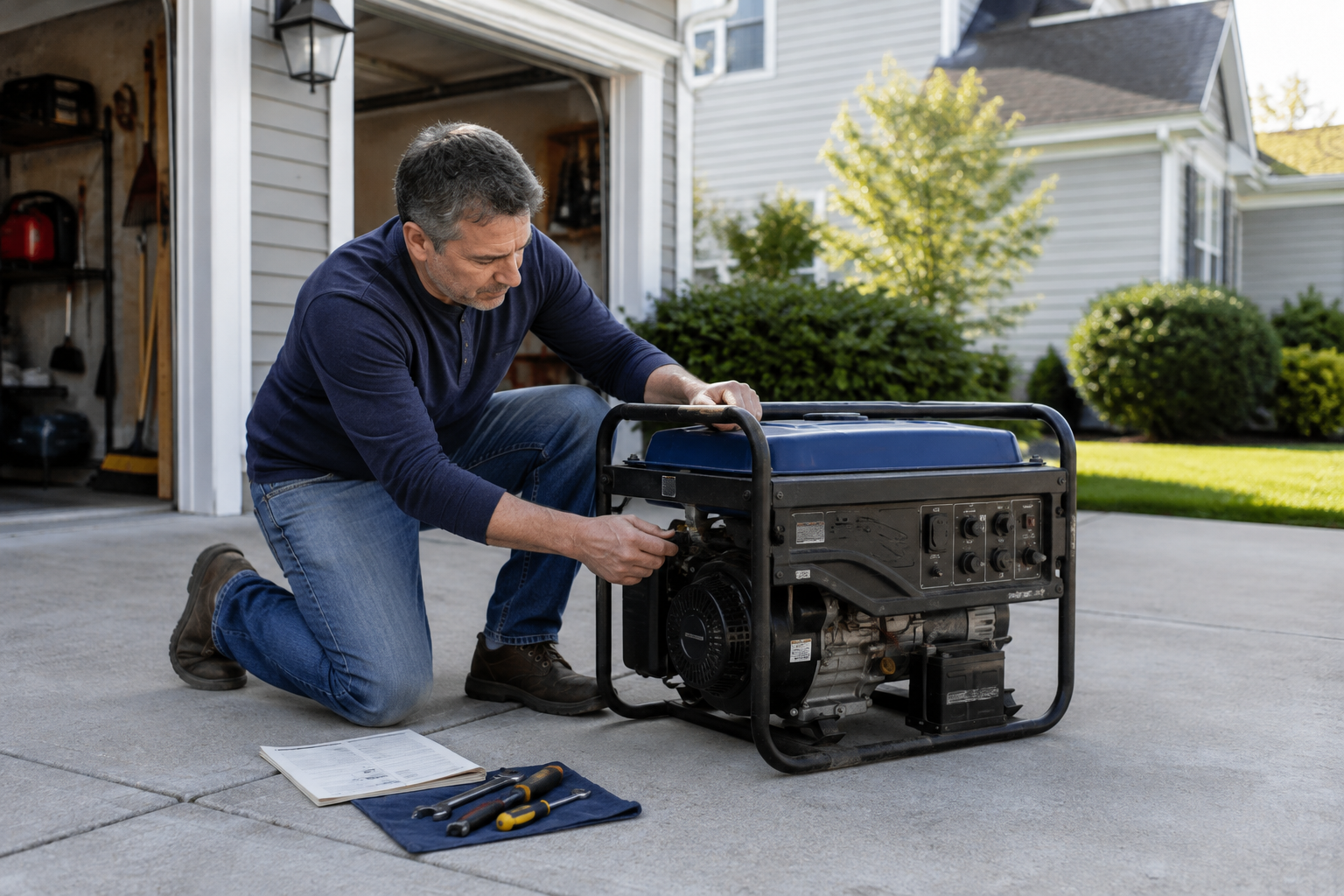
    Start With the Generator’s Manual

    Portable generators are not all designed or wired the same way.

    Before operating yours, read the manufacturer’s instructions for:

    • Safe placement and required clearances
    • Grounding
    • Weather protection
    • Extension cords
    • Electrical capacity
    • Starting and shutdown
    • Refueling
    • Maintenance and storage

    Keep the manual where you can find it during an outage.

    If the original manual is missing, find the generator’s model number on its identification label and search the manufacturer’s official website. Look for a section labeled Support, Manuals, Product Documentation or Downloads.

    Confirm that the model number on the manual matches your generator exactly before following its instructions. If the manual is no longer available online, contact the manufacturer or an authorized dealer.

    Avoid relying on an unofficial manual-download site when the manufacturer’s version is available.

    General safety guidance is important, but it does not replace the instructions for your particular generator.

    Never Run a Portable Generator Indoors

    A fuel-burning generator produces carbon monoxide, or CO. Carbon monoxide cannot be seen or smelled, and it can build up quickly enough to cause illness, unconsciousness or death.

    Never operate a portable generator in:

    • A house
    • A garage
    • A basement
    • A crawlspace
    • A shed
    • A porch
    • A carport or breezeway
    • Any other enclosed or partially enclosed space

    Opening the garage door does not make the garage safe. Opening windows or placing fans nearby does not make an indoor location safe either.

    The generator belongs outside.

    The CDC says generators should be operated outdoors more than 20 feet from windows, doors and vents. Point the exhaust away from the home and from openings that could allow fumes inside.

    That distance is not permission to place the generator anywhere a cord happens to reach. Consider the direction of the exhaust, nearby buildings and whether fumes could enter a neighbor’s home.

    Do not move the generator closer because an extension cord is too short. Use an appropriately rated cord that allows the generator to remain in a safe location.

    Safety First

    If a carbon-monoxide alarm sounds, get everyone outside into fresh air and call 911. Do not remain inside looking for the source, and do not re-enter until emergency responders say it is safe.

    Possible symptoms of carbon-monoxide poisoning include headache, dizziness, weakness, nausea, vomiting, chest pain and confusion. Someone who is sleeping may become seriously ill without recognizing the warning signs.

    If anyone develops possible symptoms while a generator or another fuel-burning device is operating, move to fresh air immediately and seek emergency help.

    Use Working Carbon-Monoxide Alarms

    Correct generator placement is the first defense against carbon monoxide. Working CO alarms provide another important layer of protection.

    Use battery-operated CO alarms or plug-in alarms with battery backup. Battery backup matters because an ordinary plug-in alarm may not work during the same outage that caused you to use the generator.

    Install CO alarms on every level of the home and outside sleeping areas, following the alarm manufacturer’s instructions. Test them regularly and replace batteries or the alarm itself when required.

    Do not place a generator closer to the house because you have CO alarms. An alarm is a warning device, not a substitute for safe placement.

    Never Backfeed Power Through a Wall Outlet

    Never try to power your house by connecting a generator to an ordinary wall outlet.

    This practice—often called backfeeding—can send electricity into household wiring and out onto utility lines. It can injure or kill utility workers, neighbors or anyone who encounters wiring believed to be de-energized. It can also damage the generator or household electrical system and create a fire hazard.

    A homemade cord with male plugs on both ends is especially dangerous and should never be used.

    There are two basic ways to use portable-generator power:

    1. Connect selected appliances directly to the generator with properly rated extension cords, following the generator and appliance instructions.
    2. Connect the generator to designated household circuits through approved transfer equipment installed by a qualified electrician.

    Transfer equipment isolates generator power from utility power and prevents dangerous backfeeding. Requirements vary with the generator, electrical system and local rules, so connecting a generator to household wiring is not a do-it-yourself project.

    The Electrical Safety Foundation International recommends having transfer equipment installed by a qualified electrician.

    If you want the generator to supply household circuits, arrange the installation before an outage. Consult a qualified electrician and, where appropriate, your utility or local code authority.

    Use the Right Extension Cords

    An extension cord becomes part of the electrical system while the generator is running. A household cord chosen only because it is nearby may not be suitable.

    Use cords that are:

    • Intended for outdoor use
    • Grounded and equipped with three-prong plugs
    • Rated to carry the connected electrical load
    • Long enough to preserve safe generator placement
    • Free from cuts, crushed areas, exposed conductors and damaged plugs
    • Used according to the generator and appliance instructions

    A cord that is too light for the load can overheat. A damaged cord can create a shock or fire hazard.

    Do not run cords through standing water or place connections where they can become wet. Protect cords from vehicle traffic, sharp edges, closed doors and other locations where they could be crushed or damaged.

    Do not remove a grounding pin to make a plug fit.

    The generator’s grounding requirements depend on its design and how it is connected. Follow the manufacturer’s instructions rather than assuming that every generator requires the same grounding arrangement.

    Keep the Generator and Connections Dry

    Generators are often needed because of hurricanes, thunderstorms, ice storms or other conditions that also bring rain and moisture.

    Electricity and water are a dangerous combination.

    The Occupational Safety and Health Administration advises keeping portable generators dry and not operating them in rain or wet conditions. Never handle the generator’s electrical components with wet hands or while standing in water.

    Follow the generator manufacturer’s instructions for protection from rain and snow. Any operating cover or shelter must be approved or specifically permitted for use with your generator and must preserve all required ventilation, exhaust direction and clearances.

    Do not drape a tarp over a running generator or improvise an enclosure around it.

    Most importantly, do not solve the rain problem by moving the generator into a garage, shed, porch or other enclosed or partially enclosed space. That replaces an electrical hazard with a carbon-monoxide hazard.

    Plan for safe weather protection before the storm. If you cannot keep the generator dry while also meeting its outdoor placement and clearance requirements, do not operate it until conditions allow safe use.

    Do Not Overload the Generator

    A generator can supply only a limited amount of power.

    Connecting more equipment than it can support may trip its protection, damage appliances, overheat cords or create a fire hazard. Some appliances also require more power when they start than they use while running.

    Before an outage, identify what you actually need to operate. For many households, that might include:

    • A refrigerator or freezer
    • A few lights
    • Phone chargers
    • A modem or router
    • Necessary medical equipment
    • A limited number of other essential devices

    Find the running and starting requirements for the equipment you intend to connect. Make sure the combined load remains within the generator manufacturer’s limits.

    If you are uncertain about your needs, our comparison of a portable power station versus a generator explains the factors to evaluate before choosing a backup-power system.

    A generator does not have to power the entire house to be useful. Managing a few essential loads safely is better than overloading the generator while trying to recreate normal life.

    Shut Down and Cool the Generator Before Refueling

    Gasoline and other generator fuels require careful handling.

    A running generator becomes hot. Spilled fuel can ignite if it contacts the engine, muffler or another hot component.

    Before refueling:

    1. Disconnect or turn off electrical loads according to the generator instructions.
    2. Shut down the generator.
    3. Allow it to cool as directed by the manufacturer.
    4. Refuel outdoors using the correct fuel and an approved container.
    5. Clean up any spill according to the manufacturer’s instructions before restarting.

    Never refuel a generator while it is operating or still hot.

    Store fuel outside living areas in approved, properly labeled containers. Keep it away from flames, pilot lights, electrical equipment and other ignition sources. Follow local rules governing the type and amount of fuel that may be stored.

    Do not assume that a garage is automatically a safe fuel-storage location. Fuel vapors can travel and ignite when they reach a pilot light, switch or another ignition source.

    Fuel also ages. A safe generator plan includes knowing how the manufacturer says to store both the machine and its fuel between outages.

    Our guide to why a generator may not start after sitting explains why storage and maintenance matter before the next emergency.

    Keep the Generator Away From Combustible Materials

    Portable generators produce heat in addition to exhaust.

    Operate the generator on a stable surface with the clearance required by its manufacturer. Keep leaves, cardboard, stored fuel and other combustible materials away from the engine and muffler.

    Do not place the generator where dry grass, storm debris or other material could contact a hot component.

    Keep children and pets away from the operating area. A generator can have hot surfaces, exposed cords, fuel and moving components even when it does not look especially dangerous.

    Remember that the engine and muffler may remain hot after shutdown.

    Inspect the Generator Before Every Use

    An outage is not the time to discover that a cord is damaged, fuel is leaking or the generator has not been maintained.

    Before starting it, check for:

    • Fuel or oil leaks
    • Loose or damaged parts
    • Blocked air inlets or exhaust
    • Damaged receptacles
    • Frayed or unsuitable extension cords
    • Deteriorated fuel lines
    • Pest nests or debris
    • Correct oil and fuel levels
    • Maintenance that is due

    Do not operate a generator that is leaking fuel, smoking unexpectedly, producing unusual odors or showing signs of electrical or mechanical damage.

    If you do not understand what you are seeing, stop and consult the manual, manufacturer or a qualified service professional.

    A brief pre-use inspection does not replace scheduled maintenance. Start, maintain and test the generator according to its instructions so that you know whether it works before the next outage.

    Continue Monitoring the Generator While It Runs

    Conditions around a generator can change after it starts.

    Periodically confirm that:

    • The generator remains dry and stable.
    • Exhaust is still directed safely away.
    • Cords and connections have not become wet or damaged.
    • Fuel or oil is not leaking.
    • The electrical load remains within capacity.
    • Children, pets and other people cannot enter the operating area.
    • Wind, water, debris or other conditions have not made the location unsafe.

    Follow the manufacturer’s instructions concerning supervision, shutdown and overnight operation. Do not assume that a generator can be started and forgotten until morning.

    Apartment and Renter Considerations

    A fuel-burning portable generator is not a practical choice everywhere.

    Never operate one inside an apartment, on a balcony, in a hallway, on an enclosed patio or anywhere that does not provide a safe outdoor operating location. Exhaust could enter your unit or another resident’s home.

    Lease terms, building rules and local regulations may also restrict generator use and fuel storage.

    If you do not have an appropriate outdoor operating location, consider whether battery banks or a portable power station can meet your most important needs. These devices avoid engine exhaust, but they still have capacity, charging and electrical-safety limitations.

    Do not improvise an unsafe generator location because the power is out.

    Prepare the Safe Setup Before You Need It

    A generator should not be an unopened machine that comes out for the first time after the lights go off.

    Before the next outage:

    • Read the correct manual.
    • Choose a safe outdoor operating location.
    • Measure more than 20 feet from doors, windows and vents.
    • Point the exhaust away from buildings and openings.
    • Determine how you will keep the generator dry without enclosing it.
    • Install and test CO alarms.
    • Obtain properly rated extension cords.
    • Calculate the electrical loads you plan to connect.
    • Arrange approved transfer equipment if the generator will supply household circuits.
    • Store fuel safely.
    • Inspect, maintain and test the generator as directed.

    If any part of the setup depends on guesswork during an emergency, solve it now.

    The Ready Chateau Generator Safety Rule

    A generator is useful only when it can be operated without creating a greater emergency than the outage itself.

    Keep it outside. Keep it more than 20 feet from doors, windows and vents. Point the exhaust away. Keep the generator and connections dry. Connect it correctly. Refuel it only after shutdown and cooling. Never backfeed power into household wiring.

    Most importantly, decide how you will use it safely before the power goes out.

    If you are still developing your outage plan, begin with what to do when the power goes out. Then test your generator, review its manual and correct any missing part of your setup while you still have light, time and working electricity.

  • Portable Power Station vs. Generator: Which Do You Actually Need?

    Portable Power Station vs. Generator: Which Do You Actually Need?

    A portable power station and a fuel-powered generator can both keep important equipment running during a power outage, but they solve different problems.

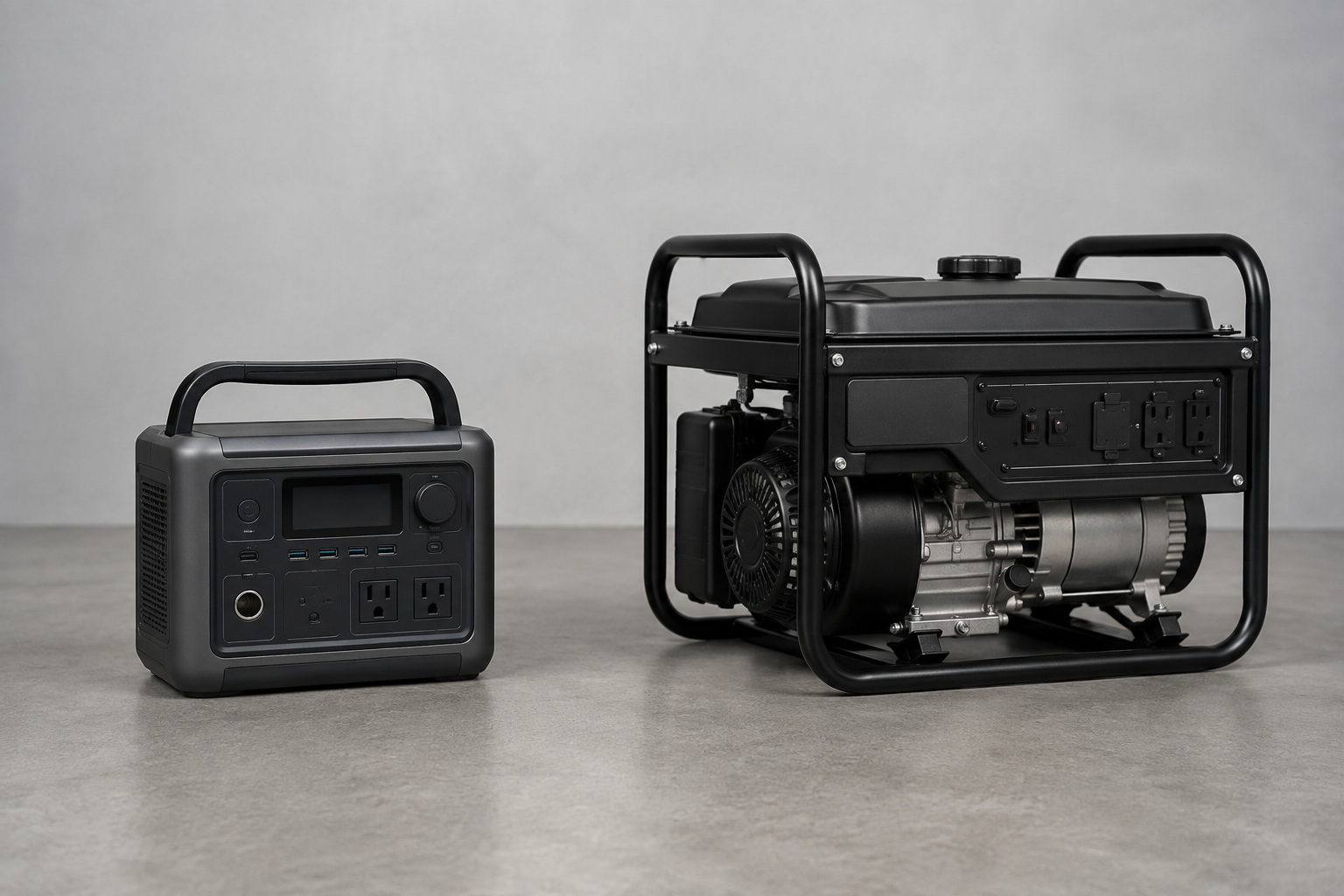
    A power station stores a limited amount of electricity in a rechargeable battery. A generator produces electricity as long as it has fuel and can continue operating safely. One is quiet and practical indoors. The other usually provides more power and can operate much longer.

    The right choice depends less on which product has the most impressive specifications and more on what your household actually needs to run, where you can safely operate the equipment and how long you expect to be without power.

    The Short Answer

    A portable power station is usually the better fit when you need quiet indoor power for phones, lights, internet equipment, a television, a compatible CPAP machine or other relatively modest loads. It requires little routine maintenance and produces no exhaust while supplying power.

    A portable generator is usually the better fit when you need to operate larger loads, support several appliances or continue producing electricity through a long outage. It requires fuel, maintenance and a safe outdoor operating location.

    Some households do not need to choose only one. A power station can handle quiet overnight loads while a generator runs outdoors during selected periods to operate larger equipment and, when the manufacturers’ instructions permit it, recharge batteries. That approach costs more, but it can reduce noise, fuel use and unnecessary generator runtime.

    Before buying either one, identify the equipment that truly matters during an outage. The best backup-power system is the one that can safely support those priorities—not the one with the longest feature list.

    What Is a Portable Power Station?

    A portable power station combines a rechargeable battery, an inverter and several types of electrical outlets in one movable unit. The battery stores direct-current electricity. The inverter converts that stored energy into alternating current for common household devices.

    Power stations may be recharged from a household outlet, a vehicle connection or compatible solar panels. Charging options and speeds vary substantially, so the manufacturer’s specifications matter.

    You may also see these products called “solar generators.” That name can be misleading. The unit does not create electricity from sunlight by itself. It is a battery power station that can be recharged from compatible solar panels.

    What Is a Portable Generator?

    A portable generator uses an engine and fuel—commonly gasoline, propane or both—to produce electricity. Unlike a battery, it does not begin with a fixed supply of stored electrical energy. It can continue producing power as long as fuel remains available and the generator is operated, refueled and maintained correctly.

    This article compares portable generators with portable power stations. A permanently installed standby generator is a different category with different installation, fuel and cost considerations.

    The Two Numbers That Matter Most

    Backup-power advertisements include many specifications, but two numbers answer most of the important questions.

    Watts tell you how much power the unit can deliver at one time. The combined running wattage of the equipment you connect must remain within the unit’s continuous output rating. Motors and compressors may also require a brief surge of additional power when they start.

    Watt-hours tell you how much energy a battery power station can store. A 1,000-watt-hour power station does not necessarily run a 1,000-watt appliance for exactly one hour. The inverter and the power station itself consume some energy, and real appliance use varies. Treat the published capacity as a starting point rather than a guaranteed runtime.

    Generators are normally compared by running watts and starting or surge watts. Their operating time depends on the load, fuel type, tank size and manufacturer’s rated runtime. Refueling can extend operation; a battery power station must be recharged from another available energy source.

    Portable Power Station Advantages

    No combustion exhaust while supplying power

    A power station does not burn fuel or produce carbon monoxide while discharging. That makes it practical for bedrooms, apartments and other occupied spaces. The charging source is a separate issue: never bring a fuel-powered generator indoors to recharge it.

    Quiet operation

    Power stations make little noise beyond possible cooling-fan operation. That matters at night, around children, in apartments and when powering medical or communications equipment.

    Simple operation and limited routine maintenance

    There is no engine oil, carburetor or stored gasoline to manage. The unit still needs inspection, periodic charging and storage within the temperature and charge-range instructions supplied by its manufacturer.

    Immediate power for smaller loads

    A charged power station can be brought inside and connected without starting an engine or handling fuel. It is particularly useful for lights, phones, routers, laptops, radios and other modest loads.

    Portable Power Station Limitations

    The stored energy is finite

    Once the battery is depleted, the power station is no longer a power source until it can be recharged. Solar panels may help, but output depends on panel capacity, sunlight, weather, placement and charging limits. Solar charging should not be treated as unlimited or guaranteed.

    Large loads use capacity quickly

    Heating appliances, cooking appliances, pumps and other high-wattage equipment can overwhelm a smaller unit or drain even a substantial battery quickly. Some devices may also exceed the inverter’s starting-surge capability.

    Battery condition matters

    Rechargeable batteries gradually lose capacity with age and use. Extreme temperatures, improper storage and unsuitable charging practices can also affect performance and safety. Follow the manufacturer’s charging and storage instructions, use the correct charger and check for applicable recalls.

    Portable Generator Advantages

    Higher output is commonly available

    Portable generators are available with enough output for refrigerators, freezers, pumps and combinations of household loads that would be difficult or expensive to support with a modest power station.

    Longer operation is possible

    A generator can continue producing electricity when additional fuel is available. That makes it useful during outages lasting several days, particularly when solar charging is unreliable or utility power is unavailable for recharging batteries.

    Fuel can restore capacity quickly

    Adding fuel after the generator has been shut down and allowed to cool takes far less time than fully charging a large battery. The tradeoff is that fuel must be purchased, transported, stored and rotated safely.

    Portable Generator Limitations

    It must remain outdoors

    A fuel-powered generator produces carbon monoxide. It must never be operated inside a home, garage, basement, crawlspace, shed, porch or carport. Current CPSC and Ready.gov guidance says to operate portable generators outside only, at least 20 feet from the home, with exhaust directed away from the building and its doors, windows and vents.

    Noise and fuel are ongoing concerns

    Generators create engine noise and require a dependable fuel supply. Fuel may be difficult to obtain during a widespread outage, and local rules may limit how much can be stored or where it may be kept.

    Maintenance is required

    Engines require inspection, oil service, periodic testing and proper storage. A generator that has been ignored for several years may not be ready when the power fails.

    Weather and electrical connections require planning

    A generator must remain outdoors but also be protected from rain and wet conditions according to its manufacturer’s instructions. Equipment should be connected with properly rated grounded extension cords, or the generator should connect to household circuits through appropriate transfer equipment installed by a qualified electrician. Never improvise a connection that sends generator power backward through household wiring.

    Which One Fits Your Household?

    Choose a portable power station when:

    • Your priorities are phones, lights, internet equipment, laptops, radios or similar smaller loads.
    • You need quiet power inside the home, particularly overnight.
    • You live in an apartment or another property without a safe generator location at least 20 feet from the building.
    • You want minimal routine maintenance and can keep the battery charged.
    • Your expected outages are usually brief, or you have a realistic way to recharge the unit.

    Choose a portable generator when:

    • You need to support larger loads or several appliances at the same time.
    • You may need power for days rather than hours.
    • You have a safe outdoor operating location and a plan for wet weather.
    • You can store, rotate and obtain the required fuel safely.
    • You are willing to test and maintain the engine before an emergency.

    Consider both when:

    • You want quiet battery power overnight but need generator capacity during the day.
    • You want to run the generator periodically rather than continuously.
    • You need a generator for large loads and a separate indoor source for communications, lighting or medical equipment.
    • You can afford the added cost and will maintain both systems.

    Four Common Household Scenarios

    1. Phones, lights and internet during short outages

    A modest power station may be the simplest solution. These loads are relatively small, and quiet indoor operation is valuable. Confirm the combined wattage and estimate how many hours the stored watt-hours can realistically support.

    2. Refrigerator, freezer and basic electronics

    Either category may work. The decision depends on appliance starting requirements, the battery’s usable capacity, outage duration and your recharging or refueling plan. Do not assume a refrigerator’s label tells the entire runtime story because compressors cycle rather than run continuously.

    3. Well pump, sump pump or several larger loads

    A generator will often be the more practical category, but pump starting requirements and electrical connections must be confirmed. Do not purchase from a rough internet estimate. Check the equipment nameplate, manuals and, when household wiring is involved, consult a qualified electrician.

    4. Electrically powered medical equipment

    Quiet indoor battery power may be useful, but this is not an ordinary appliance calculation. Ask the medical-equipment supplier and healthcare provider what backup source is compatible, how long backup power must last and what to do if power cannot be maintained. Ready.gov specifically advises households to develop a power-outage plan for electrically powered medical devices and refrigerated medicines.

    Do Not Overlook Recharging and Refueling

    Many comparisons stop after purchase price and output. During an extended outage, the more important question may be how the equipment receives its next supply of energy.

    A power station may recharge quickly from the grid—but the grid is unavailable during the outage. A vehicle may provide limited charging, and solar may help when conditions and system size are adequate. Review the unit’s actual input limits rather than assuming that adding more panels will always make it charge faster.

    A generator can be refueled, but only if suitable fuel is available. Gas stations may be closed or unable to pump fuel without electricity. Stored gasoline can deteriorate, and every fuel has storage and handling requirements.

    Your backup-power plan needs an energy-supply plan. Buying the machine is only the first step.

    A Safety Difference That Should Decide the Purchase

    Do not buy a fuel-powered generator unless your property provides a genuinely safe place to operate it. “Outside” does not mean in a garage with the door open, beneath a porch, inside a shed or beside an open window. If you cannot maintain the recommended separation from the building, a portable generator may not be a safe option for your home.

    Install working carbon monoxide alarms with battery backup on every level of the home and outside sleeping areas. Allow a generator to cool before refueling. Keep it dry without enclosing it, follow its manual and never connect it directly to household wiring unless proper transfer equipment has been installed by a qualified electrician.

    Power stations avoid carbon monoxide while supplying power, but they are not risk-free. Lithium-ion batteries can overheat or ignite if damaged, defective or charged improperly. Use the supplied or approved charging equipment, follow storage-temperature instructions, stop using a unit that is damaged, swollen, unusually hot or subject to a safety recall, and follow the manufacturer’s directions for inspection and disposal.

    How to Make the Decision Before You Shop

    1. List only the equipment you truly need during an outage.
    2. Record each item’s running wattage and any starting or surge requirement.
    3. Decide how many hours per day each item must operate.
    4. Confirm that your property has a safe generator location.
    5. Write down how you would recharge a battery or obtain and store generator fuel during a prolonged outage.

    If your list consists mainly of electronics, lights and modest overnight loads, begin by evaluating power stations. If it includes pumps, several major appliances or extended operation, begin by evaluating generators. If the list contains both kinds of needs, a combined system may be more practical than oversizing either device to do everything.

    Do not use advertised output alone to make the purchase. Confirm the continuous output, surge capability, stored energy or fuel runtime, outlet types, charging inputs and operating instructions against your actual equipment.

    Portable Generators for Home Outages: Our Picks by Power Need

    Best Portable Power Stations for Home Power Outages

    The Bottom Line

    A portable power station is not simply a smaller generator, and a generator is not automatically the better emergency tool because it produces more power.

    Power stations are strongest when quiet indoor operation, simple use and smaller essential loads matter most. Generators are strongest when higher output and long-duration operation matter most and the household can meet the fuel, maintenance and outdoor-safety requirements.

    Start with the loads, the outage duration and the operating environment. Once those are clear, the right category usually becomes much easier to identify.

    Sources

  • Why Your Generator Won’t Start After Sitting—and How to Prevent It

    Why Your Generator Won’t Start After Sitting—and How to Prevent It

    A portable generator can sit quietly in a garage or shed for years and still look ready. The fuel tank may not be empty. The oil may still be in the engine. Nothing appears broken.

    Then a hurricane approaches, the power goes out or you finally decide to test it—and the engine will not start.

    That is exactly what happened to me.

    I bought my generator in a hurry while preparing for a major hurricane. Once the immediate threat passed, I stored it with gasoline still in the tank. I did not add fuel stabilizer, drain the fuel system or take the generator out for periodic testing. It sat for a couple of years.

    Before another hurricane, I pulled it out and tested it while I still had time to deal with a problem. The old fuel had to be drained, and I eventually removed the carburetor and cleaned its clogged jets and fuel passages before the generator would run properly again.

    The neglect caused the problem. Testing before the storm kept it from becoming an emergency.

    If your generator has been sitting and will not start, do not assume it is ruined—and do not begin by taking the carburetor apart. Work from the simplest checks toward the more involved possibilities. Old fuel is a frequent cause, but the problem may be as simple as a closed fuel valve, the wrong choke position, low oil, a loose spark-plug connection or a discharged starting battery.

    Safety Comes Before Troubleshooting

    Safety First

    Do all troubleshooting outdoors, at least 20 feet from the house, with the exhaust pointed away from the home and other occupied buildings. Never start or run a portable generator in a garage, shed, basement, carport, porch or other enclosed or partially enclosed space.

    Carbon monoxide is colorless and odorless. Opening a garage door does not make generator operation inside the garage safe.

    Before working around gasoline:

    • Turn the generator off.
    • Let the engine cool completely.
    • Keep cigarettes, flames, sparks and other ignition sources away.
    • Work in a well-ventilated outdoor area.
    • Wipe up spilled fuel and allow vapors to disperse before trying to start the engine.
    • Keep the generator level so gasoline and oil do not spill.
    • Disconnect the spark-plug wire before performing service when the owner’s manual directs you to do so.

    Read the owner’s manual for your specific generator before draining fuel, removing components or performing maintenance. Control positions, fuel-draining procedures, oil requirements and service limits vary by model.

    Do not bypass a low-oil sensor, carbon-monoxide shutoff or any other safety system simply to make the engine run. Stop if you find damaged wiring, a cracked fuel line, a persistent fuel leak or anything else you cannot address confidently.

    Start With the Simple Checks

    A generator that has been sitting may have more than one problem. Begin with the starting procedure in the owner’s manual and confirm the basics before blaming the carburetor.

    1. Remove every electrical load

    Unplug extension cords, appliances and transfer equipment before starting the generator unless the owner’s manual says otherwise. A portable generator should normally be started without a connected load.

    2. Confirm the controls

    Make sure the engine switch is on, the fuel valve is open and any fuel-cap vent is in the operating position. Set the choke exactly as the manual specifies for a cold or warm engine.

    It is easy to overlook one control when a storm is approaching and you are working from memory.

    3. Check the fuel

    Verify that the tank contains the fuel type required by the manufacturer. If the gasoline has been sitting for months—or you do not know how old it is—do not assume it is usable merely because it still smells like gasoline.

    Do not try to rescue years-old gasoline by pouring fresh fuel or stabilizer on top of it. Fuel stabilizer can slow deterioration when added to fresh gasoline, but it cannot restore gasoline that has already degraded.

    4. Check the oil

    Place the generator on a level surface and verify the oil level using the procedure in the owner’s manual. Many portable generators have a low-oil shutdown system that prevents the engine from starting or stops it during operation when the oil level is too low.

    Use the specified oil and do not overfill the crankcase.

    5. Check the starting battery

    If the generator has electric start, inspect the battery and its connections. A battery can discharge while the generator sits, especially if the manual’s storage-charging instructions were not followed.

    A dead electric-start battery does not necessarily mean the engine has failed. Some models may also have a recoil starter, but follow the manufacturer’s instructions rather than assuming the two starting methods work the same way.

    6. Inspect the spark plug and air filter

    Make sure the spark-plug wire is firmly connected. If the manual permits homeowner inspection, remove and examine the spark plug for heavy deposits, damage or an incorrect gap. Replace it with the specified plug when necessary.

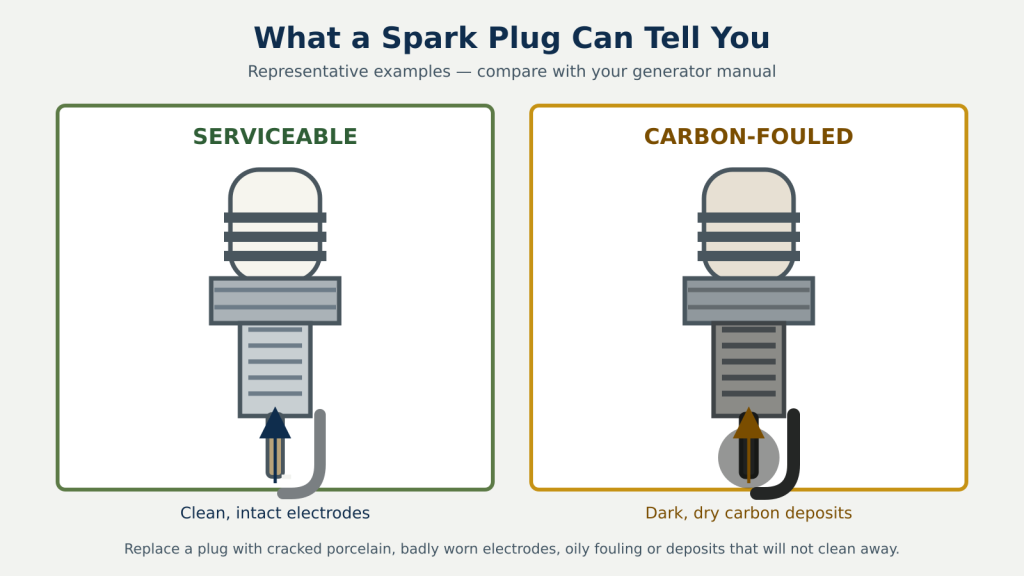
    How to Inspect, Clean and Gap a Spark Plug

    A spark plug may show dark, dry carbon deposits and still be serviceable after cleaning. Replace it instead if the porcelain is cracked, the electrodes are badly worn or burned, it has oily contamination, or stubborn deposits cannot be removed.

    Side-by-side illustration of a serviceable generator spark plug and a carbon-fouled spark plug.
    • Clean around the plug before removing it so debris cannot fall into the cylinder.
    • Remove the plug with the correct spark-plug socket.
    • Remove light deposits with a small wire brush and approved spray-on spark-plug cleaner.
    • Do not use abrasive blasting.
    • Replace the plug if the porcelain or electrodes are damaged or the deposits cannot be removed.

    The correct spark-plug gap varies by engine. Find the required measurement in the generator’s owner’s manual before checking or adjusting it.

    To check the gap with a feeler gauge:

    • Select the blade or combined blades that match the specified gap.
    • Slide the gauge between the center electrode and the curved ground electrode.
    • A correctly sized gauge should pass through with slight resistance.
    • If adjustment is permitted, bend only the curved ground electrode.
    • Do not pry against the center electrode or porcelain.
    • Measure again after every adjustment.

    When reinstalling the plug, start the threads by hand to reduce the risk of cross-threading. Tighten it exactly as the manufacturer directs, then reconnect the spark-plug lead.

    Inspect the air filter for dirt, deterioration, oil saturation or obstruction. Clean or replace it only according to the model’s instructions.

    Why Old Gasoline Causes So Many Starting Problems

    Gasoline changes during storage. It oxidizes and loses volatility, and it can leave gum or varnish-like deposits inside the fuel system. The small amount of fuel sitting in a carburetor can deteriorate faster than the larger amount in the tank.

    Those deposits can restrict the carburetor’s tiny jets and fuel passages. The float or needle may also stick. The engine then receives too little fuel, too much fuel or an improper mixture of fuel and air.

    Possible fuel-system symptoms include:

    • The engine will not start.
    • The engine starts briefly and dies.
    • The engine runs only with the choke partly or fully engaged.
    • The engine surges or runs unevenly.
    • Fuel does not appear to reach the carburetor.
    • Gasoline leaks from the carburetor or enters the engine oil.

    Those symptoms can have other causes, so treat them as clues rather than a diagnosis.

    What to Do With Old Fuel

    Use the fuel-draining procedure in the owner’s manual. Depending on the generator, that may involve the tank, the carburetor bowl or both.

    Drain gasoline only into an approved fuel container. Never pour unwanted gasoline onto the ground, into a drain, into a storm sewer or into household plumbing. Contact your local household hazardous-waste program for disposal instructions.

    Once the old fuel has been removed, inspect the drained gasoline and the generator’s fuel system for water, rust, debris or damaged components. Add only fresh fuel that meets the manufacturer’s requirements.

    If fresh fuel and the correct starting procedure solve the problem, do not stop there. Watch for leaks, unstable running or an inability to carry a normal load. A generator that starts but runs poorly is not yet ready for an outage.

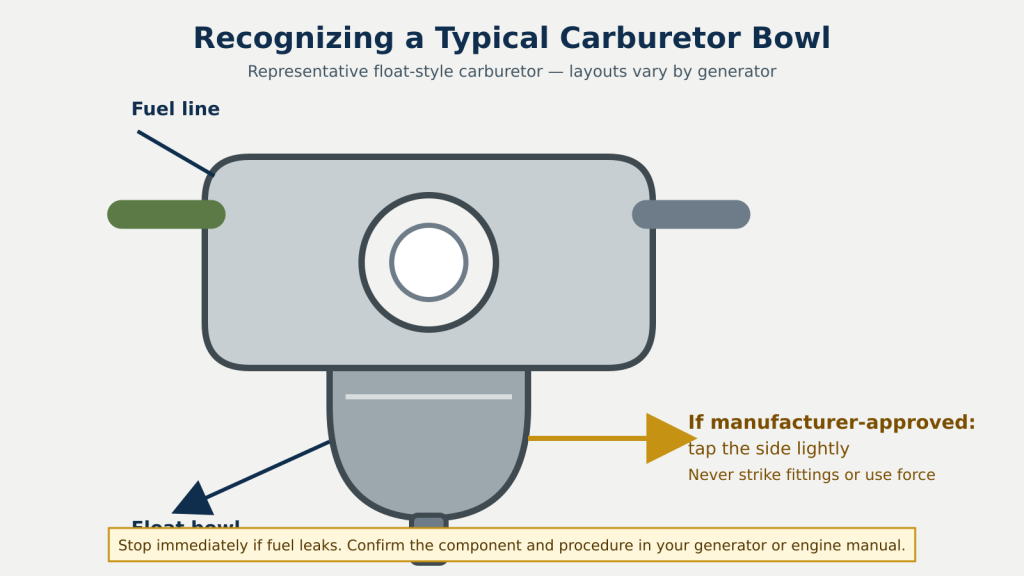
    Can Tapping the Carburetor Help?

    Sometimes fuel is not flowing because the carburetor float or needle is stuck. Briggs & Stratton includes lightly tapping the side of a carburetor among its troubleshooting suggestions for some small engines when fuel is not reaching the engine.

    Labeled illustration showing the float bowl on a representative small-engine carburetor.

    That does not make it a universal generator repair.

    This is a limited troubleshooting measure—not a cure for stale fuel, clogged jets, corrosion or damaged parts. If it works, the generator still needs to be inspected and tested. If fuel begins leaking, turn the fuel valve off, move away from ignition sources and correct the leak before attempting another start.

    Before You Follow a Repair Video

    A good video can make carburetor removal, linkage placement and reassembly much easier to understand than written instructions alone. YouTube can be useful, but the video must match your equipment.

    Find the generator’s model and serial-number label before searching. Also identify the engine model when it is listed separately. Two generators with similar names or wattage ratings may use different engines, carburetors, control layouts and service procedures.

    Search using the exact manufacturer and model number followed by the repair:

    [manufacturer] [model number] carburetor cleaning

    Before following a video:

    • Start with the generator or engine manufacturer’s official channel when one is available.
    • Confirm that the generator or engine shown matches yours.
    • Compare the procedure with the owner’s or service manual.
    • Watch the entire video before removing anything.
    • Photograph hoses, springs and linkages before disconnecting them.
    • Avoid instructions that bypass sensors, alter factory adjustments or dismiss fuel-leak precautions.
    • Stop if the video and your equipment do not match.

    Manufacturer videos are generally the better source for specifications, controls, maintenance procedures and safety requirements. Independent repair videos can be helpful because they often show real disassembly and common problems, but they require more judgment.

    Champion Power Equipment’s official carburetor-cleaning video is a useful example of the detail a manufacturer video can provide. NGK’s official spark-plug gap video demonstrates the general measuring and adjustment principle. Neither replaces the specifications or procedure for your generator.

    When Carburetor Cleaning Becomes the Next Step

    If the controls are correct, the oil level is correct, the ignition and air-filter checks do not reveal the problem, old gasoline has been removed and fresh fuel still does not reach the engine properly, the carburetor may need cleaning or service.

    This is where my own generator repair ended up.

    Carburetor cleaning can be a manageable job for someone who is comfortable working on small engines, but it is not identical on every generator. Linkages, gaskets, drain screws, jets, adjustment settings and replacement parts vary.

    At a minimum, the work may involve:

    • Turning off and safely controlling the fuel supply
    • Disconnecting the spark-plug wire
    • Removing the air-cleaner assembly
    • Documenting the position of hoses, springs and linkages
    • Removing the carburetor without bending or damaging the linkage
    • Disassembling only the components permitted by the service information
    • Cleaning jets and fuel passages without enlarging calibrated openings
    • Inspecting the float, needle, bowl, seals and gaskets
    • Reassembling the carburetor exactly as designed
    • Checking carefully for fuel leaks before starting the engine

    Do not force wire, drill bits or other hard objects through a carburetor jet. Enlarging or damaging a calibrated passage can change the fuel mixture and create another problem.

    Stop and use a qualified small-engine technician if you do not have model-specific instructions, cannot control the fuel safely, find corrosion or damaged parts, are uncertain about linkages or adjustments, or see any leak after reassembly.

    In some cases, replacing the carburetor or having it professionally serviced may be more practical than cleaning it repeatedly.

    When the Generator Still Will Not Start

    A generator that still will not start after the basic fuel, oil, control, spark-plug and air-filter checks may have a blocked fuel line, damaged ignition component, compression problem, electrical fault or another model-specific condition.

    Professional service is the appropriate next step when:

    • Fuel leaks persist.
    • The engine has little or no compression.
    • Wiring or ignition components are damaged.
    • The recoil starter or electric starter is not operating correctly.
    • The engine starts but surges, stalls or produces abnormal smoke.
    • The generator engine runs but electrical output is absent or unstable.
    • A safety-shutdown indicator or fault code remains active.
    • The repair exceeds your tools, information or experience.

    A successful start is not the only standard. The generator must run safely and supply stable power under an appropriate load before you depend on it.

    How to Prevent the Problem From Happening Again

    There is no single fuel-storage rule that fits every generator and every storage period.

    Honda provides different fuel procedures for short, medium and long storage periods on some models. Generac recommends treating fuel that will sit even for shorter periods and draining the fuel tank and running the carburetor dry before storage longer than 30 days on many portable models. Other manufacturers and models may specify different steps.

    Your owner’s manual is the authority for your machine.

    Depending on the model and expected storage time, the correct procedure may include:

    • Adding the specified amount of fuel stabilizer to fresh gasoline
    • Running the engine long enough for treated fuel to reach the carburetor
    • Closing the fuel valve and running the carburetor dry
    • Draining the carburetor bowl
    • Draining both the tank and carburetor for long-term storage
    • Charging or removing the electric-start battery
    • Changing or checking the oil
    • Storing the generator upright in a dry, protected location

    Never assume that fuel stabilizer makes gasoline permanent. Date stored fuel, follow the stabilizer manufacturer’s directions and replace it within the period permitted by the generator and fuel-treatment manufacturers.

    Build a Generator Readiness Routine

    The best time to discover a starting problem is when the weather is calm and repair shops are not overwhelmed.

    After each use

    • Inspect the generator for leaks, damage and loose connections.
    • Record the operating hours.
    • Check the maintenance schedule.
    • Prepare the fuel system for the expected storage period.
    • Store cords and necessary accessories where they can be found.

    During storage

    • Follow the manufacturer’s exercise or test interval.
    • Check an electric-start battery as directed.
    • Inspect the storage area for moisture, pests, corrosion or fuel odor.
    • Keep the owner’s manual with the generator.
    • Record each test and the next scheduled check.

    Before hurricane or severe-weather season

    • Move the generator to its safe outdoor operating location.
    • Inspect the fuel system, oil, air filter, spark plug and battery.
    • Start it using fresh, approved fuel.
    • Let it warm up according to the manual.
    • Test it under an appropriate load if the manufacturer permits.
    • Confirm that required cords, inlet equipment or transfer equipment are ready.
    • Test the home’s carbon-monoxide alarms.
    • Correct problems before a storm is approaching.

    A maintenance record does not need to be complicated. Record the date, operating hours, fuel treatment or draining performed, maintenance completed, test load and anything that needs attention.

    The Most Important Step: Test It Early

    My generator problem was caused by neglect. But the most important thing I did was test the generator before the next hurricane arrived.

    That created time to drain the old fuel, clean the carburetor and confirm that the generator worked again. Waiting until the power failed would have turned a repairable maintenance problem into an emergency.

    If your generator has been sitting, find the owner’s manual and test it now—not when the forecast changes and not after the lights go out.

    Buying the generator was only the beginning. Maintaining it, testing it and knowing that it will operate safely are what make it part of a real preparedness plan.

    Sources

    Consumer Product Safety Commission — Portable Generator Safety

    Honda Power Equipment — Generator Fuel Recommendations

    Generac — Portable Generator Troubleshooting Guide

    Generac — Preparing a Portable Generator for Storage

    Briggs & Stratton — Small Engine Fuel Recommendations

    Briggs & Stratton — Carburetor Troubleshooting and Cleaning

    EPA — Household Hazardous Waste

    Briggs & Stratton — Changing and Gapping Spark Plugs

    Generac — Inspecting a Portable Generator Spark Plug

    Champion Power Equipment — Official Carburetor-Cleaning Video

    NGK Spark Plugs — Official Spark-Plug Gap Video

  • What to Do When the Power Goes Out: A Homeowner’s Complete Guide

    What to Do When the Power Goes Out: A Homeowner’s Complete Guide

    When the power goes out, you don’t need to solve every problem at once.

    Start with the people in your home, check for immediate hazards, find out what happened, and protect the things that actually matter. A short outage may require little more than patience. An outage that lasts through the night or into the next day requires a different plan.

    The key is knowing what matters now—and what matters next.


    Power Just Went Out? Do These Things First

    If the lights just went out, start here.

    1. Check the People First

    Before worrying about the refrigerator, generator, or Wi-Fi, make sure everyone in the household is safe.

    Pay particular attention to anyone who depends on electricity for:

    • Medical equipment
    • Refrigerated medication
    • Mobility or accessibility equipment
    • Safe heating or cooling
    • Other essential powered devices

    If losing electricity creates an immediate medical or safety problem, address that first. Follow the backup instructions provided by the person’s healthcare provider, device manufacturer, or medication provider.

    The FDA recommends that people who rely on medical devices understand what happens if power is lost, what backup supplies they need, and whether devices, supplies, or medicines have special temperature requirements.

    2. Check for Immediate Hazards

    Look and listen before you start troubleshooting.

    Watch for:

    • Smoke or fire
    • A burning electrical smell
    • Sparking or damaged electrical equipment
    • Downed power lines
    • Flooding or water around electrical equipment
    • A carbon monoxide alarm

    If your home relies on a sump pump and the outage occurs during heavy rain or flooding, check that risk immediately. A sump pump that has stopped operating can turn a power outage into a flooding problem quickly.

    Stay away from fallen or damaged power lines and anything they may be touching.

    If electrical equipment or the breaker panel is wet, damaged, or surrounded by water, don’t attempt to operate it. Never enter standing water to reach electrical equipment.

    3. Determine Whether the Outage Is Just Your House

    Look outside. Do neighboring homes have power? Are streetlights on?

    Check your electric utility’s outage information if phone service is available.

    If the outage appears limited to your home, and your electrical panel and the surrounding area are dry and undamaged, check for an obviously tripped circuit breaker if you’re comfortable doing so.

    If a breaker trips again after being reset, stop. Repeatedly resetting it doesn’t fix the underlying problem.

    Don’t remove panel covers or attempt electrical repairs.

    4. Get Safe Lighting

    Use flashlights, battery-powered lanterns, or rechargeable lighting if available.

    Avoid candles when practical. Open flames add a fire hazard at exactly the time when people are moving around with limited visibility.

    5. Keep the Refrigerator and Freezer Closed

    Keep both doors closed. Don’t start moving food yet.

    An unopened refrigerator can keep food cold for about four hours. A full freezer can maintain its temperature for about 48 hours, while a half-full freezer generally provides about 24 hours, as long as the door stays closed.

    Every unnecessary opening gives away some of that time.

    6. Turn Off or Disconnect Sensitive Equipment

    Turn off or disconnect sensitive electronics and appliances when practical. Leave one light switched on so you’ll know when service returns.

    Don’t handle equipment that is wet or damaged.

    7. Find Out What Is Happening

    Check reliable sources such as:

    • Your electric utility
    • Local emergency-management alerts
    • Local government information
    • National Weather Service information when weather is involved

    A restoration time is useful, but remember: it’s an estimate.

    Make decisions based on how long your household can safely manage without electricity—not solely on when the utility expects the lights to come back on.

    If everyone is safe and you’ve completed these first steps, you have time to make the next decisions.


    The First Hour: Understand What You’re Dealing With

    Not every outage deserves the same response.

    A problem affecting one house is different from a neighborhood outage. A neighborhood outage is different from widespread storm damage that may take days to repair.

    Find out what you can from your utility and local authorities.

    If your utility hasn’t already recorded the outage, report it through its outage line, app, website, or other reporting system. Don’t assume someone else has already done it.

    If severe weather is involved, look beyond the restoration estimate. More storms, extreme temperatures, flooding, ice, or high winds can affect not only the power but your ability to get fuel, food, or other supplies later.

    Preserve Your Communications

    Your phone may become one of your most useful pieces of emergency equipment.

    Use it accordingly.

    Limit unnecessary streaming and other battery-heavy activity. Use low-power settings when appropriate, and don’t burn through your power banks simply because they’re available.

    You don’t need every device in the house at 100 percent.

    You need a reliable way to receive information and communicate if the outage lasts longer than expected.


    Decide What Actually Needs Electricity

    One of the easiest mistakes during an outage is trying to power everything because everything normally uses electricity.

    Instead, ask:

    What actually needs power right now?

    Think in three groups.

    Critical

    Things whose loss could threaten someone’s health, safety, or the home itself.

    Depending on your household, that might include:

    • Essential medical equipment
    • A sump pump during flooding
    • A well pump when water is needed
    • Other household-specific safety equipment

    Important

    Things that make an extended outage manageable and may become essential over time:

    • Refrigerator or freezer
    • Phones and communications
    • Selected lighting
    • Fans during hot weather
    • Other household-specific needs

    Convenience

    Things you’d prefer to have but can safely live without for a while.

    This distinction matters because backup power is limited.

    You don’t need to replace the electrical grid. You need to protect the functions that matter.


    Decide Whether You Need Backup Power

    Don’t start a generator simply because the electricity went out.

    Ask:

    What problem am I trying to solve?

    Charging phones and running a few lights is one problem.

    Keeping a refrigerator, well pump, sump pump, or medical equipment operating is another.

    Start with what matters most and work from there. Don’t consume limited fuel or battery capacity powering things you don’t really need.

    Choosing between a generator and a portable power station, calculating generator size, and determining how long different equipment can run are separate subjects. During the outage, your first job is simpler:

    Decide what needs power and what can wait.

    If you don’t have a generator or portable power station, that’s fine. Skip the backup-power section below and continue with food, temperature, water, and extended-outage planning.


    If You Use a Portable Generator, Keep It Safe

    A portable generator can make an extended outage much easier to manage. Used incorrectly, it can also create serious hazards.

    Keep It Outside—and Away From the House

    Never operate a portable generator inside a house, garage, basement, carport, porch, or other enclosed or partially enclosed space—even with doors or windows open.

    Generator exhaust contains carbon monoxide, an odorless and colorless gas that can kill without warning.

    Current CPSC guidance says to operate portable generators outdoors at least 20 feet from homes and buildings, with the exhaust directed away from windows, doors, and vents.

    Keep working carbon monoxide detectors inside the home.

    CPSC portable-generator safety guidance

    What If the Generator Cord Won’t Reach?

    This is a real-world problem. The cord that came with your generator—or the cord you already own—may not be long enough to reach from a safe generator location.

    Don’t move the generator closer to the house just because the cord is too short.

    If you’re powering appliances directly, use appropriately rated extension cords long enough to maintain safe generator placement. CDC specifically recommends having at least 20 feet of outdoor-rated extension cord available with a generator.

    If your generator connects to a permanently installed generator inlet or transfer/interlock system, don’t improvise an extension or adapter. Use a properly rated generator connection cable of the needed length that is compatible with your generator and installed system.

    Before the next outage, put the generator where you would safely operate it and make sure the connection equipment you own will actually reach.

    Keep It Dry

    A generator needs to remain outside, but it also needs protection from rain and standing water.

    Don’t solve the rain problem by moving it into a garage, enclosed porch, or similar space.

    Follow the generator manufacturer’s instructions for operating in wet weather. CPSC notes that manufacturer instructions may call for an appropriate noncombustible generator tent or may advise waiting until the rain or snow passes.

    Don’t Use Fuel-Burning Equipment Indoors

    Don’t use a gas oven to heat the house. Don’t bring grills, camp stoves, charcoal burners, or similar equipment indoors.

    These devices can produce carbon monoxide. If a CO alarm sounds, get everyone outside to fresh air and seek emergency help.


    What About a “Suicide Cord”?

    This comes up in the real world, so it deserves a direct answer.

    A male-to-male extension cord—sometimes called a “suicide cord”—should not be used to feed generator power into a household outlet.

    The answer is no—even if you plan to switch off the main breaker first.

    The exposed male prongs can become energized, creating an electrocution hazard. Improper backfeeding can also create electrical and fire hazards and potentially endanger utility workers.

    The problem isn’t simply that there is a more expensive or more code-compliant way to connect a generator. The improvised connection introduces hazards that aren’t eliminated by following a particular breaker sequence.

    No Generator Inlet? You Still Have an Option

    You don’t need to power the house to use your generator.

    Plug the appliances you actually need directly into the generator with appropriate extension cords.

    Start with the essentials. That might mean the refrigerator or freezer, a light, and a way to charge phones.

    Add other loads only when needed and only within the generator’s capacity.

    It’s less convenient than powering household circuits, but it’s practical—and it avoids improvising a dangerous connection to the home’s wiring. CDC specifically recommends individual heavy-duty, outdoor-rated extension cords for appliances powered directly by a generator.

    Choosing an Extension Cord Without an Engineering Degree

    Don’t choose by color.

    Green, orange, and yellow are common extension-cord colors, but the color doesn’t tell you how much electrical load the cord can safely carry.

    Look at the writing on the cord itself. You’ll usually see a wire size such as:

    16/3 — 14/3 — 12/3 — 10/3

    Here’s the part worth remembering:

    The smaller the first number, the heavier the wire.

    A 12/3 cord is heavier than a 16/3 cord. A 10/3 is heavier still.

    For a small load such as a lamp or phone charger, a lighter properly rated outdoor cord may be enough. For a refrigerator, freezer, or other larger load, use a heavier cord rated to handle the appliance.

    If you have two suitable cords and aren’t sure which to use, use the heavier one.

    Also:

    • Keep the cord run as short as practical
    • Don’t use damaged cords
    • Keep plugs and connections dry
    • Don’t pile several large loads onto one cord just because the plugs fit
    • Don’t exceed the generator’s capacity

    You don’t need to calculate voltage drop during a blackout. You need a sound, outdoor-rated cord that is rated for the appliance you’re powering.

    If you’re dealing with a particularly high-draw appliance, a very long cord run, or something you’re unsure about, check the appliance and cord ratings rather than guessing.

    For the future, if you want a portable generator to power household circuits, have appropriate generator connection equipment installed for your electrical system.

    Owning a generator and having a safe way to use its power are two different things.


    Protect Your Refrigerated and Frozen Food

    Food doesn’t become unsafe the moment the lights go out.

    Time and temperature matter.

    During the First Four Hours

    Keep the refrigerator closed.

    An unopened refrigerator should keep food cold for about four hours.

    For a short outage, don’t make the situation worse by repeatedly opening the door to check what’s inside.

    Preserve the cold you already have.

    After About Four Hours

    Now you need to pay closer attention.

    Don’t assume that everything suddenly becomes unsafe at the four-hour mark, and don’t simply start another countdown.

    Food safety depends on what the food is, the temperature it reached, and how long it remained there. Use current USDA/FoodSafety.gov guidance to decide what should be kept and what should be discarded.

    Don’t taste questionable food to decide whether it’s safe.

    The Freezer Gives You More Time

    With the door kept closed:

    • A full freezer can maintain temperature for about 48 hours
    • A half-full freezer can maintain temperature for about 24 hours

    Frozen food that still contains ice crystals or remains at 40°F or below may be safely refrozen, although the quality may change.

    When you’re uncertain, use current federal food-safety guidance rather than smell, appearance, or guesswork.

    FoodSafety.gov power-outage food guidance


    Watch the Temperature—and the People

    Sometimes electricity isn’t the real emergency.

    What happens because the electricity is gone is the emergency.

    During extreme heat, losing air conditioning can make the house unsafe. During severe cold, losing heat can do the same.

    Pay particular attention to people who are more vulnerable to temperature extremes.

    Don’t wait until everyone is miserable before considering alternatives.

    If the house can no longer provide a safe environment, moving temporarily to another safe location may be the better preparedness decision.


    Don’t Forget About Water

    A power outage does not automatically mean your tap water is unsafe.

    But electricity and water can be connected in ways that aren’t always obvious.

    Municipal Water

    Water service may continue normally during an outage.

    Pay attention to notices from your water utility or local authorities. If they issue a boil-water, conservation, or other advisory, follow it.

    Don’t assume the water is contaminated simply because the electricity is off—and don’t ignore an official advisory because the water still looks normal.

    Private Wells

    If your home depends on an electric well pump, losing electricity may also mean losing your normal water supply.

    That’s one reason stored emergency water matters even when the emergency itself isn’t a water emergency.

    Water storage and treatment deserve their own guide. For now, simply recognize whether your household’s water depends on electricity.


    If the Outage Lasts Overnight

    An overnight outage is a good time to reassess.

    Not because midnight creates a special safety threshold, but because your situation has changed.

    Before going to sleep, ask:

    • Is everyone safe?
    • Is the indoor temperature acceptable?
    • Are medical equipment and medications secure?
    • Do we have safe lighting available?
    • Are phones sufficiently charged?
    • What is the status of the refrigerator and freezer?
    • Do we have enough water?
    • How much generator fuel or battery capacity remains?
    • Has the restoration estimate changed?
    • Is the weather improving or getting worse?

    Before You Go to Sleep

    Take a few minutes to make sure:

    • Flashlights are easy to reach
    • Walkways are clear
    • Phones and essential communications are available
    • Carbon monoxide detectors are working
    • No unnecessary candles or open flames remain burning
    • Everyone knows what to do if conditions change

    If you’re using backup power, ask one more question:

    What actually needs to remain powered overnight?

    Don’t keep a generator running merely because you’ve been running it all day. Decide which loads truly need continuous power and whether the generator needs to operate overnight to support them.

    If it does need to continue operating, make sure it remains safely positioned and operated according to the manufacturer’s instructions.

    Don’t become so focused on maintaining power that you create a different hazard.


    If the Outage Extends Into the Next Day

    Don’t simply repeat yesterday’s plan.

    Reassess it.

    Ask one useful question:

    Are conditions improving, stable, or deteriorating?

    Then reconsider:

    People → Water → Food → Medication → Temperature → Fuel → Communications → Sanitation → Backup Power

    A household that managed the first six hours easily may face different problems after a full day.

    Fuel may be getting low. Food decisions may be changing. A home with a well may be short on water. Indoor temperatures may be moving in the wrong direction. Medical backup supplies may be running down.

    Preparedness means responding to the situation you actually have—not stubbornly following the plan you started with.


    Know When Staying Home Is No Longer the Best Plan

    Staying home isn’t always the goal.

    Consider moving to a safer location when:

    • Critical medical needs can no longer be supported
    • Indoor temperatures are becoming unsafe
    • Authorities order or recommend evacuation
    • Fire, flooding, electrical, or structural hazards develop
    • Essential water or sanitation can no longer be maintained
    • Someone in the household can no longer remain reasonably safe
    • Conditions are deteriorating faster than your available resources can support

    There isn’t a universal number of hours after which everyone should leave.

    One household may safely manage a long outage during mild weather. Another may need to relocate within a few hours because of medical needs or dangerous temperatures.

    Preparedness isn’t measured by how long you can stay in your house.

    Sometimes the prepared decision is leaving before conditions become dangerous.


    When the Power Comes Back

    The lights coming back on doesn’t mean you’re finished.

    Take a few minutes to return the household to normal.

    Check for Problems

    If the outage involved flooding, storm damage, burning odors, sparking, or damaged electrical equipment, don’t energize questionable equipment simply because utility power has returned.

    Wet or damaged electrical equipment may need professional inspection.

    Evaluate Your Food

    If the outage lasted long enough to affect refrigerated or frozen food, use the time-and-temperature guidance discussed earlier.

    Don’t rely on taste or appearance.

    Make Sure Important Systems Are Working

    Check the household systems that matter.

    Did the refrigerator restart? Is the well pump operating? Did heating or cooling return normally? Is medical equipment functioning properly?

    Don’t assume that every system returned to normal just because the lights came back on.

    Recharge What You Used

    Recharge the things you’ll depend on during the next outage:

    • Phones
    • Power banks
    • Flashlights and lanterns
    • Radios
    • Portable power stations
    • Medical-device backup batteries
    • Other rechargeable emergency equipment

    An emergency battery that goes back into the closet empty isn’t ready for the next emergency.

    Shut Down Backup Equipment Properly

    Follow the manufacturer’s instructions for shutting down your generator or other backup-power equipment.

    Maintenance and storage can come later. For now, shut it down correctly and make note of anything that needs attention.


    Before You Put Everything Away

    One of the most useful things you can do after an outage takes about ten minutes.

    Don’t rely on remembering the details six months from now.

    Look at what actually happened.

    The Ready Chateau 10-Minute Outage Review

    Ask:

    What couldn’t we find?

    Flashlights? Extension cords? Instructions? Something else?

    What didn’t work?

    Did the generator refuse to start? Did a flashlight fail? Was a power bank dead?

    What wasn’t charged?

    What did you expect to be ready but wasn’t?

    What did we run out of?

    Fuel? Batteries? Water? Ice? Medication? Easy-to-prepare food?

    What information didn’t we have?

    Utility information? Generator instructions? Medication guidance? Important phone numbers?

    What did we think was essential but barely use?

    Preparedness isn’t always about adding more things.

    What proved more important than expected?

    Maybe it was a battery fan, a lantern, a power bank, a cooler—or something unique to your household.

    What would have become a serious problem if the outage lasted another 24 hours?

    That may be the most useful question of all.

    Fix the Weaknesses While You Remember Them

    Don’t wait for the next storm forecast.

    Replace what failed.

    Recharge what was depleted.

    Repair what didn’t work.

    Restock what you used.

    Reorganize what you couldn’t find.

    Learn what you didn’t know.

    Test what you’re counting on next time.

    The outage just gave you a real-world test of your household preparedness.

    Use the results.


    The Bottom Line

    You don’t need to power everything in your house during an outage.

    You need to protect the people in it.

    Start with safety. Find reliable information. Protect essential functions. Use backup power carefully. Reassess as conditions change, and recognize when staying home is no longer the safest option.

    Then, when the lights come back on, don’t simply put everything away.

    Fix what didn’t work before the next outage.

    That’s how a household becomes better prepared—not by owning more equipment, but by understanding what it actually needs and keeping those resources ready.