
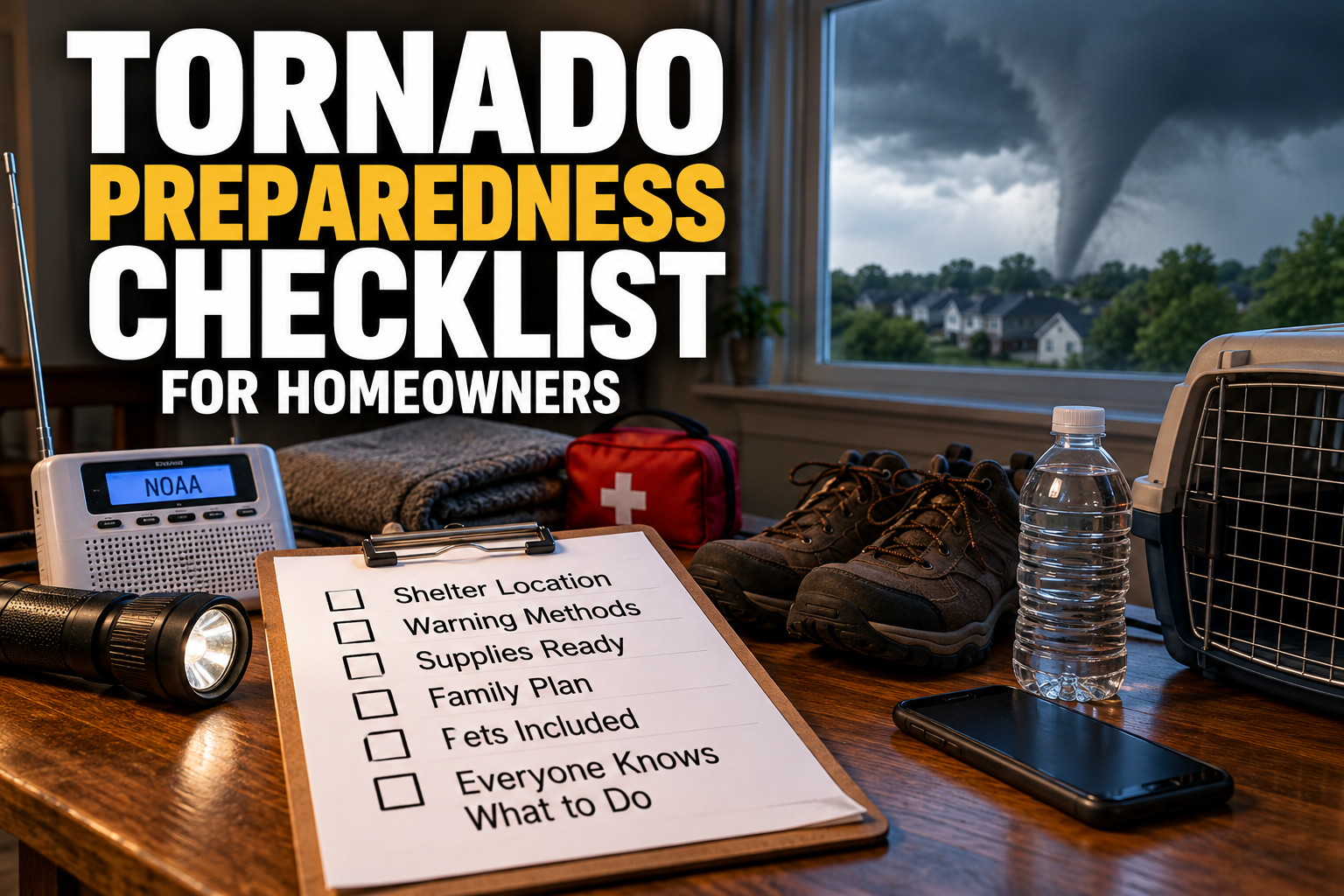
Tornado preparation does not need to be complicated.
The most important decisions should be made before a warning appears on your phone: where your family will shelter, how everyone will receive warnings, what you will take into the shelter, and what you will do if severe weather arrives overnight.
A tornado can develop quickly. Once a warning is issued, you may have only minutes—or less—to act. That is not the time to decide which room in the house is safest.
Use this checklist to get the basics in place before severe weather arrives.
For a more detailed explanation of shelter locations, warning methods and household planning, see our guide How to Prepare Your Home for a Tornado.
Short Answer
A tornado-ready household should be able to answer five questions:
- ☐ Where will we shelter?
- ☐ How will we receive a warning, including while we are asleep?
- ☐ Can everyone—including children and pets—reach the shelter quickly?
- ☐ Are basic emergency supplies already in or near the shelter?
- ☐ Does everyone know what to do when a Tornado Warning is issued?
If you cannot answer one of those questions, start there.
Before Tornado Season
Do the work that you do not want to be doing while a storm is approaching.
Choose Your Tornado Shelter
- ☐ Identify the safest available location in your home.
Not sure which room offers the best protection? See Where Is the Safest Place in Your House During a Tornado? for a room-by-room guide to choosing your shelter location.
A purpose-built storm shelter or safe room offers the strongest protection. FEMA publishes specific standards for residential safe rooms designed to provide a high level of protection from extreme winds. FEMA: Taking Shelter from the Storm.
If you do not have one, use:
- ☐ A basement, preferably an interior portion away from windows.
- Or:
- ☐ A small interior room without windows on the lowest floor of the house.
An interior bathroom, closet or hallway may be a good option. Put as many walls as practical between your family and the outside.
Avoid windows, exterior rooms and upper floors. Also consider what is directly above the shelter location. CDC recommends avoiding locations beneath especially heavy objects such as refrigerators or pianos that could fall through a damaged floor. CDC tornado safety guidance.
Make Sure Everyone Knows the Location
- ☐ Show every member of the household where to go.
- ☐ Practice getting there from bedrooms and common areas.
- ☐ Include children in the practice.
- ☐ Decide who will help anyone with limited mobility.
- ☐ Decide who is responsible for pets.
- ☐ Keep the route to the shelter clear.
A shelter that takes ten minutes to clean out is not ready.
Set Up More Than One Way to Receive Warnings
Do not depend entirely on an outdoor siren.
Outdoor warning systems may not be loud enough to wake someone inside a house, and severe weather can arrive overnight.
- ☐ Keep Wireless Emergency Alerts enabled on your phone.
- ☐ Use a reliable weather app or local alert service if available.
- ☐ Keep a NOAA Weather Radio available.
- ☐ Make sure the weather radio has battery backup.
- ☐ Test the radio periodically.
- ☐ Keep phones charged when severe weather is forecast.
The National Weather Service specifically recommends multiple ways to receive warnings and emphasizes Wireless Emergency Alerts and NOAA Weather Radio for nighttime tornadoes. National Weather Service tornado safety guidance.
If you need a weather radio, see our guide to the Best NOAA Weather Radios for Tornadoes and Severe Weather.
Know the Difference Between a Watch and a Warning
This distinction matters.
Tornado Watch
A Tornado Watch means conditions are favorable for tornadoes to develop.
You do not normally need to shelter just because a watch has been issued, but you should be ready to move quickly.
During a watch:
- ☐ Check the latest forecast.
- ☐ Turn on your NOAA Weather Radio.
- ☐ Charge phones and backup batteries.
- ☐ Make sure everyone knows where the shelter is.
- ☐ Bring pets inside or keep them where they can be reached quickly.
- ☐ Put shoes, flashlights and other shelter supplies where you can grab them.
- ☐ Avoid unnecessary travel if storms are approaching.
Tornado Warning
A Tornado Warning means a tornado has been sighted or indicated by weather radar.
Take shelter immediately. CDC tornado safety guidance.
Do not go outside to look for the tornado.
Do not stand at a window.
Do not wait to see whether the storm will actually reach your neighborhood.
Go to your predetermined shelter.
Keep Basic Supplies Near Your Shelter
You do not need to move your entire 72-hour emergency kit into a bathroom every time thunderstorms develop.
But a few items should be close enough to grab quickly.
- ☐ Flashlight or headlamp
- ☐ Spare batteries
- ☐ NOAA Weather Radio
- ☐ Charged phone
- ☐ Portable phone power bank
- ☐ Sturdy shoes for each household member
- ☐ Basic first-aid supplies
- ☐ Necessary medications
- ☐ Bottled water
- ☐ Whistle
- ☐ Blankets, pillows or another way to protect against debris
- ☐ Pet leash, carrier or other necessary pet supplies
Sturdy shoes are easy to overlook. After a tornado, the floor and yard may contain broken glass, nails, splintered wood and other debris. The National Weather Service specifically recommends having sturdy shoes nearby when severe weather threatens. National Weather Service severe-weather safety guidance.
For a complete list of what to keep there, see What Should Be in a Tornado Emergency Kit?
For a larger household supply kit, see How to Build a 72-Hour Emergency Kit.
Protect Your Head and Body
Flying and falling debris is one of the major dangers during a tornado.
Once you are in your shelter:
- ☐ Stay away from windows.
- ☐ Get as low as practical.
- ☐ Get under something sturdy if available.
- ☐ Use blankets, a mattress or pillows for additional protection.
- ☐ Protect your head and neck.
Some families also keep bicycle, sports or similar helmets near their tornado shelter. CDC notes that head injuries are a common cause of tornado deaths, but it does not recommend delaying shelter while looking for a helmet. Shelter comes first; a helmet is only an additional layer of protection if it is already readily available. CDC tornado safety guidance.
Plan for Children, Pets and Anyone Who Needs Assistance
A good tornado plan has to work for the people actually living in the house.
- ☐ Make sure children understand where to go.
- ☐ Teach them the difference between a Tornado Watch and Tornado Warning.
- ☐ Make sure they know not to go outside looking for the storm.
- ☐ Keep pet carriers and leashes accessible.
- ☐ Practice moving pets into the shelter.
- ☐ Plan in advance for anyone who uses a wheelchair, walker or other mobility equipment.
- ☐ Keep essential medications and medical information accessible.
If someone needs extra time to reach shelter, consider moving earlier when severe weather is approaching rather than waiting until the last possible moment. The National Weather Service specifically notes that people with reduced mobility may need to act during a Tornado Watch so they can be safely sheltered before a warning. National Weather Service tornado guidance.
If You Live in a Manufactured or Mobile Home
Do not plan to ride out a tornado inside a mobile or manufactured home.
Even a tied-down mobile home does not provide adequate tornado protection.
- ☐ Identify a sturdy building or storm shelter nearby.
- ☐ Know how long it takes to reach it.
- ☐ Decide when you will leave.
- ☐ Do not wait until a tornado is visible.
If severe weather is approaching, give yourself enough time to reach the safer location before conditions become dangerous. CDC tornado safety guidance.
If Severe Weather Is Expected Overnight
Overnight tornadoes deserve special attention because you may be asleep when the warning is issued.
Before going to bed:
- ☐ Check the forecast.
- ☐ Turn on your NOAA Weather Radio.
- ☐ Keep Wireless Emergency Alerts enabled.
- ☐ Charge your phone.
- ☐ Put sturdy shoes beside the bed.
- ☐ Keep a flashlight nearby.
- ☐ Make sure the route to your shelter is clear.
- ☐ Bring pets inside.
- ☐ Tell everyone in the house that severe weather is possible.
This is one situation where redundancy matters. A phone plus a NOAA Weather Radio is much better than assuming one device will wake the entire household. National Weather Service tornado safety guidance.
When a Tornado Warning Is Issued
This part of the checklist should be simple.
- ☐ Go to your shelter immediately.
- ☐ Bring children and pets.
- ☐ Take your phone and weather radio if they are within reach.
- ☐ Stay away from windows.
- ☐ Get low.
- ☐ Protect your head and neck.
- ☐ Remain sheltered until the immediate threat has passed.
Do not waste time opening windows. That old tornado myth can cost valuable sheltering time. National Weather Service tornado safety guidance.
If You Are Away From Home
Your tornado plan should not stop at your front door.
At work, school, a store or another building, follow the facility’s tornado plan and move to the designated shelter.
Avoid large open rooms such as gymnasiums, auditoriums and cafeterias when a safer interior location is available.
If you are driving, the best option is to reach a sturdy shelter. Do not stop beneath a highway overpass. Vehicles and overpasses are not safe tornado shelters. National Weather Service tornado safety guidance.
After the Tornado
The danger does not necessarily end when the wind stops.
- ☐ Continue monitoring official information.
- ☐ Check household members for injuries.
- ☐ Watch for downed power lines.
- ☐ Stay out of badly damaged buildings.
- ☐ Watch for broken glass, nails and unstable debris.
- ☐ Leave immediately if you smell gas or suspect a leak.
- ☐ Use flashlights rather than candles if the power is out.
- ☐ Keep children and pets away from damaged areas.
- ☐ Photograph damage when it is safe to do so.
If you use a portable generator after the storm, operate it outdoors and well away from the house. CDC advises keeping portable fuel-burning equipment at least 20 feet from windows, doors and vents and using a battery-operated or battery-backup carbon monoxide alarm. CDC post-tornado safety guidance.
The Five-Minute Tornado Check
If severe weather is forecast today, you can make your household safer in about five minutes:
- ☐ Confirm the shelter location.
- ☐ Turn on warning methods.
- ☐ Charge the phones.
- ☐ Put shoes and flashlights near the shelter.
- ☐ Bring pets inside.
- ☐ Make sure everyone knows the plan.
That is the point of tornado preparedness.
You are not trying to predict exactly where a tornado will go. You are making sure that if a warning reaches your phone at 2 A.M., nobody in the house has to stop and figure out what to do.
The warning should trigger the plan—not start the planning.