
When a tornado warning is issued, you may have only minutes—or less—to get everyone to safety.
That is why a tornado emergency kit should be a little different from the larger emergency kit you might use during a prolonged power outage or evacuation. The most useful tornado kit is compact, easy to reach and already stored where you plan to shelter.
You should not have to walk through the house gathering flashlights, shoes, a weather radio and other supplies while a tornado warning is already in effect.
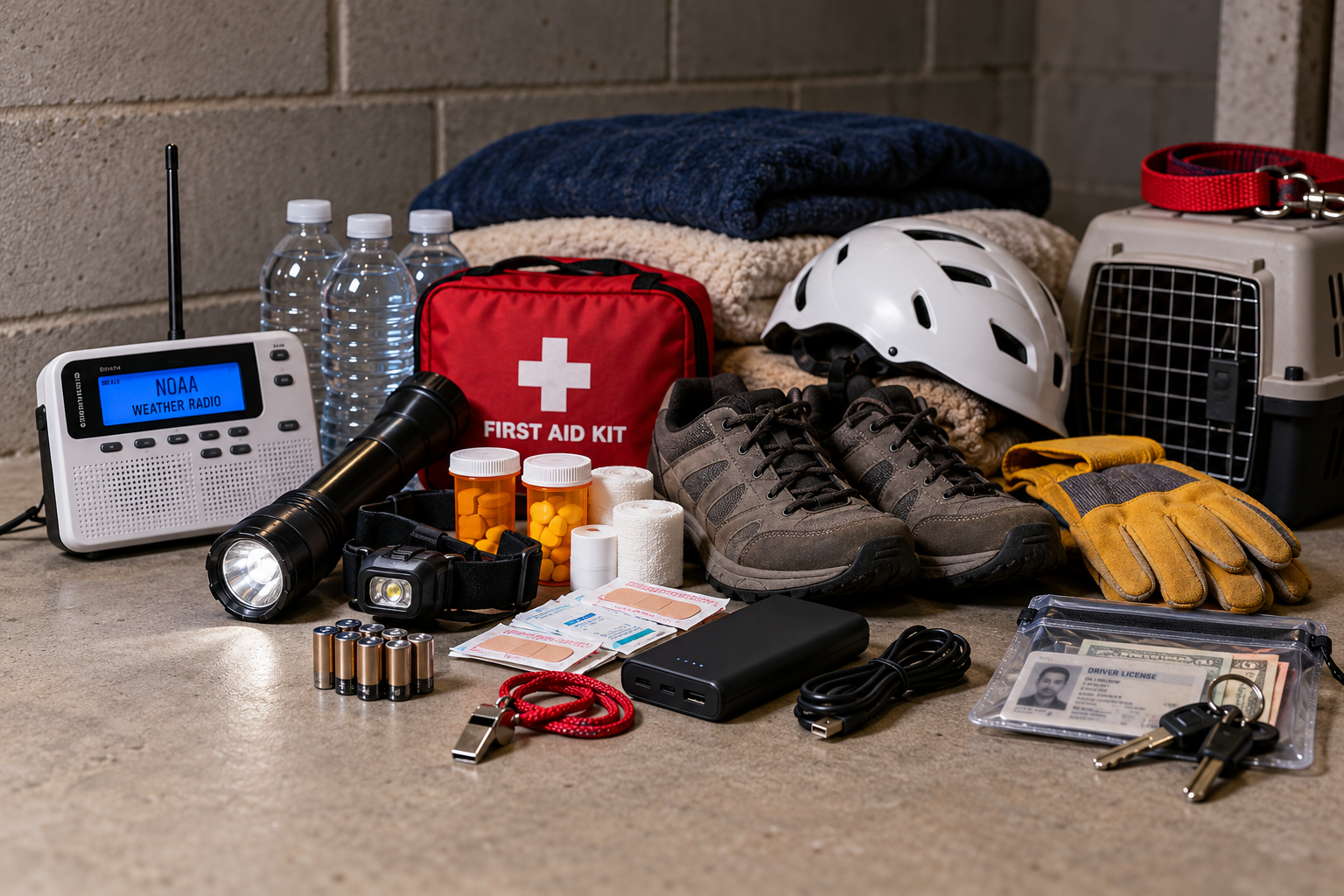
Short Answer: Keep a flashlight or headlamp, sturdy shoes, a NOAA Weather Radio, charged phone and backup power, first-aid supplies, essential medications, a whistle, water and basic head and body protection in or immediately beside your tornado shelter. Add anything your children, pets or household members with medical needs may require.
Think of this as your tornado shelter kit. Your larger emergency supplies can take care of the hours and days that follow.
Start With the Right Shelter Location
Before worrying about what goes into your tornado kit, make sure you know where you are going to use it.
A properly constructed tornado safe room or storm shelter provides the best protection. If you do not have one, the National Weather Service recommends going to a basement or to a small interior room on the lowest floor of a sturdy building, away from windows.
We cover that decision in more detail in Where Is the Safest Place in Your House During a Tornado?
Once you have chosen that location, store your tornado supplies there whenever practical.
That last part matters.
A flashlight stored in the garage does you little good if your family is sheltering in a downstairs closet.
1. NOAA Weather Radio
A NOAA Weather Radio with battery backup belongs near your tornado shelter.
Do not rely on outdoor warning sirens as your only alert system. A weather radio can provide warnings inside your home, including at night when you may be asleep.
The National Weather Service recommends having multiple ways to receive warnings and specifically recommends keeping a NOAA Weather Radio and a fully charged phone available for nighttime tornadoes.
If you need help choosing one, see our Best NOAA Weather Radios for Tornadoes and Severe Weather guide. We compare several radios designed for emergency use and explain which features matter most.
Check the radio periodically, keep it programmed correctly and replace or recharge its backup batteries as needed.
2. Flashlight or Headlamp
Power may fail before, during or after a tornado.
Keep at least one dependable flashlight in your shelter area along with spare batteries or another reliable way to recharge it.
A headlamp can be particularly useful because it leaves both hands free. That can matter if you are helping children, handling a pet carrier, checking an injury or moving through a darkened house after the storm.
The National Weather Service recommends keeping a flashlight readily available when severe weather threatens.
Avoid depending on the flashlight in your phone. Your phone battery may be much more valuable for warnings and communication.
If you need dedicated emergency lighting, see our Best Emergency Lighting for a Power Outage guide for the types of flashlights, headlamps and other lighting we recommend keeping ready.
3. Sturdy Shoes
This is one of the easiest tornado-preparedness items to overlook.
Keep sturdy, closed-toe shoes near your shelter location—or wear them when you take shelter.
If a tornado damages your home, the floor and surrounding area could contain broken glass, nails, splintered wood and other sharp debris. Both the National Weather Service and CDC recommend sturdy footwear because of the hazards that may remain after a tornado.
If severe storms are expected overnight, put shoes somewhere you can reach them quickly.
This is a small preparation that could make a major difference after the storm passes.
4. Charged Cell Phone and Backup Power
Your phone can provide weather alerts, emergency information and a way to communicate after the storm.
Before severe weather arrives:
- Charge your phone.
- Make sure Wireless Emergency Alerts are enabled.
- Keep a charged power bank available.
- Store the appropriate charging cable with it.
The National Weather Service specifically recommends a fully charged phone with Wireless Emergency Alerts enabled as part of nighttime tornado preparation.
After a tornado, text messages may sometimes be a better way to communicate than voice calls, particularly when networks are heavily used. The National Weather Service recommends using texts or social media to let family members know you are safe.
For the tornado shelter itself, a small power bank is usually more practical than a large backup power system. But if you want to keep phones, lights, radios and other essential equipment running during a longer outage, see our Best Portable Power Stations for Home Outages guide.
5. First-Aid Supplies and Essential Medications
Keep a basic first-aid kit with your tornado supplies.
It does not have to be enormous. At minimum, you want supplies for treating common cuts, scrapes and minor injuries until additional help is available.
Also consider any medical supplies that someone in your household cannot safely be without.
That could include:
- Prescription medications
- Inhalers
- EpiPens or other prescribed emergency medication
- Hearing-aid batteries
- Glucose supplies
- Necessary mobility or medical-device supplies
For medications that cannot practically remain in the shelter all the time, make them part of your severe-weather routine before storms arrive rather than waiting until a warning is issued.
6. A Whistle
A whistle takes almost no room, costs very little and can be surprisingly important.
If debris blocks your exit or you become trapped, a whistle can help rescuers locate you without requiring you to continually shout.
CDC recommends using a whistle, banging on a wall or pipe, or sending a text to attract attention if you are trapped after a tornado.
We would keep one permanently in the shelter kit.
7. Head and Body Protection
Flying and falling debris causes many tornado injuries, so protecting your head and body is important.
Depending on the space available, consider keeping:
- Blankets
- Pillows
- A thick comforter
- Cushions
- Bicycle or similar helmets
The National Weather Service recommends protecting yourself from flying debris with blankets, pillows or cushions and protecting your head whenever possible.
A helmet can provide additional head protection, but there is an important limitation.
CDC says there is not research establishing how effective helmets are at preventing tornado-related head injuries. More importantly, looking for helmets should never delay getting to shelter.
If you choose to use them, keep them at the shelter location so they are immediately available.
A helmet is extra protection. It is not a substitute for being in the safest shelter available.
8. Drinking Water
Keep some drinking water in or near your shelter.
For the tornado itself, you probably do not need to squeeze several days of water into a small interior closet. The larger emergency water supply stored elsewhere in your home serves a different purpose.
A few bottles in the shelter can cover immediate needs, particularly if someone must take medication or you cannot safely leave the shelter right away.
Your larger household emergency supply should be designed for a longer disruption.
For guidance on building and maintaining that supply, see How to Store Emergency Water at Home.
If you still need containers for your emergency water supply, our Best Emergency Water Storage Containers guide compares the options we recommend for different amounts of water and storage situations.
9. Work Gloves and Basic Protective Clothing
A pair of sturdy work gloves deserves a place in the kit.
They may not be necessary while you are sheltering, but they can become valuable immediately afterward if debris blocks your way.
CDC recommends sturdy footwear, gloves, long sleeves and other protective clothing when walking around or handling tornado debris.
Do not begin moving heavy structural debris simply because you have gloves. Damaged buildings, downed electrical lines, gas leaks and unstable structures can create serious hazards after a tornado.
10. Identification, Keys and a Little Cash
If your home is badly damaged, you may need to leave after the storm.
Having basic identification, keys and some emergency cash available can make that easier.
You do not necessarily need to keep original passports, birth certificates and other irreplaceable documents in your tornado shelter. Important records are better protected as part of your broader emergency-document plan.
But consider keeping a small waterproof pouch containing the items you may need immediately.
If you have not already organized your records, see Important Documents for an Emergency.
11. Supplies for Children
If you have young children, think about what they might need while sheltering.
Depending on age, that could include:
- Diapers and wipes
- Formula or feeding supplies
- Necessary medications
- Hearing protection
- A small comfort item
A favorite stuffed animal may not look like emergency equipment, but tornado warnings can be frightening for children. If a familiar item fits easily in the shelter kit, there is nothing wrong with keeping one there.
The important point is to prepare these things before severe weather arrives.
12. Supplies for Pets
Your tornado plan should include your pets.
Consider keeping:
- A leash or harness
- Pet carrier
- Small water supply
- Necessary medications
- Basic identification information
If your cat disappears under a bed every time thunder starts, waiting for a tornado warning to find the carrier is not much of a plan.
When severe weather is expected, consider moving pets and their supplies closer to your shelter area before conditions become dangerous.
Don’t Turn Your Tornado Kit Into a Giant Survival Kit
It is easy for emergency kits to grow until they become so large that nobody wants to move them.
That defeats the purpose here.
Your tornado shelter kit has a very specific job:
Help protect your household during a tornado and handle the immediate problems you may face afterward.
Your full 72-hour emergency kit serves a broader purpose.
See How to Build a 72-Hour Emergency Kit for those longer-term supplies.
You do not need to duplicate everything in that kit inside your tornado shelter.
A Simple Tornado Shelter Kit
For most households, we would start with:
Keep in or beside the shelter:
- NOAA Weather Radio
- Flashlight or headlamp
- Spare batteries
- Charged power bank and phone cable
- Sturdy shoes
- Work gloves
- First-aid kit
- Essential medications
- Whistle
- A few bottles of water
- Blankets or other debris protection
- Helmets, if your family chooses to use them
- Pet leash or carrier
- Household-specific medical or child supplies
Then customize the kit for the people who actually live in your home.
That is more useful than copying a generic emergency-supply list.
What If You Live in a Mobile or Manufactured Home?
A tornado kit does not make a mobile or manufactured home a safe tornado shelter.
The National Weather Service and American Red Cross recommend leaving mobile and manufactured homes for a sturdy building or designated storm shelter when tornadoes threaten.
In that situation, think of your tornado kit as a grab-and-go shelter bag.
Keep it light enough to carry quickly, and know where you are going before severe weather develops.
Do not wait until you can see a tornado before leaving for your planned shelter.
Be Ready for the Power Outage After the Storm
Even when your home escapes major tornado damage, the storm may leave you without electricity.
That can create a second set of hazards.
If you use a portable generator after the storm, keep it outdoors and well away from the house, and never operate it in a garage, basement or other enclosed space. Carbon monoxide can accumulate without warning.
A working carbon monoxide alarm with dependable backup power is an important part of preparing for outages involving generators or other fuel-burning equipment.
For more information, see Carbon Monoxide Detectors and Backup Power. If you need an alarm, our Best Carbon Monoxide Alarms for Power Outages and Generator Use guide covers the models we recommend.
Prepare the Kit Before You Need It
The best time to assemble a tornado kit is on an ordinary day when the weather is quiet.
Choose your shelter location. Put the essential supplies there. Make sure everyone in the household knows where to go.
Then practice.
Our Tornado Preparedness Checklist for Homeowners can help you work through the rest of the preparation, while How to Prepare Your Home for a Tornado covers the steps you can take before severe weather arrives.
When storms are forecast, charge your devices, check your weather radio, bring pets inside and make sure shoes, flashlights and medications are ready.
The goal is simple:
When a tornado warning arrives, you should be moving toward shelter—not searching the house for supplies.
That few minutes of preparation beforehand may be far more valuable than anything you could add to the kit at the last second.