
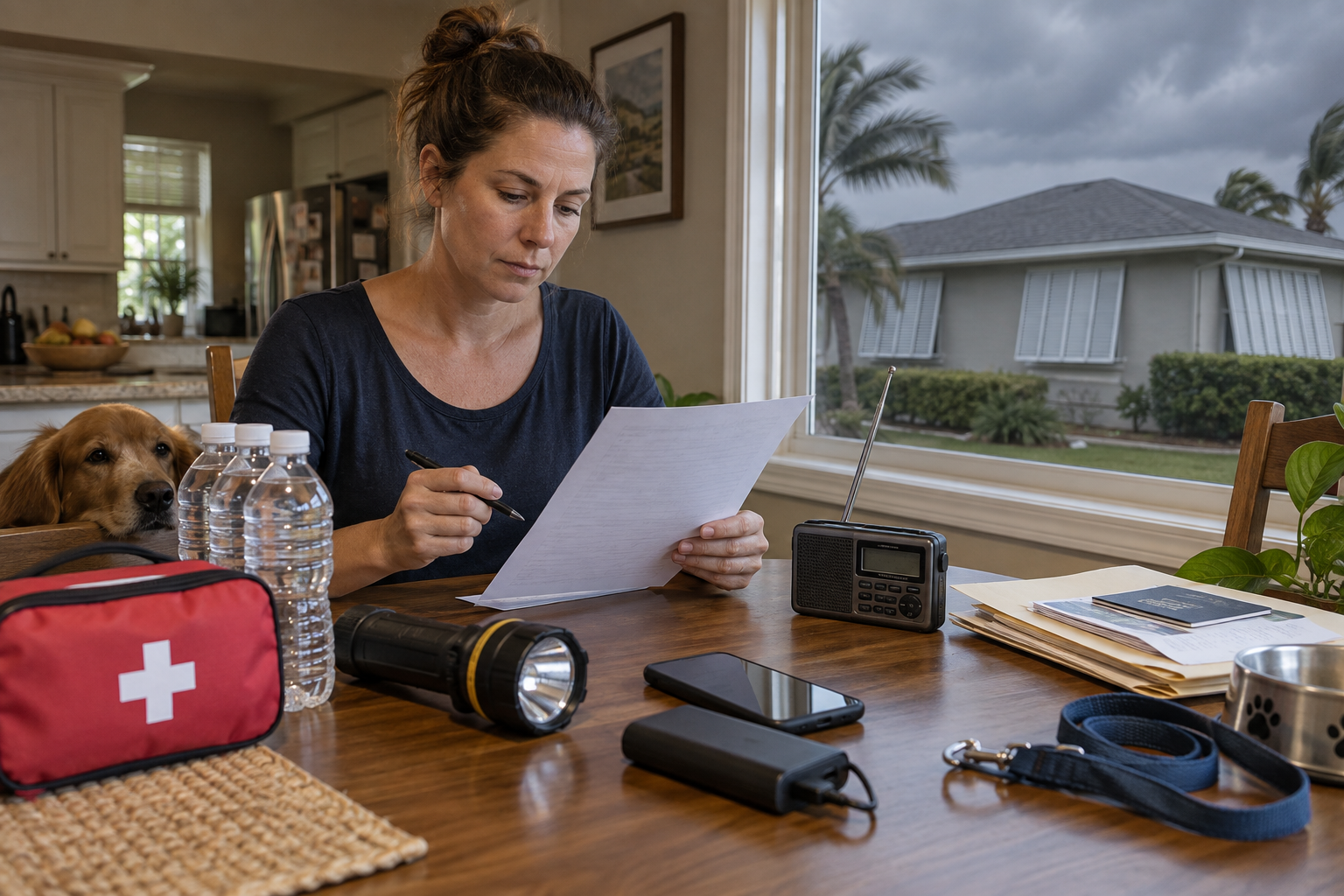
Hurricane preparation is easier when you are working from a list instead of trying to remember everything while a storm is moving closer.
This checklist is organized by timing. Some jobs belong at the beginning of hurricane season. Others should wait until a storm could affect your area. The goal is not to do every task in one frantic afternoon. It is to handle the slow, predictable work early so you can focus on safety and official instructions later.
If you need more detail on protecting the house itself, start with Ready Chateau’s guide to preparing your home for a hurricane. Use this page as the working checklist that keeps the whole household on track.
Quick Answer
A complete hurricane plan covers five things: where you will go if you must evacuate, how you will receive official alerts, what your household will need for several days, how you will protect the home, and how you will stay safe during an extended power outage.
Begin before a storm is forecast. Once a hurricane watch or warning is issued, use the remaining time for final preparations—not projects that should have been handled weeks earlier.
Before Hurricane Season
Know Your Risk
Hurricane damage is not limited to the coastline. Storm surge is a major coastal threat, but heavy rain, inland flooding, high winds and tornadoes can affect communities far from the point of landfall.
☐ Find out whether your home is in a hurricane evacuation zone, flood-prone area or manufactured-home evacuation area.
☐ Learn the evacuation routes designated by your state or local emergency management agency.
☐ Identify at least two destinations outside the evacuation zone. Include a hotel, friend or relative when possible, because public shelters may have limited space and different rules.
☐ Check whether nearby shelters accept pets. If they do not, identify a pet-friendly alternative before you need it.
☐ Consider household needs that may make an early departure necessary, including mobility limitations, medical equipment, pregnancy, young children, older adults and animals.
☐ Sign up for alerts from your local emergency management agency and enable Wireless Emergency Alerts on household phones.
Build a Household Plan
A plan should answer the practical questions that become harder once roads are crowded, phones are busy and family members are in different places.
☐ Choose an out-of-area contact everyone can call or text.
☐ Decide how household members will reconnect if the storm arrives during work or school hours.
☐ Write down important phone numbers. Do not rely only on contacts stored in a phone.
☐ Decide who will help children, older relatives, neighbors or household members with disabilities.
☐ Plan transportation. If you do not drive or do not have a reliable vehicle, contact local emergency management now to learn what assistance may be available.
☐ Include pets in the evacuation plan. Prepare carriers, leashes, identification, vaccination records, food, water and medications.
☐ Practice the route and make sure every driver knows where to go.
Protect Important Information
A phone may be lost, damaged or out of power after a storm. Keep essential information in more than one form.
☐ Photograph or video each room and valuable item for a home inventory.
☐ Store copies of identification, insurance information, prescriptions, medical details, property records and emergency contacts in a waterproof container.
☐ Keep a secure digital backup that can be reached away from home.
☐ Save your insurance company’s claims number and policy information.
☐ Review what your homeowners or renters policy covers. Standard policies generally do not cover flood damage, so confirm your specific protection before a storm threatens.
☐ Keep a small amount of cash in manageable denominations in case card systems and ATMs are unavailable.
Prepare Emergency Supplies
Ready.gov recommends having enough supplies for several days. The American Red Cross suggests a three-day evacuation supply and a two-week supply for staying at home. Build toward what is realistic for your household instead of waiting until you can assemble a perfect kit.
☐ Store water for drinking and sanitation. A common planning minimum is one gallon per person per day, with additional water for heat, illness, pregnancy or pets.
☐ Stock shelf-stable food your household already eats, including food that requires little or no cooking.
☐ Keep at least several days of prescription medications when possible, along with copies of prescriptions and necessary medical supplies.
☐ Add flashlights, headlamps, spare batteries and battery-powered lanterns. Do not depend on candles for emergency lighting.
☐ Keep a battery-powered or hand-crank weather radio.
☐ Pack first-aid supplies, sanitation items, masks, insect repellent and needed personal-care products.
☐ Include phone charging cables, vehicle chargers and charged power banks.
☐ Store pet food, water, medications, cleanup supplies and comfort items.
☐ Keep a manual can opener, basic tools, work gloves and sturdy shoes.
☐ Put evacuation supplies in containers or bags that can be loaded quickly.
Prepare for a Power Outage
Hurricane outages may last much longer than the storm itself. Decide in advance what must keep running and what can remain off.
☐ Charge portable power stations, power banks, rechargeable lights and medical-device backup batteries.
☐ Test smoke alarms and carbon monoxide alarms. Replace batteries if needed.
☐ Make a written priority list for refrigeration, communication, medical needs, lighting and fans.
☐ If you own a portable generator, review the manual, test it safely and confirm you have the correct outdoor-rated extension cords.
☐ Plan to operate a portable generator outdoors only, at least 20 feet from the home, with the exhaust pointed away from the building.
☐ Never plan to run a generator in a garage, shed, porch or other enclosed or partly enclosed space.
☐ Never connect a generator to a household outlet. A properly installed transfer switch or other approved transfer equipment is required to power home wiring safely.
☐ Keep refrigerator and freezer thermometers where you can read them.
☐ Freeze containers of water or gel packs to help the freezer stay cold longer, leaving room for water to expand.
☐ Fill vehicle fuel tanks and recharge electric vehicles before demand rises, while continuing to follow evacuation instructions.
Maintain the Home and Property
These tasks are best handled before hurricane season or well before a specific storm.
☐ Trim weak or damaged tree limbs using a qualified professional when the work is beyond safe homeowner reach.
☐ Clean gutters, downspouts and drains so rainwater can move away from the house.
☐ Repair loose roofing, siding, screens, fences and exterior fixtures.
☐ Identify how you will protect windows and doors. Measure openings and label storm panels if you use them.
☐ Check the garage door and review the manufacturer’s wind-protection instructions.
☐ Know how to shut off electricity, water and gas if local officials or your utility instruct you to do so. Do not shut off gas casually; only the utility or a qualified professional should restore service.
☐ Check sump pumps, drainage systems and backup power arrangements where flooding is a concern.
☐ Store outdoor fuel safely and legally in approved containers, away from living areas and ignition sources.
☐ Photograph the exterior of the home before the season and again before a storm for insurance documentation.
When a Storm Could Affect Your Area
Follow the National Hurricane Center, National Weather Service and local emergency management—not social-media rumor or a single forecast image. The forecast track, hazards and local instructions can change.
☐ Review the current forecast and local evacuation information at least twice a day, or more often when officials advise.
☐ Confirm where you will go and when you will leave if an evacuation is ordered.
☐ Contact anyone who may need transportation or assistance.
☐ Refill prescriptions as early as allowed.
☐ Finish laundry and wash dishes while water and power are dependable.
☐ Charge every phone, radio, battery bank and backup power device.
☐ Test flashlights and place them where people can find them in the dark.
☐ Withdraw needed cash and fuel vehicles without waiting for the final rush.
☐ Buy only the remaining gaps in your supplies. Avoid emptying shelves of items you already have.
☐ Move patio furniture, grills, tools, planters, decorations and other loose items indoors or secure them properly.
☐ Protect windows and doors using your planned materials. Tape does not prevent a window from breaking.
☐ Clear the yard and drainage paths.
☐ Set the refrigerator and freezer to colder settings before the storm, but do not freeze foods that should not be frozen.
☐ Place important records, medicines and electronics in waterproof bags or containers.
☐ Bring pets inside and keep carriers, leashes and identification ready.
☐ Let your out-of-area contact know your plan.
Hurricane Watch: Finalize the Plan
A hurricane watch generally means hurricane conditions are possible within the watch area, usually within 48 hours. Preparations become more difficult and dangerous once tropical-storm-force winds begin, so do not treat the watch as an invitation to wait.
☐ Complete window, door and outdoor-property preparations while conditions are still safe.
☐ Check the evacuation order, route and destination again.
☐ Load the vehicle with go bags, medications, documents, pet supplies, water and food.
☐ Move vehicles to a safer location if flooding, falling trees or flying debris are concerns.
☐ Set aside clean containers for additional drinking water if local officials recommend filling them.
☐ Turn the refrigerator and freezer to their coldest safe settings and keep the doors closed as much as possible.
☐ Identify a small interior room on the lowest level not likely to flood, away from windows, for sheltering from wind.
☐ Keep shoes, flashlights, helmets if available, a first-aid kit and a weather radio in the shelter area.
☐ Continue monitoring official updates and be ready to leave immediately.
Hurricane Warning: Act, Do Not Experiment
A hurricane warning generally means hurricane conditions are expected within the warning area, usually within 36 hours. At this point, personal safety and official instructions take priority over the property.
☐ Evacuate immediately when ordered. Do not delay to finish protecting the house.
☐ Leave early if anyone in the household needs extra travel time or depends on electrical medical equipment.
☐ Use official routes and do not take shortcuts around barricades.
☐ Never drive through floodwater. Turn around and choose another route.
☐ If you are staying because local officials have not ordered evacuation, bring everyone and all pets inside before conditions deteriorate.
☐ Close and lock windows and doors after shutters or panels are in place.
☐ Keep phones charged and preserve battery life.
☐ Stay away from windows, skylights and exterior doors.
☐ Do not go outside during the eye of the storm. Dangerous winds can return quickly from the opposite direction.
☐ Call 911 only for a life-threatening emergency.
If You Evacuate
☐ Take medications, identification, insurance records, emergency contacts, cash and essential medical equipment.
☐ Take water, food, clothing, hygiene items, phone chargers and bedding as your destination requires.
☐ Take pet carriers, leashes, records, food, water and medications.
☐ Unplug nonessential electronics if time permits.
☐ Follow local instructions concerning utilities. Never turn off gas unless told to do so.
☐ Tell your out-of-area contact where you are going and when you expect to arrive.
☐ Lock the home and leave before roads become unsafe.
☐ Do not return until local officials say the area is safe.
If You Shelter at Home
Sheltering at home is not the right choice when officials order evacuation, when the home is in a storm-surge or serious flood zone, or when the building cannot provide safe protection.
☐ Keep everyone in the chosen interior shelter area during the strongest winds.
☐ Continue receiving alerts through more than one source when possible.
☐ Use flashlights rather than candles if power fails.
☐ Keep refrigerator and freezer doors closed. An unopened refrigerator generally keeps food safely cold for about four hours. A full freezer can hold temperature for about 48 hours, or about 24 hours if half full.
☐ Keep generators, grills, camp stoves and other fuel-burning equipment outdoors and away from doors, windows and vents.
☐ Do not use floodwater for drinking, cooking, brushing teeth or washing dishes.
☐ Move to a higher level if water enters the home, but avoid a closed attic where rising water could trap you. Call for help and follow local rescue instructions.
☐ Stay indoors until officials say conditions are safe.
After the Storm
The storm’s departure does not end the danger. Floodwater, downed power lines, unstable buildings, damaged trees, heat and carbon monoxide can all cause serious injuries after a hurricane.
☐ Wait for official clearance before returning home or leaving your shelter.
☐ Avoid floodwater. It may contain sewage, chemicals, sharp debris or hidden electrical hazards.
☐ Stay away from downed power lines and report them to the utility.
☐ Do not enter a visibly damaged building until authorities or a qualified professional say it is safe.
☐ Photograph damage before moving or discarding items when it is safe to do so.
☐ Wear sturdy shoes, gloves and protective clothing during cleanup.
☐ Use generators only outdoors, at least 20 feet from the home, with exhaust directed away.
☐ Keep working carbon monoxide alarms operating. If an alarm sounds or anyone develops headache, dizziness, weakness, nausea, chest pain or confusion, move to fresh air and call 911.
☐ Follow local drinking-water advisories. Use bottled, boiled or properly treated water when instructed.
☐ Discard food that contacted floodwater.
☐ Check refrigerated food with time and temperature guidance—not smell or appearance alone.
☐ Be alert for heat illness, cuts, falls, electrical hazards and overexertion during cleanup.
☐ Contact your insurer promptly and keep receipts for storm-related expenses.
☐ Check on neighbors only when conditions are safe.
The Ready Chateau Final Check
Before you consider the household prepared, make sure you can answer yes to these questions:
☐ Do we know whether and when we would evacuate?
☐ Does every household member know the plan?
☐ Can we receive official alerts if the power and internet fail?
☐ Do we have water, food, medications and essential supplies for several days?
☐ Are our important documents protected and accessible?
☐ Have we secured the home without waiting for the final forecast?
☐ Can we manage a power outage without bringing carbon monoxide or electrical hazards into the home?
☐ Are pets, medical needs and transportation included?
☐ Do we know what hazards to expect after the storm?
Bottom Line
A hurricane checklist works best when it is used early. The more you complete before a storm is on the map, the fewer decisions you have to make under pressure.
Know your evacuation plan, build practical supplies, protect the home, prepare for an outage and follow official instructions when conditions change. You may not be able to prevent the storm, but you can remove many of the last-minute problems that make it more dangerous.
Sources Consulted
- Ready.gov — Hurricanes
- Ready.gov — Make a Plan
- Ready.gov — Pet Preparedness
- National Hurricane Center — Hurricane Hazards
- National Weather Service — Hurricane Safety
- American Red Cross — Hurricane Preparedness
- Centers for Disease Control and Prevention — Hurricane Safety
- Centers for Disease Control and Prevention — Prevent Carbon Monoxide Poisoning
- USDA Food Safety and Inspection Service — Food Safety During Power Outages