
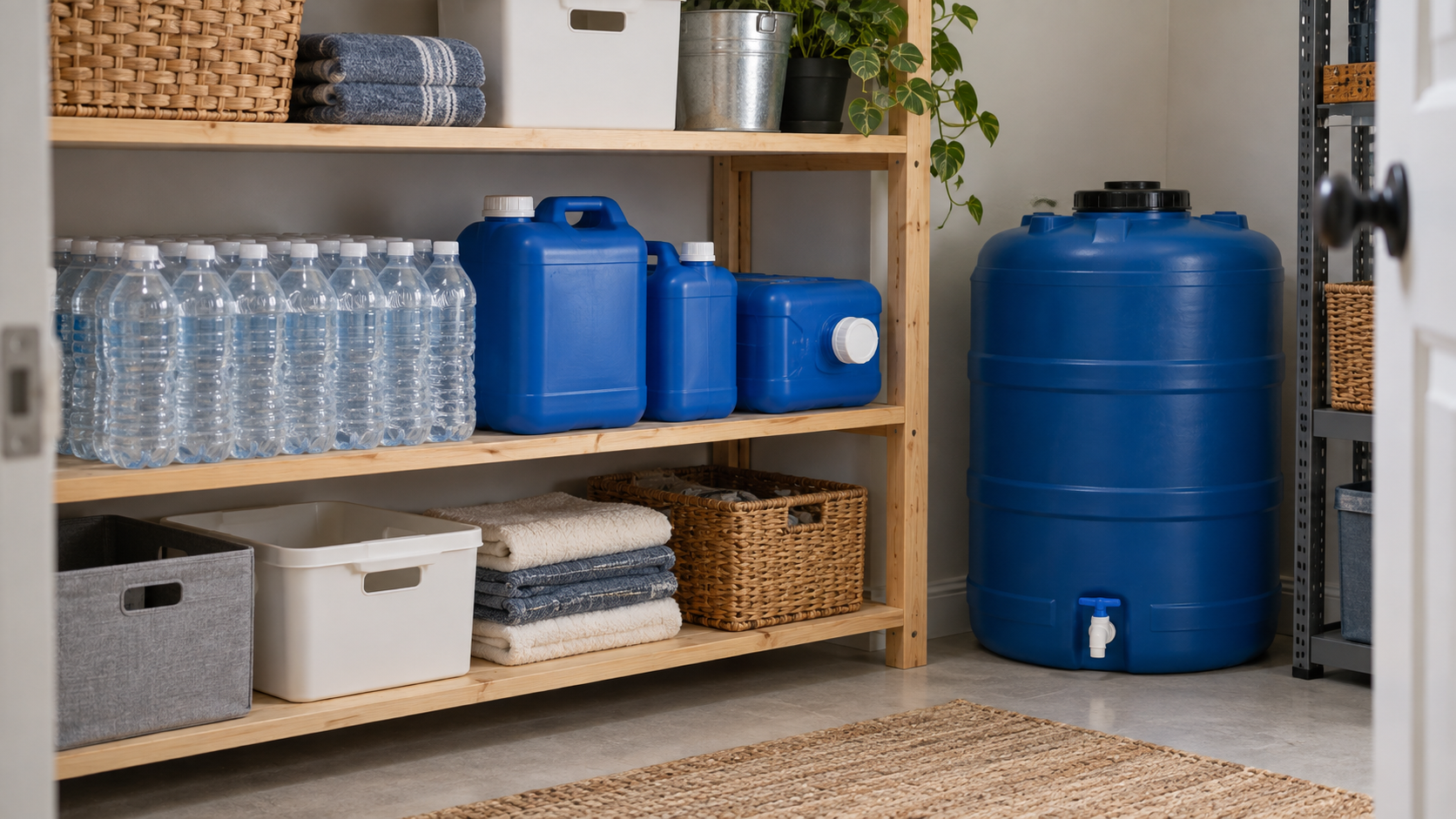
Choosing an emergency water container looks simple until you calculate the weight, find a place to store it and try to pour from it. A container that holds plenty of water may be too heavy to move. A compact one may stack neatly but take longer to fill and rotate. A large tank may solve the capacity problem while creating a new problem if its valve leaks or the water must leave the house with you.
The best setup is usually not one product. It is a combination of sealed bottled water for immediate use, manageable reusable containers for flexibility and, when the household has suitable space, a larger fixed container for added capacity.
This guide compares five practical approaches and explains which one fits different homes. It does not repeat the cleaning, filling and rotation process covered in our guide to storing emergency water correctly.
Affiliate disclosure: Ready Chateau may earn a commission from qualifying purchases made through links on this page, at no additional cost to you. As an Amazon Associate I earn from qualifying purchases.
The Short Answer
For most households, begin with unopened commercially bottled water, then add reusable food-grade containers in sizes the people in your home can actually lift and use. A large tank makes sense only after you have chosen a permanent, structurally sound location and a reliable way to dispense the water.
Our quick picks:
- Best first layer: Unopened commercially bottled water.
- Best simple reusable jug: Reliance Aqua-Tainer, especially the 4-gallon size when lifting is a concern.
- Best rugged portable container: Scepter 5-Gallon Military Water Container.
- Best for tight or awkward storage spaces: 3.5-Gallon WaterBrick.
- Best high-capacity fixed storage: WaterPrepared 55-Gallon Tank.
No recommendation is best for every household. Capacity, filled weight, storage temperature, opening design and the way you will dispense the water matter more than a dramatic product claim.
How We Chose These Options
Ready Chateau has not performed laboratory or long-term hands-on testing on these containers. The recommendations are based on current public-health guidance, manufacturer specifications and practical household use. We considered:
- Whether the container is identified for drinking-water or food storage.
- Whether it closes tightly and is made from durable, unbreakable material.
- How much it weighs when full.
- Whether its opening, cap, gasket and dispensing method can be kept clean.
- How efficiently it uses ordinary household storage space.
- Whether the container remains useful during both a stay-at-home outage and an evacuation.
The CDC recommends FDA-approved food-grade water-storage containers for water filled at home. It also advises choosing a tightly closing, durable container with a narrow opening when possible. Those requirements are the starting point for every recommendation below.
Decide How Much Water You Need Before Buying Containers
The CDC recommends storing at least one gallon per person per day for three days and trying to store a two-week supply when possible. Pregnant people, people who are ill, pets and households in hot climates may need more.
Use our guide to calculate how much emergency water your household needs before choosing containers. The container decision becomes easier once you know whether you are trying to store 12 gallons, 30 gallons or more than 50.
Remember that one gallon of water weighs about 8.3 pounds. That means:
- A 3.5-gallon container holds about 29 pounds of water before the container is counted.
- A 4-gallon container holds about 33 pounds of water before the container is counted.
- A 5-gallon container holds about 42 pounds of water before the container is counted.
- A 7-gallon container holds about 58 pounds of water before the container is counted.
- A 55-gallon tank holds about 457 pounds of water before the tank and fittings are counted.
A capacity you cannot safely lift, place or dispense is not useful capacity.
1. Unopened Commercially Bottled Water
Best for: The first three days, easy distribution and households that want the least complicated starting point.
The CDC calls unopened commercially bottled water the safest and most reliable emergency source. It arrives sealed, requires no container preparation and is easy to divide among family members, vehicles and evacuation kits.
Bottled water is also forgiving. If one bottle leaks, the rest of the supply remains protected. Smaller bottles can be handed to a child, an older adult or a neighbor without transferring water between containers.
The tradeoff is storage efficiency. Cases of small bottles create more packaging and usually use more space per gallon than purpose-built reusable containers. Thin one-gallon retail jugs may also be less durable than rigid emergency-water containers.
Ready Chateau recommendation: Use commercially bottled water to establish your first layer quickly. Store it in its original sealed packaging, follow the manufacturer’s date and storage guidance, and protect it from heat, sunlight and chemicals. Add reusable containers later if you want a larger supply.
2. Reliance Aqua-Tainer
Best for: A straightforward reusable jug for a pantry, closet, vehicle or short-term household outage.
Reliance offers the rigid Aqua-Tainer in 4-gallon and 7-gallon sizes. That choice is useful because the same general design can serve households with very different lifting abilities.
The 7-gallon version stores more water in one container, but the water alone weighs about 58 pounds. Once the container is included, it is portable in theory but heavy in practice. The 4-gallon version gives up some capacity but is far easier for many adults to lift, place and pour.
This is the uncomplicated middle-ground option: more durable and space-efficient than a collection of disposable bottles, but less permanent than a drum or tank.
Consider before buying: Choose the size by filled weight, not by the number printed on the label. Inspect the cap and dispensing parts before every rotation, and do not stack filled containers unless the manufacturer’s current instructions specifically allow the arrangement you plan to use.
Ready Chateau recommendation: For most households, the 4-gallon Aqua-Tainer is the safer default. Choose the 7-gallon model only when someone in the home can comfortably manage roughly 60 pounds or the container will remain in place while being dispensed.
3. Scepter 5-Gallon Military Water Container
Best for: Rugged portable storage, frequent transport and households willing to pay more for a tougher container.
Scepter identifies its 5-gallon Military Water Container as food-grade and BPA-free, with superior impact resistance and an easy-to-transport design. Its narrow, upright shape makes it useful when containers must fit beside other supplies or travel in a vehicle.
Five gallons is a practical compromise between capacity and handling, but it is not light. Expect roughly 42 pounds of water plus the weight of the container. That may be manageable for one adult and too much for another.
The Scepter is strongest where durability and transport matter. A household that expects the container to stay untouched in a closet may not benefit enough from the heavier-duty construction to justify its typically higher cost.
Consider before buying: Confirm that you are buying the water container, not a similar-looking fuel container. Use only the cap, gasket and dispensing accessories intended for that model, and label it clearly as drinking water.
Ready Chateau recommendation: Choose the Scepter when the container may be moved regularly, loaded into a vehicle or used beyond a stationary home supply. For quiet indoor storage, a less expensive food-grade jug may do the same basic job.
4. 3.5-Gallon WaterBrick
Best for: Apartments, closets, under-bed areas and households that need smaller modular containers.
The standard WaterBrick holds 3.5 gallons and measures 9 by 18 by 6 inches. The manufacturer lists an empty weight of 2.52 pounds and describes the container, lid and gasket as BPA-free, FDA-compliant materials. Its interlocking shape allows the containers to be cross-stacked, which can make better use of low or narrow spaces.
The smaller capacity is the main advantage. About 29 pounds of water is still substantial, but it is easier to manage than a 5- or 7-gallon load. Several small containers also reduce the risk that one damaged seal will affect the entire supply.
The tradeoff is complexity. More containers mean more caps, gaskets, labels and surfaces to inspect. The 3¼-inch lid is wider than the narrow opening preferred by the CDC when possible, so clean handling and a clean dispensing method deserve extra attention.
Check current price: WaterBrick 3.5-Gallon Water Containers — 4-Pack on Amazon
Consider before buying: Plan the stack before filling, follow the manufacturer’s stacking instructions and keep every lid accessible enough to inspect. Do not assume that a stackable shape makes any shelf or floor capable of carrying the combined weight.
Ready Chateau recommendation: WaterBrick is the strongest choice here for limited space or limited lifting ability. It is less attractive when low cost per gallon and the fewest possible components are the priorities.
5. WaterPrepared 55-Gallon Tank
Best for: A larger stay-at-home supply in a house with a permanent, level and properly supported location.
WaterPrepared lists its 55-gallon tank at approximately 22 by 28 by 30 inches. The manufacturer describes it as stackable and made from BPA-free, FDA food-grade materials, with a large fill cap and front dispensing connections.
A 55-gallon tank approaches the two-week, one-gallon-per-person-per-day target for a four-person household. That capacity is difficult to match with small jugs without using a great deal of shelf and floor space.
The limitation is equally important: a filled tank can approach 480 pounds after the tank and fittings are included. It is not an evacuation container, and it should not be filled until its permanent location, floor capacity, clearance and dispensing method have been settled.
A large tank also concentrates risk. One damaged valve, contaminated opening or inaccessible room can affect most of the household supply. Keep a separate layer of bottled water or smaller containers even when a tank holds the majority.
Check current price: WaterPrepared 55-Gallon Water Storage Tank on Amazon
Consider before buying: Measure the route into the storage area as well as the final footprint. Confirm that the floor can support the filled weight, test every valve before relying on it, and follow the manufacturer’s current instructions for installation and stacking. Marketing claims about UV resistance do not replace the CDC recommendation to store water in a cool location away from direct sunlight and toxic substances.
Ready Chateau recommendation: Choose a 55-gallon tank only as the fixed-capacity layer of a mixed system. It should supplement—not replace—water that household members can lift and carry.
Which Container Fits Your Household?
Apartment or very limited storage: Begin with bottled water, then add WaterBricks or other smaller food-grade containers that fit under beds or on properly rated low shelving.
Typical house with a pantry or conditioned storage room: Combine bottled water with several 4- or 5-gallon containers. This provides useful capacity without making the entire supply immovable.
Household with limited lifting ability: Favor individual bottles, one-gallon commercial containers and 3.5- or 4-gallon reusable containers. More pieces are easier to manage than one oversized jug.
Household preparing for evacuation: Keep small sealed bottles and rugged portable containers with the 72-hour emergency kit. A large tank can support sheltering at home but cannot travel with you.
Household building toward two weeks: Use a layered system. Keep small water for immediate use, medium containers for flexible household needs and a fixed tank only if the home can support it.
What to Avoid
- Containers that previously held bleach, pesticides, fuel or any other toxic substance.
- Unlabeled generic containers whose food-grade or drinking-water suitability cannot be confirmed.
- Glass containers that can break during an emergency.
- Thin milk jugs or similar containers that are difficult to clean thoroughly and prone to leaking.
- A single oversized container with no backup supply.
- A barrel or tank purchased before its filled location and dispensing method are planned.
- Collapsible containers as the only long-term supply. They can be useful for temporary collection or transport, but they are a weaker primary choice than durable rigid containers.
Accessories That Actually Matter
- A compatible spigot or pump tested before the emergency.
- A spare manufacturer-approved cap, gasket or valve when those parts are replaceable.
- A permanent marker or durable labels for “Drinking Water” and the fill date.
- A clean, food-grade transfer hose when a large tank requires one.
- Shelving or a platform rated for the full stored weight—not merely the empty containers.
Accessories should solve a real handling problem. A full tank with a missing pump is not ready, and an expensive rack is not useful if the floor below it cannot support the load.
How to Build the Supply Without Overspending
Start with the minimum instead of waiting to afford the perfect system. One case of bottled water is more useful today than a large tank that remains on a wish list.
Then add capacity in stages:
- Calculate the three-day target for everyone in the household, including pets.
- Cover as much of that target as practical with sealed bottled water.
- Add one or two manageable reusable containers.
- Use the containers through one filling and rotation cycle before buying more.
- Expand toward two weeks only after the storage location and routine work in real life.
This approach also reveals whether a cap is frustrating, a container is too heavy or a spigot is difficult to clean before you repeat the purchase several times.
Do Not Let the Container Replace the Routine
A food-grade label does not keep water safe by itself. Reusable containers must still be cleaned and sanitized, filled without recontamination, labeled, protected from heat and chemicals, inspected and rotated.
The CDC recommends replacing water filled at home every six months. For unopened commercially bottled water, follow the manufacturer’s date and storage guidance. Review how long stored water lasts and set a rotation schedule before the purchase disappears into a closet.
The Bottom Line
The best emergency water-storage system is a mix of containers matched to the household. Commercially bottled water is the simplest first layer. A 4- or 5-gallon rigid container adds reusable capacity. WaterBricks help when space or lifting is limited. A 55-gallon tank can extend a stay-at-home supply when the home has a safe permanent location.
Do not buy solely by gallon capacity. Buy by filled weight, storage space, clean dispensing and the people who will actually use the water. A modest supply divided among manageable containers is more resilient than one impressive container no one can move.