
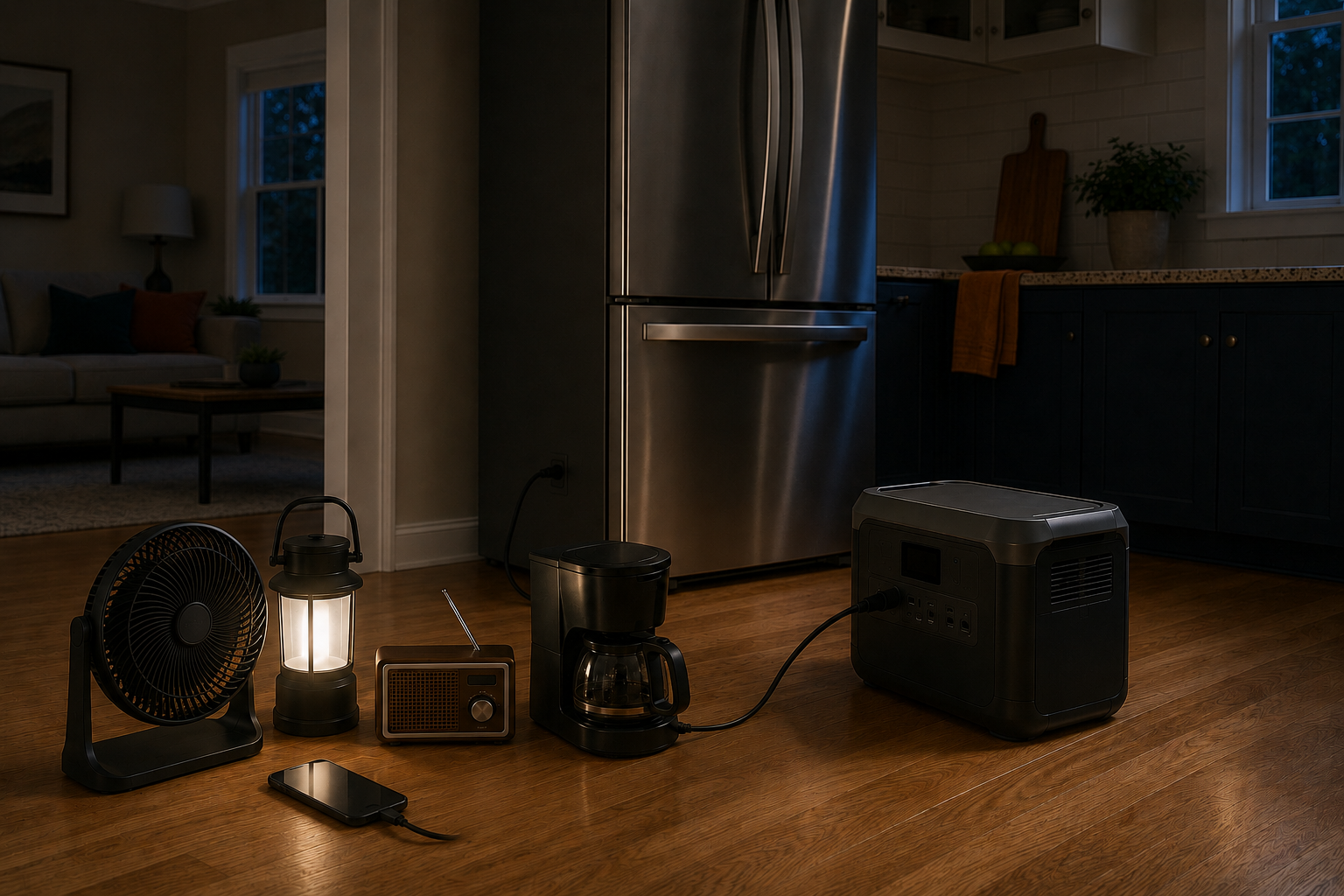
When the power goes out, the goal is not to recreate normal life. It is to keep the household safe, protect the things that matter and use limited backup power where it does the most good.
That means the first question is not, “How much can my generator or power station run?” It is, “What must keep working, and what can wait?”
Short Answer
Most households can cover a useful group of essentials with far less power than the whole house normally uses. A refrigerator, a few LED lights, phones, a modem or router and a portable fan may fit within a modest backup plan. Pumps, furnace blowers, medical equipment, cooking appliances and air conditioning require more careful planning.
Whether a load will work depends on four things:
- The power source’s continuous output
- The extra power a motor or compressor needs when it starts
- The voltage and connection the equipment requires
- How long the battery or fuel must last
A backup source can have enough watts to start a refrigerator but not enough stored energy to run it overnight. It can also have plenty of battery capacity but too little surge output to start the compressor. You have to check both power and runtime.
Power the Household in Layers
1. Protect health and immediate safety
Equipment that supports breathing, mobility, medication, temperature control or another health need comes first. Do not estimate a medical device’s requirements from a generic chart. Use its exact label and instructions, and confirm the backup plan with the device manufacturer, supplier and health-care provider.
Extreme heat or cold can also turn comfort into a safety issue. A fan may help someone feel cooler, but the CDC warns that fans alone do not prevent heat-related illness when temperatures are very high. Know where you can go if the home becomes unsafe.
2. Protect refrigeration and necessary household systems
A refrigerator or freezer is often the largest load in a basic outage plan. It cycles rather than running continuously, but its compressor can require several times more power for a moment when it starts.
A sump pump, well pump or furnace blower may be even more important in some homes. These loads often have motors, high starting demand, hardwired connections or 240-volt requirements. They should not be added to a portable setup by guesswork.
3. Keep communication and safe lighting available
Phones, a modem or router, a radio and a few LED lights usually use much less power than heating, cooling or cooking appliances. They are often the easiest loads to keep running, and they help the household receive alerts, contact others and move safely after dark.
Internet service may still be unavailable if the provider’s local equipment has lost power. Keep another way to receive emergency information.
4. Add comfort and convenience only after the essentials fit
A television, laptop, fan or small kitchen appliance may be reasonable when capacity allows. Electric heat, hot plates, toaster ovens, hair dryers and similar resistance-heating loads consume a large share of a small power station’s output and energy.
Use them only if the source, connection and runtime plan can safely support them. During a limited outage, a lower-power alternative is often the better choice.
A Quick Load Guide
These figures are planning examples, not ratings for your equipment. Check the appliance label and manufacturer’s information before relying on any backup source.
| Load or group | Typical planning demand | Main limit |
|---|---|---|
| Phone chargers, LED lights, modem/router | Usually tens of watts each or less | Add the label watts for every item. These are often the easiest loads to support. |
| Refrigerator or freezer | About 130–200W running; roughly 1,200–1,600W starting in Honda examples | The compressor’s startup surge and the appliance’s cycling determine output and runtime needs. |
| Portable fan | About 40W running and 120W starting in Honda’s example | Useful for comfort, but not a substitute for air conditioning in dangerous heat. |
| Laptop or television | Often about 50–250W each | Actual model, brightness, charging and use can change demand. |
| Microwave or coffee maker | Roughly 600–1,500W while operating | High draw but short use. It may be practical to run one by itself. |
| Sump pump, well pump or furnace blower | From hundreds to more than 2,000W; starting demand may be much higher | Check motor startup, voltage and whether the equipment is hardwired. |
| Space heater or portable electric cooking | Often about 1,300–1,500W | These loads can consume a small system’s output and stored energy quickly. |
| Central air, electric water heater, range or dryer | Several thousand watts; commonly 240V and hardwired | Usually outside a small portable-backup plan. Use a properly designed system. |
The ranges above are drawn from representative manufacturer planning examples. They show the scale of the problem; they do not replace the ratings for your equipment. A newer refrigerator, a larger pump or a different appliance may be far outside the example.
A Realistic Essential-Load Example
Suppose a household wants to run:
- A refrigerator using 200W after startup
- Four 10W LED bulbs
- A 40W portable fan
- A 15W modem and router
- Two phone chargers using 30W together
The combined running load is about 325W. That looks small, but the refrigerator may need about 1,600W for a moment when its compressor starts. If the other loads remain on, the source may need to supply roughly 1,725W during that start.
A backup source with 1,000W of continuous output but only 1,000W of surge output would not be a dependable match for this example. A source with sufficient surge capacity may operate the group, but runtime is a separate question.
For a generator, use How Much Generator Do I Need? to enter the actual running and starting figures. For a battery system, the refrigerator-runtime calculator can estimate how long the stored energy may last.
What a Portable Power Station Can Usually Handle
A portable power station is often a good fit for electronics, LED lighting, communication equipment and selected appliances that stay within its output limits. Larger stations may also operate a refrigerator, freezer, fan or certain medical devices if the exact startup, continuous-output and compatibility requirements are met.
The number marked in watts tells you how much power the station can deliver at one time. The number marked in watt-hours tells you roughly how much energy it stores. Neither number replaces the other.
A station that can start every connected load may still run out of energy quickly if it is powering a heater, cooking appliance or several devices continuously. Compare the two types of backup in Portable Power Station vs. Generator if you are still deciding which system fits your needs.
What a Portable Generator Changes
A portable generator can generally support larger or longer-running loads because it continues producing power while fuel is available. It still has output, voltage, receptacle, cord, fuel and connection limits.
Do not add loads until a generator trips and call that a plan. Overloading can shut the system down when an essential motor starts. It can also overheat an undersized cord or create other hazards.
A fuel-burning generator must operate outdoors only, at least 20 feet from the home, with the exhaust directed away from doors, windows and vents. Never operate one in a garage, porch, carport, shed or other enclosed or partly enclosed space. Never connect it to a wall outlet. Read the portable-generator safety guide before using one.
240-Volt and Hardwired Loads Are a Separate Decision
A wattage total does not tell you whether the equipment can be connected.
Many well pumps, sump pumps, furnace blowers, central air conditioners, electric water heaters, ranges and dryers are hardwired or require 240V. Many portable power stations provide only 120V, and a generator’s full advertised output may not be available through every receptacle.
Do not improvise a connection or alter household wiring. If the outage plan includes hardwired or 240V equipment, have a qualified electrician verify the power source, voltage, transfer equipment, inlet, breaker and local requirements.
Medical Equipment Needs Its Own Plan
An electrically powered medical device should not be treated as one more row in a household wattage chart.
Ready.gov recommends talking with the medical provider about a power-outage plan for devices and refrigerated medicines. The FDA also advises checking the device instructions or contacting the distributor or manufacturer to determine whether the equipment can be used with a battery or generator.
Confirm:
- The device’s exact input and startup requirements
- Whether it requires a particular power quality, accessory or backup battery
- How long it can safely be without power
- Who to contact if the backup fails
- Where the person can go if the home becomes unsafe
Do not change treatment, disconnect equipment or substitute an unapproved power source based on a generic online estimate. Make the medical backup plan with the appropriate provider and device professionals before an outage.
Manage Loads Instead of Powering Everything at Once
The 1960s sitcom Green Acres turned the need to manage generator loads into a running joke. Oliver Douglas assigned every appliance a number because the farmhouse generator could support only so much at once, and Lisa kept choosing combinations that exceeded the limit. The comedy was exaggerated; the electrical lesson was not. During a real outage, the same idea is called load management.
Think of a generator or power station as a power budget. The refrigerator, pump and essential equipment get first claim. A coffee maker, microwave, television or other convenience load can take a turn when the plan leaves enough room for essential equipment to restart.
Start large motors separately. Turn off a microwave, coffee maker or other high-draw appliance while a pump or refrigerator is starting. Charge phones and battery packs when other demand is low. Keep refrigerator and freezer doors closed so the compressors do not have to work as hard.
Remember that some equipment restarts automatically. A refrigerator, freezer, pump or furnace blower can switch on while another appliance is operating. If two large loads could start together, the source and connection plan must account for it or reliably prevent it.
Load management is not permission to exceed a rating. Every operating combination must remain within the limits of the power source, receptacle, cord, inlet and transfer equipment.
Make Your Outage Load List Before You Need It
Use this process while the power is still on:
- Divide equipment into “must run,” “helpful” and “can wait.”
- Record the voltage, running watts and starting watts from the label or official manual.
- Mark every motor, compressor, 240V load and hardwired connection.
- Add the running demand for equipment that may operate together.
- Add the largest realistic startup demand.
- Compare the result with every limit in the power path.
- Estimate how long the battery or fuel must last.
- Test the exact setup under safe, supervised conditions.
If a rating or connection is unclear, stop and verify it with the manufacturer or a qualified professional. Guessing low does not make the load smaller.
Bottom Line
During an outage, a few carefully chosen loads can do more for the household than trying to power everything.
Protect health first. Keep refrigeration, communication and safe lighting available. Add fans, electronics and short-use appliances only when capacity allows. Treat pumps, medical devices, hardwired equipment and 240V loads as special cases that require exact information.
Then calculate with the real ratings, plan the runtime and test the setup before the next outage.
If you are building the rest of the household plan, start with What to Do When the Power Goes Out.