
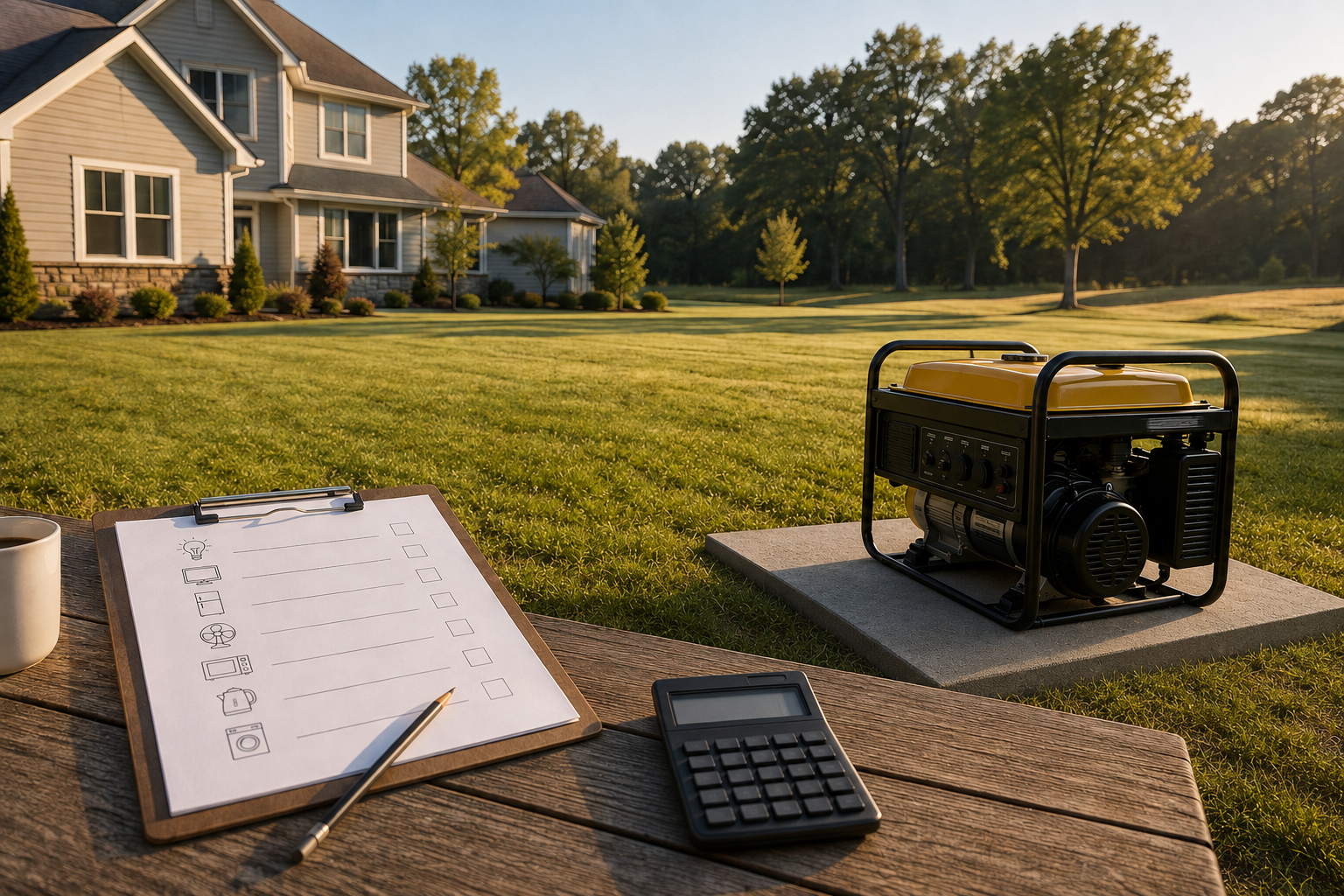
Shopping for a generator by house size sounds simple. A small house needs a small generator, a large house needs a large one and somewhere in the middle is the right answer for everyone else.
That shortcut does not work very well.
A 2,500-square-foot home with gas heat, gas water heating and a plan to power only the refrigerator, lights and phones may need less backup power than a much smaller all-electric home with a well pump, electric heat and medical equipment.
The right generator size depends on what your household actually needs to run—not the number of bedrooms or square feet.
The Short Answer
List the equipment you need during an outage. Add the running watts for everything that may operate at the same time. Then account for the additional power that the largest motor or compressor may require when it starts.
After that, confirm that the generator provides the correct voltage, enough output on the fuel you intend to use and a safe way to connect the equipment.
That calculation can help you estimate a portable generator for ordinary household essentials. If your plan includes central air conditioning, electric heat, a well pump, medical equipment, several large motors or most of the house, have a qualified electrician or generator professional confirm the size and connection system.
Decide What Needs Power
Do not start with the house’s square footage. Start with the outage you are planning for and the loads that protect health, safety and the home.
For many households, the first list includes:
- A refrigerator or freezer
- Necessary medical equipment
- A sump pump, well pump or furnace blower
- A limited amount of lighting
- Phones, radios and internet equipment
- Fans, a window air conditioner or another practical cooling plan
- Anything else the household cannot safely go without
Then separate essentials from conveniences. A microwave may be useful, but it does not have to run while a pump is starting. A clothes dryer may matter during a long outage, but it may not justify enough generator capacity to operate normally. Managing when equipment runs can reduce generator size, fuel use and cost.
If you are still deciding whether a fuel-powered generator is the right backup system, compare a portable power station and a generator before sizing either one.
Choose How Much of the House You Want to Power
Most backup-power plans fall into one of three levels:
- Plug-in essentials: A portable generator supplies a refrigerator, freezer, lights, chargers and other modest equipment through properly rated extension cords. This generally does not cover hardwired loads.
- Selected circuits: A qualified electrician installs approved transfer equipment and a power inlet so the generator can supply chosen household circuits. This also makes deliberate load management easier.
- Whole-home operation: Heating, central cooling, cooking and water heating can move the project beyond a simple portable-generator calculation. A standby system should be evaluated as one professionally installed electrical and fuel system.
Understand Running Watts and Starting Watts
Running watts are the power an appliance uses after it is operating. Starting watts—also called surge watts—describe the brief increase some motors and compressors need when they start.
Your generator must support the combined running load and a realistic startup event while the other planned loads are operating. This is why adding only running watts can produce a generator that looks adequate but trips or stalls when a refrigerator, pump, furnace blower or air conditioner starts.
Wattage charts use “starting watts” in two different ways. Some list the appliance’s total demand during startup. Others list only the additional watts above its normal running load.
For example, an appliance that uses 300 running watts and 1,200 total starting watts needs 900 additional watts during startup:
1,200 total starting watts − 300 running watts = 900 additional starting watts
If a chart already provides additional starting watts, do not subtract the running watts again. Always follow the definition used by the equipment manufacturer or calculator.
Where to Find the Wattage
Use actual equipment information whenever possible. Check:
- The appliance identification label or nameplate
- The owner’s manual
- The manufacturer’s official specifications
- The generator manufacturer’s sizing guide
- A qualified electrician, HVAC professional or equipment dealer for hardwired or high-demand loads
Generic wattage charts are useful for an early estimate, but they should not be treated as the exact requirement for every refrigerator, pump or air conditioner. Honda’s wattage guide and Champion’s wattage chart both show how widely common household loads can vary.
Some labels provide volts and amps instead of watts. Manufacturer guides sometimes estimate watts by multiplying volts by amps. That can be a useful planning shortcut for simple loads, but alternating-current motors and compressors introduce starting demand and other factors that the shortcut may not capture accurately.
If the label is unclear—or the equipment is hardwired—do not guess.
Common Household Wattage Estimates
The figures below are useful for early planning. They are not model-specific ratings. Use the appliance nameplate, owner’s manual or manufacturer’s specifications when available.
The “total starting watts” column is the appliance’s approximate total demand during startup—not just the extra surge above its running load. “Same as running” means the chart does not assign a separate startup surge. Voltage still must be checked separately, especially for pumps, water heaters and other hardwired equipment.
| Household load | Typical running watts | Typical total starting watts |
|---|---|---|
| Refrigerator | 150–400 W | 800–1,200 W |
| Freezer | 100–500 W | 500–1,000 W |
| Window AC (5,000 BTU) | 450–600 W | 900–1,200 W |
| Window AC (10,000 BTU) | 900–1,200 W | 1,800–2,400 W |
| Furnace fan (1/2 HP) | 300–800 W | 800–1,600 W |
| Sump pump (1/3 HP) | 500–800 W | 1,000–1,600 W |
| Sump pump (1/2 HP) | 800–1,050 W | 1,300–2,150 W |
| Well pump (1/2 HP) | 750–1,000 W | 1,500–2,000 W |
| Microwave | 600–1,200 W | Same as running |
| Space heater | 750–1,500 W | Same as running |
| Television (32–55 in.) | 80–400 W | Same as running |
| LED light bulb | 8–15 W | Same as running |
| Phone or laptop charger | 20–100 W | Same as running |
| CPAP with heated humidifier | 60–120 W | Same as running |
| Internet router and modem | 10–20 W | Same as running |
| Electric water heater | 3,000–4,500 W | Same as running |
How to Calculate Your Generator Requirement
Use this process for an initial estimate:
- List every appliance and device you expect to power.
- Record its voltage, running watts and total starting watts. Note whether a source gives total or additional starting watts.
- Decide which loads may operate at the same time and add their running watts.
- Find the largest additional startup demand likely to occur while the other loads are running.
- Add that startup demand to the simultaneous running total.
- Compare the result with the generator’s running and surge ratings, voltage, receptacles, breaker limits and output on the fuel you will use.
Do not plan to operate continuously at the absolute edge of the rating. Follow the manufacturer’s sizing guidance rather than applying an unsupported universal percentage.
Generator Sizing Calculator
Use the calculator on this page to add the appliances and devices that may run at the same time. Choose a built-in estimate or replace it with information from your own equipment.
The calculator reports the simultaneous running load, an estimated peak with the largest single startup event, a more conservative all-motors-start estimate and a warning for 240-volt loads.
Treat the results as planning figures—not a generator recommendation. Compare them with the generator’s fuel-specific running and surge ratings, voltage, receptacles, breakers and connection equipment.
Enter total starting watts, not only the extra startup amount. Add identical appliances as separate loads.
This calculator estimates electrical demand; it does not select a generator. Compare the result with the generator’s continuous and surge ratings on the fuel you will use, plus voltage, receptacles, breakers and connection equipment. Have hardwired, medical, central-HVAC, whole-home or uncertain loads professionally evaluated.
A Simple Household Example
Suppose a household plans to run a refrigerator, freezer, LED lights, internet equipment, chargers and a portable fan. Its estimated loads are:
- Refrigerator: 300 running watts; 1,200 total starting watts
- Freezer: 300 running watts; 1,000 total starting watts
- All other selected loads: 300 running watts
The simultaneous running load is 900 watts. The refrigerator adds the largest startup demand: 1,200 total starting watts minus 300 running watts, or 900 additional watts.
The estimated peak is therefore 900 running watts plus 900 additional starting watts, or approximately 1,800 watts.
That is a planning figure, not a recommendation to buy a generator labeled 1,800 watts. Actual equipment data, automatically cycling loads, voltage, connection limits and the manufacturer’s recommended allowance still matter. If the refrigerator and freezer could start together, account for that possibility or manage the loads.
Check the Generator, Not Just the Total Watts
A generator can have enough advertised wattage and still be wrong for the job. Before buying, check four things:
- Voltage: A 240-volt load requires a generator and connection system that provide compatible 240-volt power. An adapter cannot create voltage or capacity.
- Fuel rating: Dual- and tri-fuel generators may produce less power on propane or natural gas than on gasoline. Use the rating for the fuel you expect to burn.
- Continuous and surge output: Compare normal household demand with running watts and motor-starting demand with surge watts.
- The complete power path: Receptacles, breakers, cords, power inlets and transfer equipment can limit how much power reaches the load.
Generac’s guidance on portable-generator power limits illustrates why the largest number on the box may not be available through every protected receptacle. The generator is only one part of the system; every component between it and the appliance must be appropriate for the load.
If the plan includes a well pump, electric water heater, range, dryer, central air conditioner or other hardwired 240-volt equipment, have a qualified electrician verify the generator and connection plan.
Use Load Management Before Buying More Generator
You may not need to operate everything at once. A microwave, coffee maker or water heater can usually wait while a pump or compressor starts.
Honda’s sizing guidance shows how starting large loads at different times can allow a smaller generator to serve more equipment. Manual load management may be as simple as turning one appliance or circuit off before using another.
The plan still has to be realistic. Refrigerators, freezers, pumps and furnace blowers can restart automatically. If two large motors can start together, include that possibility in the calculation or use a dependable system that prevents it.
A smaller generator can cost less, use less fuel and be easier to move. The tradeoff is paying closer attention to what is running.
When to Stop Calculating and Call a Professional
A homeowner worksheet is useful for understanding the problem. It is not a substitute for professional sizing when the project includes:
- Central air conditioning or a heat pump
- Electric resistance heat or electric water heating
- A hardwired well pump, sump pump or furnace with uncertain starting data
- Medical equipment that cannot safely lose power
- Several large motors that may start together
- A connection to household wiring
- Whole-home standby operation
- A service panel, fuel supply or load requirement you do not understand
A qualified electrician can verify the actual loads, voltage, transfer equipment, inlet, breaker and local requirements. A standby-generator professional can also evaluate fuel supply, equipment placement and load-management options.
Safety First
Never connect a generator to a wall outlet. Supplying household wiring requires approved transfer equipment installed by a qualified electrician. Improper backfeeding can energize utility lines, injure or kill utility workers and create electrical or fire hazards.
Operate a portable fuel-burning generator outdoors only, at least 20 feet from the home, with the exhaust directed away from doors, windows and vents. Keep the generator and electrical connections dry, use working carbon-monoxide alarms and follow the manufacturer’s instructions.
Review our complete portable-generator safety guide before planning how the generator will be placed and connected. The U.S. Consumer Product Safety Commission also provides current generator and carbon-monoxide guidance.
Generator Sizing Checklist
Before choosing a generator, confirm that you have:
- Listed the loads that truly need power
- Used actual running, total starting and voltage information where available
- Calculated what may run at the same time and allowed for realistic motor starts
- Checked the generator’s ratings for the fuel you will use
- Checked receptacle, breaker, cord, inlet and transfer-equipment limits
- Decided how large loads will be managed
- Obtained professional help for hardwired, high-demand, medical or whole-home loads and planned a safe connection and operating location
Buy for the Plan, Not the House
The right generator is not the one assigned to your square footage by a generic chart.
It is the one that can safely support the electrical loads your household has decided are important—without depending on wishful math, an incompatible connection or more fuel than you can reasonably store and obtain.
Start with the loads. Calculate the running and starting demand. Check the voltage, fuel rating and connection limits. Manage what does not need to run at the same time.
Then choose the generator.
Once you own it, the work is not finished. Learn why a generator may not start after sitting and how often to run your generator so the equipment you sized carefully is actually ready when the power goes out.