
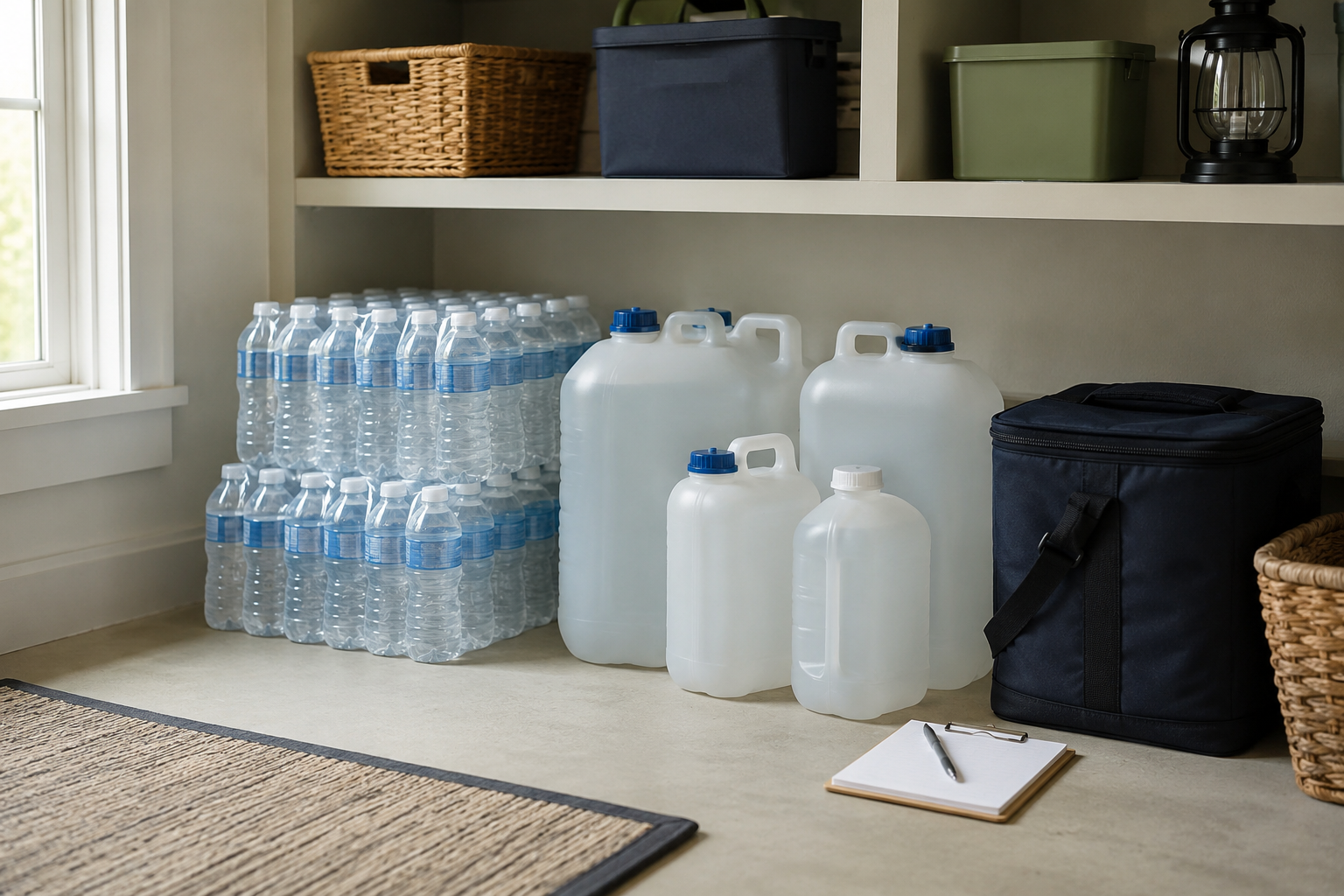
Water is easy to overlook because it is usually available with a turn of the faucet. Then a water main breaks, a storm contaminates the system, a private well pump loses power or local officials issue a drinking-water advisory—and the amount already in your home suddenly matters.
Unlike flashlights, batteries or canned food, water is bulky and heavy. A household can need dozens of gallons, yet many people have little more than a few bottles in the refrigerator.
The goal is not to fill every available corner with water. It is to establish a realistic minimum, adjust it for your household and build the supply in manageable stages.
The Short Answer
Store at least one gallon of water per person per day for a minimum of three days. If space and circumstances allow, work toward a two-week supply for use at home.
For a household of four, that means:
- 12 gallons for three days
- 28 gallons for seven days
- 56 gallons for fourteen days
Those figures are the human baseline. Pets, hot weather, illness, pregnancy, infant feeding and certain medical needs can increase the amount your household should have.
The one-gallon guideline includes water for drinking, cooking, brushing teeth and limited hygiene. It does not preserve normal household water use. It is not enough for regular showers, laundry, routine dishwashing or normal toilet flushing.
Think of one gallon per person per day as a minimum planning allowance—not a promise that every household will be comfortable on that amount.
How to Calculate Your Household’s Baseline
Use this simple formula:
Number of people × number of days = baseline gallons
Examples:
- One person for three days: 1 × 3 = 3 gallons
- Two people for seven days: 2 × 7 = 14 gallons
- Four people for fourteen days: 4 × 14 = 56 gallons
- Six people for fourteen days: 6 × 14 = 84 gallons
Do this calculation before choosing containers. The total quantity tells you how much storage space, lifting capacity and rotation work the plan will require.
Three Days, Seven Days or Two Weeks?
Three days is the minimum starting point.
The Centers for Disease Control and Prevention recommends storing at least a three-day supply. That is the first threshold to meet if your household currently has little or no emergency water.
Seven days is a practical intermediate goal.
A week provides more margin for a prolonged outage without making the first step feel impossible. It is not a separate government standard; it is a practical bridge between the minimum and a stronger home supply.
Two weeks is the stronger home-storage target.
The CDC advises trying to store a two-week supply when possible. The American Red Cross similarly recommends three days of water for evacuation and two weeks for use at home.
That distinction matters. An evacuation supply must be portable enough to load or carry. A home supply can be larger and divided among several safe locations.
If two weeks is not realistic today, do not let the larger number prevent you from storing three days. Meet the minimum first, then add another day or another case at a time.
Who Needs More Than the Baseline?
The one-gallon rule is not equally generous for every household. Review the following adjustments before treating your calculation as complete.
Hot weather and physical exertion
People generally need more drinking water in hot conditions and when doing strenuous work. Households preparing for summer hurricanes, extreme heat or outdoor cleanup should build extra margin into the baseline rather than assuming one gallon will always be enough.
Pregnancy and illness
CDC guidance specifically advises storing additional water for pregnant women and people who are sick. The amount will depend on the person and the circumstances, so the safest approach is to plan above the baseline and follow medical guidance when a health condition affects fluid needs.
Pets
Calculate pet water separately. There is no useful one-size-fits-all amount for every animal. A cat, a large dog and a household with several pets will not have the same needs.
Measure how much safe water your pets normally consume in a day, then add a margin for heat, stress, spills and cleaning bowls. The American Veterinary Medical Association recommends keeping at least seven days of water in a pet emergency kit. If your household is building toward a two-week home supply, extending the pet supply to the same period avoids leaving part of the household unprepared.
Infants
Water planning changes when an infant depends on formula. CDC guidance identifies ready-to-feed infant formula as the safest option during an emergency because it is sterile and does not require mixing with water. If powdered formula must be used, the household needs safe water for preparation and additional safe water for cleaning feeding items.
Water-dependent medical needs
A generic storage formula is not enough for someone whose care depends on dialysis or another water-sensitive medical plan. Follow the person’s healthcare provider or treatment facility instructions before an emergency. A prescribed fluid restriction can also conflict with ordinary emergency advice, so do not improvise a medical water plan from the one-gallon rule.
How Much Space and Weight Will It Take?
Water weighs about 8.34 pounds per gallon. The water alone in a fourteen-day supply for four people weighs about 467 pounds. For six people, 84 gallons weighs about 701 pounds.
That does not mean a two-week supply is unreasonable. It means the storage plan must account for weight and access.
- Do not place the entire supply on a questionable shelf.
- Do not store every container where one leak or obstruction could make all of it unusable.
- Keep at least part of the supply where it can be reached without moving heavy equipment.
- Use container sizes that household members can safely lift and pour.
Larger containers use space efficiently, but they are difficult to move once filled. Smaller containers are easier to carry and provide redundancy. Many households will be better served by a combination rather than one enormous container.
Apartment/Renter Note
Limited space does not make emergency water optional. Start with a three-day supply in smaller containers that fit the storage you actually have. Distribute the weight at floor level in sensible locations, protect containers from damage and keep enough water portable for an evacuation.
A two-week supply for a small household may still fit when it is divided rather than concentrated in one place. The goal is useful water you can safely reach—not an impressive container that cannot be moved.
Drinking Water and Utility Water Are Not the Same
The baseline calculation should represent water that is safe for drinking and food preparation. Do not count a swimming pool, hot tub, decorative pond or rain barrel as part of your drinking-water supply.
Some nonpotable water may be useful for toilet flushing or certain cleaning tasks when local conditions make that safe. Keeping a separate utility-water plan can protect the drinking supply, but questionable water should never be treated as safe merely because it looks clear.
Storage Basics That Affect the Quantity Plan
Container selection and water treatment deserve their own detailed guides. For purposes of calculating your supply, these rules are enough to prevent common planning mistakes:
- Unopened commercially bottled water is the safest and most reliable emergency supply, according to the CDC.
- Use food-grade water-storage containers when filling your own supply.
- Never use a container that previously held bleach, pesticides or other toxic chemicals.
- Label home-filled containers as drinking water and include the storage date.
- Replace home-filled water every six months.
- Follow the manufacturer’s date and storage directions for commercially bottled water.
- Store water in a cool place away from direct sunlight, gasoline, pesticides and other toxic substances.
Do not postpone the quantity calculation while searching for the perfect container. Safe bottled water can establish the first three days while you decide how to build the larger supply.
A Practical Water-Storage Plan
- Count every person who normally depends on the household.
- Multiply that number by three to establish the minimum human supply.
- Calculate pets and special household needs separately.
- Separate the water that must travel during an evacuation from the larger supply that can remain at home.
- Build from three days to seven days, then toward fourteen days when practical.
- Record where the water is stored and when it must be rotated.
This approach follows the same People → Risks → Inventory → Essentials → Gaps → Maintenance framework used in Start With the Basics. It also turns the water section of The Complete Home Emergency Preparedness Checklist into a measurable household target.
Your First Step
Count the people in your household and multiply by three. Then compare that number with the safe drinking water you already have.
If the calculation says twelve gallons and you have four, your immediate gap is eight gallons. Close that gap before worrying about specialized tanks, filters or a perfect long-term system.
Once the three-day minimum is in place, repeat the calculation for seven and fourteen days. That gives you a clear improvement path instead of one overwhelming purchase.
When the Water Emergency Begins
Use stored safe water for drinking, cooking, brushing teeth and any task covered by local drinking-water instructions. Follow official notices about whether tap water must be boiled, disinfected or avoided entirely.
Do not assume water is safe because it looks or smells normal. If your stored supply begins running low, Ready.gov advises against rationing drinking water unless authorities direct you to do so. Use what you need for health today while seeking an additional safe source for tomorrow.
If the disruption is related to a power outage, the steps in What to Do When the Power Goes Out can help you address the rest of the household safely while protecting your water supply.
The Bottom Line
Store at least one gallon per person per day for three days. Treat that as the minimum, not the finish line. Add water for pets and special needs, keep part of the supply portable and work toward two weeks at home when space and circumstances allow.
Emergency water storage does not need to happen in one expensive purchase. Count the household, close the three-day gap and build from there. A modest supply you can reach, rotate and use is more valuable than a perfect plan that never leaves the shopping list.
Sources Consulted
- CDC: How to Create an Emergency Water Supply
- Ready.gov: Water
- American Red Cross: Survival Kit Supplies
- American Veterinary Medical Association: Pets and Disasters
- CDC: Prepare and Store Powdered Infant Formula in an Emergency
- CDC: What to Do When You Need Dialysis During an Emergency
- U.S. Geological Survey: A Million Gallons of Water—How Much Is It?