
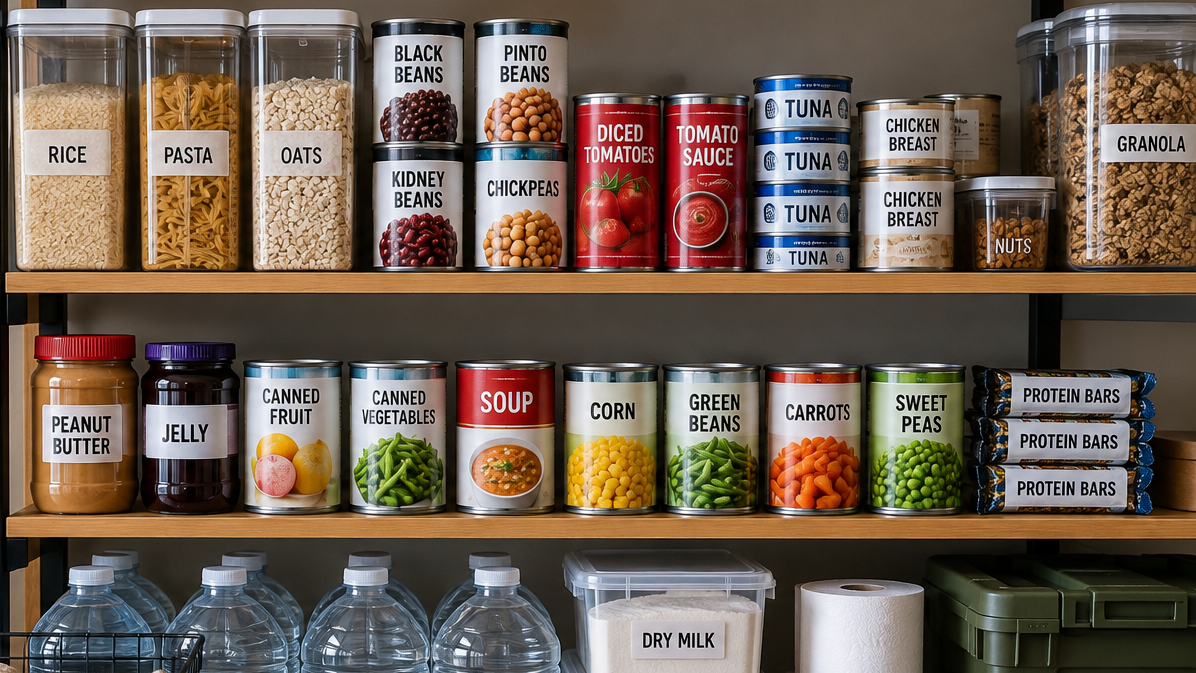
“How much emergency food do I need?” sounds like a question that should have one simple answer.
It does not.
A household with two adults who can cook during an outage has different needs from a family with young children, an older parent, food allergies, pets or no practical way to heat food. The right amount also depends on what kind of disruption you are preparing for and how long you want to be able to stay home without shopping.
Fortunately, you do not need to calculate every calorie your household might consume during a disaster.
A better place to begin is much simpler: choose how many days you want to cover, count the people you are feeding and build enough realistic meals for that period.
Start With a 3-Day Minimum
Federal preparedness guidance generally starts with enough food and other supplies to last several days. Ready.gov recommends keeping at least a several-day supply of nonperishable food, while North Carolina emergency preparedness guidance recommends enough food for three to seven days for each person and pet.
Three days is a useful starting point because it gives a household some breathing room during a short power outage, storm, transportation disruption or temporary store closure.
For one person, a basic three-day plan could mean:
- 3 breakfasts
- 3 lunches
- 3 dinners
- A few snacks or easy extras
For four people, the same three-day plan becomes 36 meal portions:
4 people × 3 days × 3 meals = 36 meal portions
That does not mean you need 36 cans or 36 individual packages. One box of cereal might provide several breakfasts. A pot of shelf-stable soup ingredients may provide several servings. The point is to count usable meals instead of counting packages.
Seven Days Is a Stronger Household Target
Once you have three days covered, moving toward seven days gives you substantially more flexibility.
ReadyNC recommends three to seven days of food and other supplies for each person and pet.
A seven-day food supply can help when an outage lasts longer than expected, roads are difficult to travel, stores reopen slowly or you simply prefer not to join the rush for groceries immediately after a storm.
Using the same simple calculation:
People × Days × Meals Per Day
A household of four planning for seven days would need:
4 × 7 × 3 = 84 meal portions
Again, that number is a planning tool, not a requirement to purchase 84 separate products.
Think in meals:
- What would everyone eat for breakfast?
- What could serve as lunch?
- What could serve as dinner?
- Which meals work without refrigeration?
- Which meals work without cooking?
If you can answer those questions for seven days, you have a much clearer picture of what you actually need.
Two Weeks Is a Practical Long-Term Home Goal
That makes two weeks a reasonable longer-term target for a household that has the storage space, budget and ability to rotate the food.
You do not have to reach two weeks immediately.
A practical progression is:
3 days → 7 days → 14 days
Build the first three days. Make sure the meals work. Then extend the same system to a week. Once that feels manageable, add the second week.
This approach fits the Ready Chateau philosophy much better than buying a large emergency-food package all at once and hoping it matches your household.
How Much Food Is That for Your Household?
Here is a simple planning table based on three meals per person per day.
| Household Size | 3 Days | 7 Days | 14 Days |
|---|---|---|---|
| 1 person | 9 meal portions | 21 | 42 |
| 2 people | 18 | 42 | 84 |
| 3 people | 27 | 63 | 126 |
| 4 people | 36 | 84 | 168 |
| 5 people | 45 | 105 | 210 |
| 6 people | 54 | 126 | 252 |
These numbers are not calorie recommendations. They are simply a way to make the size of the job visible.
A “meal portion” should represent what that person would realistically eat.
A six-year-old child and a large adult probably do not need identical portions. Someone with a medical diet may need completely different foods. Use the table as a planning framework, then adjust it to your household.
Do Not Build the Plan Around Calories Alone
You will sometimes see emergency-food plans built around a fixed number of calories per person per day.
That can be useful for specialized planning, but it is not the easiest approach for most households.
Calorie needs vary with age, body size, health, activity level and other factors. More importantly, a mathematically perfect calorie supply is not very useful if your family will not eat the food or cannot prepare it when the power is out.
For most homeowners, complete meals are easier to plan and easier to manage.
Instead of asking:
“How many calories are in the pantry?”
Ask:
“How many breakfasts, lunches and dinners can we actually serve?”
That question usually exposes shortages much faster.
Include Food You Can Eat Without Cooking
A household may have plenty of food and still have a problem if every meal requires a stove.
Your supply should include at least some meals that can be eaten without heating.
Examples might include combinations of:
- Peanut or other nut butter
- Crackers
- Canned or pouched meat or fish
- Ready-to-eat beans
- Canned fruit
- Shelf-stable milk
- Dry cereal
- Nutrition or granola bars
- Applesauce or fruit cups
- Other shelf-stable foods your household normally eats
USDA guidance also recommends keeping a hand-held can opener with an emergency food supply.
You do not need every meal to be no-cook. You do need enough options that losing electricity does not immediately make your emergency pantry useless.
Your Refrigerator and Freezer Are the First Layer — Temporarily
During a short outage, the food already in your refrigerator and freezer may be useful, but you should not count it as your entire emergency supply.
That means refrigerated and frozen food can sometimes become the first food you use during an outage.
But your longer-term plan should depend on shelf-stable food rather than assuming refrigeration will continue indefinitely.
Never taste food to determine whether it is safe after a power outage. Follow food-safety guidance based on time and temperature and discard questionable perishables.
Count Everyone You Are Actually Feeding
Emergency-food planning should include more than the number of adults in the house.
Consider:
- Children
- Older family members
- Overnight guests who may realistically shelter with you
- Infants
- People with allergies or medically necessary diets
- Pets
Government preparedness guidance specifically reminds households to include infant needs, special diets and pet food when building an emergency supply.
If your dog eats two cups of food per day, for example, a seven-day household plan needs at least seven days of dog food too.
Pets should not become an afterthought once the storm arrives.
Add a Little Margin
If your calculation says your household needs exactly 84 meal portions for seven days, you do not need to treat 84 as a magic number.
A small margin can cover:
- Larger appetites
- An extra person staying with you
- A damaged package
- A meal that does not work as expected
- A disruption lasting longer than planned
The goal is not to create an enormous stockpile. It is simply to avoid designing a plan with absolutely no room for error.
Watch Foods That Use a Lot of Water
Dry rice, pasta, dried beans and dehydrated meals can be useful because they store well.
But they also consume something else you need during an emergency: water.
Some foods require water for cooking. Others create pots and dishes that require additional water for cleanup.
That means emergency food and emergency water planning cannot be completely separated.
If a large portion of your food supply consists of dry foods, make sure your stored water plan includes the water required to prepare them.
This is one reason a combination of dry staples and ready-to-eat foods works well for many households.
A Simple Way to Build Your Supply
You do not need to fill an entire pantry this weekend.
Start with three days.
Write down what your household would realistically eat for breakfast, lunch and dinner. Include at least a few no-cook meals.
Then check your pantry.
You may discover that you already have much of the first three days.
Buy only what is missing.
Once three days are complete, repeat the process until you have seven. If your space and budget allow, gradually work toward two weeks.
Our guide Build an Emergency Food Supply Without Wasting Money explains how to choose foods your household will actually eat, select useful package sizes and rotate the supply instead of letting it expire in the back of a closet.
Example: A Family of Four for Seven Days
Suppose a four-person household wants one week of emergency food.
Their planning target is:
4 people × 7 days × 3 meals = 84 meal portions
They might divide that into:
- 28 breakfast portions
- 28 lunch portions
- 28 dinner portions
Then they plan actual foods.
Breakfast might rotate among cereal with shelf-stable milk, oatmeal when cooking is available and breakfast bars with fruit.
Lunch might include tuna or chicken with crackers, peanut butter, canned fruit, soup or shelf-stable meal combinations.
Dinner might include pasta, rice dishes, canned beans, canned meat, vegetables or other familiar pantry meals.
Some meals require cooking. Others do not.
That mixture is important. If the stove is unavailable, the family still has something useful to eat.
Do Not Forget the Foods People Actually Want
Emergency food is partly about nutrition, but morale matters too.
A week of eating unfamiliar food under stressful conditions is not likely to improve anyone’s mood.
Include a reasonable amount of familiar snacks, coffee or tea, powdered drink mixes, crackers, cookies or other comfort foods your household normally enjoys.
That does not mean filling the pantry with junk food.
It means recognizing that an emergency food supply is meant for real people living through an inconvenient or stressful situation.
Three Days First. Then Build From There.
You do not need a year’s worth of food to be better prepared tomorrow than you are today.
For most households, the sensible progression is straightforward:
Start with three complete days.
Build toward seven days.
Then consider a two-week home supply if your household, space and budget support it.
Count meals instead of cans. Include food that works without cooking. Account for children, dietary needs and pets. Make sure the food matches the water and cooking resources you actually have.
Most importantly, build a supply your household can really use.
An emergency pantry should not be a museum of food you hope never to touch. It should be an extension of the pantry you already live with every day.