
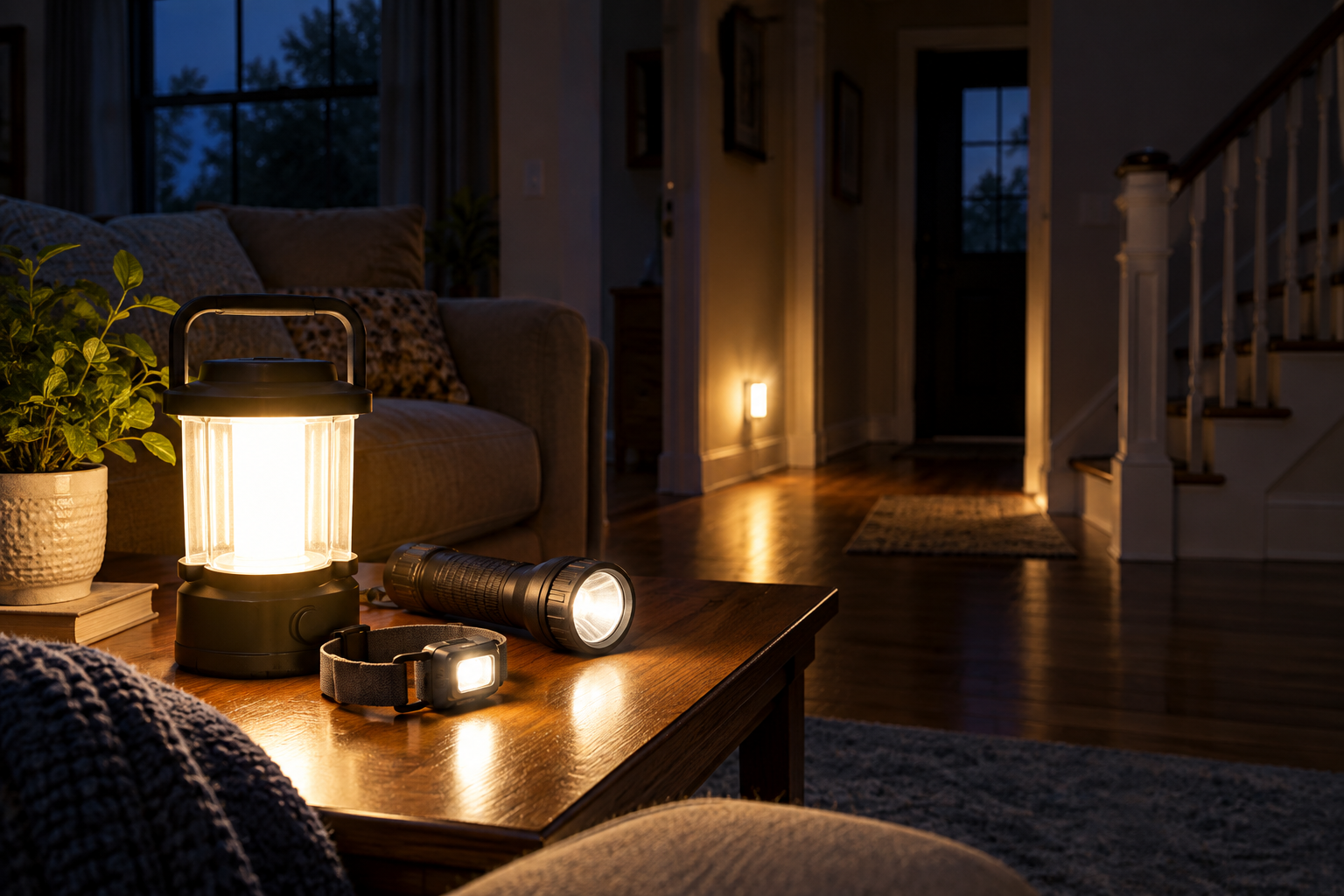
When my kids ask what I want for Christmas, my birthday or Father’s Day, I usually give them the same answer: a house can never have too many flashlights or tape measures.
Tape measures may not be especially useful during a power outage, but flashlights certainly are. So are headlamps, lanterns and the other forms of emergency lighting we will cover below.
Over the years, I have learned that owning several flashlights is not quite the same as being prepared. The batteries may be dead, the light may be buried in a drawer or every flashlight may somehow end up in the same room. When the power goes out after dark, you need working lights positioned where people can actually reach them.
Rooms that were familiar an hour ago suddenly have dark stairways, hidden obstacles and cabinets you cannot search without holding up your phone. Using your phone as a flashlight also drains the battery you may need for alerts, emergency calls and communication.
The best emergency lighting plan is not one extremely bright flashlight. It is a small group of reliable lights that handle different jobs throughout your home.
Quick Answer
Most homes should have one flashlight for every household member, at least one hands-free headlamp, one or two LED lanterns for shared rooms and a backup light that uses a different power source. Choose lights with multiple brightness settings and keep extra batteries with them.
The Best Emergency Lighting Setup for Most Homes
A practical home setup includes:
- One flashlight for each person
- At least one headlamp for hands-free work
- One or two LED lanterns for shared living areas
- Automatic emergency lights near stairs or hallways
- A backup light with a different power source
- Extra batteries stored in a cool, dry place
This combination provides personal lighting, room lighting and redundancy without making the system unnecessarily complicated.
Ready.gov recommends having a flashlight for every household member. That is a good starting point, but flashlights alone do not solve every lighting problem during an extended outage.
Four Emergency Lights We Would Keep at Home
These four lights are not competing for the same job. Each fills a different role in a practical home lighting plan: automatic light when the power first fails, hands-free light for essential tasks, dependable battery-powered room lighting and a brighter rechargeable lantern with another way to generate power.
Affiliate disclosure: Ready Chateau may earn a commission from qualifying purchases made through links on this page, at no additional cost to you.
1. Energizer Auto-On Rechargeable LED Flashlight
The first few seconds of an outage are often when emergency lighting matters most. This Energizer light stays plugged into an outlet and charges while utility power is available, then turns on automatically when the power fails. You can also remove it from the outlet and use it as a handheld flashlight. We like it near a hallway, staircase or bedroom where immediate light can help someone move safely before the other emergency lights are located.
Limitation: Its built-in rechargeable battery has limited runtime, so we would use it as the automatic first layer of an emergency lighting plan—not as the primary light for a long outage.
Check the Energizer Auto-On Rechargeable LED Flashlight on Amazon
2. COAST FL75 Headlamp — Best for Hands-Free Tasks
A headlamp is most useful when the job requires both hands. The COAST FL75 provides up to 700 lumens, an adjustable beam and a red-light option, but the feature we especially like for emergency preparedness is its use of three common AAA batteries. During a long outage, you can replace depleted batteries immediately instead of waiting for a light to recharge.
Limitation: At its highest brightness, it will use batteries much faster. For most indoor tasks, use a lower setting and save maximum output for situations where you actually need it.
Check the COAST FL75 Headlamp on Amazon
3. Streamlight Siege AA Lantern — Best for Replaceable-Battery Room Lighting
The Streamlight Siege AA is designed for area lighting rather than throwing a narrow beam across a long distance. It produces up to 200 lumens and uses three AA batteries. On its 50-lumen low setting, Streamlight rates it for up to 37 hours of runtime. It also includes red and SOS modes, is waterproof, and floats if dropped in water. We like it as a dependable room lantern that does not depend on household power or a rechargeable battery.
Limitation: Its 200-lumen maximum output is modest compared with larger rechargeable lanterns. That is intentional in our setup—we would use the Siege AA for efficient, dependable lighting and use a higher-output lantern when more light is actually needed.
Check the Streamlight Siege AA Lantern on Amazon
4. Goal Zero Lighthouse 600 — Best for Rechargeable Area Lighting
The Goal Zero Lighthouse 600 provides up to 600 lumens for lighting a larger shared area. Its built-in rechargeable battery can be charged by USB or a compatible solar panel, and it can also provide USB power to a small device such as a phone. The built-in hand crank adds another charging option when other power sources are unavailable. We like it as the higher-output rechargeable part of the system rather than as the only lantern in the house.
Limitation: Treat the hand crank as an emergency backup, not the primary charging method. Cranking produces relatively little energy compared with USB or solar charging, and using the lantern at high brightness will shorten runtime considerably.
Check the Goal Zero Lighthouse 600 on Amazon
You do not need to buy all four of these products if you already own reliable lights that fill the same roles. The goal is the system, not the brand names: immediate automatic light, hands-free light, dependable replaceable-battery lighting and rechargeable area lighting. Use what you already have when it works, then fill the gaps in your setup.
Flashlights for Personal Use
A dependable flashlight is still the most important emergency light to own.
It gives you a focused beam for moving through the house, checking outside, finding supplies or inspecting a problem. Every person should know where their flashlight is stored and be able to reach it without crossing a dark room.
Look for a flashlight with:
- Low, medium and high brightness settings
- A simple physical power button
- A textured or nonslip grip
- A battery indicator
- Water resistance
- A shape that will not roll off a table
- Common, easy-to-replace batteries
The brightest flashlight is not automatically the best one. A lower setting is usually more comfortable indoors and preserves battery power. High brightness is more useful when checking a yard, driveway or exterior damage.
Headlamps for Hands-Free Tasks
A headlamp becomes surprisingly useful once you have to cook, provide first aid, carry supplies or check an electrical panel in the dark.
Because the light follows your line of sight, both hands remain available. That makes a headlamp especially useful for:
- Preparing food
- Helping children or older adults
- Administering first aid
- Handling tools
- Checking a generator from a safe location
- Walking a pet
- Navigating stairs while carrying something
Choose a headlamp with an adjustable strap and more than one brightness level. A very bright, single-setting headlamp can be uncomfortable indoors and may blind anyone who looks toward you.
A red-light mode can be useful when you want enough light to move around without fully disrupting your night vision, but it is an optional feature rather than a necessity.
LED Lanterns for Lighting a Room
Lanterns spread light across a room instead of concentrating it into a narrow beam. They work well on a kitchen counter, dining table or bathroom shelf.
The best emergency lantern should have:
- A wide, even light pattern
- Multiple brightness settings
- A stable base
- A carrying handle
- A hook for hanging
- A battery indicator
- Enough runtime to last through the night on a lower setting
Avoid relying on one oversized lantern for the entire house. It may create glare in one room while leaving hallways, bathrooms and bedrooms completely dark.
Two smaller lanterns are often more useful than one extremely bright model because they can be placed where people actually need them.
Automatic Emergency Lights for Hallways and Stairs
Plug-in emergency lights remain charged while power is available and turn on automatically when the electricity goes out.
They are particularly helpful near:
- Stairways
- Main hallways
- Bedrooms
- Bathrooms
- Exterior doors
An automatic light gives everyone immediate visibility before flashlights or lanterns have been located. This can reduce the chance of a fall during the first confusing moments of an outage.
These lights should not be your only emergency lighting. Their internal batteries still need to be tested, and their useful runtime may be limited. Treat them as an automatic first layer, not the entire plan.
Solar and Hand-Crank Lights as Backups
Solar and hand-crank lights can provide another way to produce light when replacement batteries or household power are unavailable.
They are most useful as secondary lights because charging speed depends on the product, available sunlight and the amount of time spent cranking. A small solar panel that works well during a sunny afternoon may be far less effective during several days of stormy weather.
Keep one if it adds useful redundancy, but do not make it your only source of emergency light.
What Do Lumens Mean?
Lumens describe how much visible light a product produces. A higher number means a brighter light.
Watts measure the electrical power a light uses, not how bright it appears. When comparing modern LED lights, lumens are more useful than watts.
As a practical starting point:
- A low setting is best for reading, close work and conserving batteries.
- A moderate setting works well for most indoor navigation and room lighting.
- A high setting is useful for outdoor checks and longer distances.
Do not shop by the maximum lumen number alone. Multiple brightness settings and useful runtime are usually more valuable during a power outage than a very bright mode that quickly drains the battery.
Choose a Useful Beam Pattern
Flashlights generally produce one of two beam styles.
A flood beam spreads light across a wider area. It is comfortable indoors and useful for close work.
A spot beam reaches farther and is better for checking a yard, driveway or distant object.
Some flashlights allow you to adjust between the two. If you are purchasing one general-purpose emergency flashlight, a balanced or adjustable beam provides the most flexibility.
Battery-Powered or Rechargeable?
Both options have advantages. The most reliable plan is to avoid depending entirely on one battery system.
Replaceable-Battery Lights
Lights powered by common disposable batteries can be restored immediately by installing a fresh set. They are useful during long outages when wall charging is unavailable.
Their disadvantages include battery leakage, the cost of replacements and the need to keep the correct sizes on hand.
Rechargeable Lights
Rechargeable lights are convenient for regular use and reduce the number of disposable batteries you need to buy. However, they must be charged before an outage begins.
A rechargeable light that has been sitting untouched for a year may not be ready when you need it.
Dual-Power Lights
Some lights can operate from a rechargeable battery pack or standard replaceable batteries. This can provide excellent flexibility, provided both power options are tested and stored correctly.
For most households, a mix works well: rechargeable lights for regular use and at least one replaceable-battery light as a backup.
Standardize Your Batteries When Possible
Emergency lighting becomes easier to maintain when several devices use the same battery size.
Instead of keeping four or five different battery types, consider choosing lights that mostly use one or two common sizes. This reduces confusion and makes it easier to rotate your supply.
Store batteries:
- In a cool, dry location
- In their original packaging when possible
- Away from metal objects
- Away from excessive heat
- Separately from damaged or leaking batteries
Do not mix old and new batteries or combine different battery types in the same device. Follow the light manufacturer’s instructions for the correct batteries and charging equipment.
Features Worth Paying For
Emergency lights do not need dozens of modes. A few practical features matter more.
Multiple Brightness Settings
A lower setting extends runtime and reduces glare indoors. Save the highest setting for situations where you truly need it.
Battery-Level Indicator
An indicator helps you identify a weak battery before the outage.
Easy Controls
The power button should be easy to find and operate in the dark. Complicated sequences and tiny switches become frustrating when you are under stress.
Stable Base or Hanging Hook
A flashlight that can stand upright or a lantern that can hang overhead becomes much more useful as temporary room lighting.
Water Resistance
Storm-related outages may require you to step outside in rain or handle the light with wet hands. Some level of water resistance is valuable for an emergency light.
Lockout Feature
A lockout prevents a light from switching on inside an emergency kit and quietly draining its battery.
Where to Keep Emergency Lights
A flashlight stored somewhere in the garage will not help when the power goes out while you are upstairs.
Keep lights where you can reach them without navigating through darkness:
- Beside each bed
- Near the main living area
- In or near the kitchen
- Near stairs
- With the household emergency kit
- Near—but not directly on—the electrical panel
- In each vehicle
Do not place every light in one container. If that area becomes inaccessible, the entire lighting supply becomes inaccessible with it.
If hurricanes are a concern where you live, add emergency lighting to your Hurricane Preparedness Checklist before the storm arrives.
How Many Emergency Lights Does a Home Need?
There is no single number that fits every home, but this is a practical starting point:
- One personal flashlight per household member
- One headlamp for each adult who may need to perform tasks
- One lantern for the main shared living area
- One additional lantern for another floor or major room
- One automatic light near a central hallway or staircase
- One backup light in the emergency kit
Larger homes, multi-level homes and households with mobility concerns may need additional pathway lighting.
The goal is not to illuminate every room as brightly as normal. The goal is to let everyone move safely, complete essential tasks and preserve battery power.
Test Your Lights Before You Need Them
Emergency lighting is only useful if it works.
Add a quick lighting check to your regular home-preparedness routine:
- Turn on every flashlight, headlamp and lantern.
- Test every brightness setting.
- Check for battery corrosion or leakage.
- Recharge rechargeable models according to the manufacturer’s instructions.
- Replace damaged batteries, charging cables or lights.
- Confirm that spare batteries are still in good condition.
- Check the Consumer Product Safety Commission recall database for rechargeable products.
Test automatic plug-in lights by unplugging them or using their test button.
A monthly check is ideal, but attaching the task to an existing routine—such as testing smoke alarms or reviewing your emergency supplies—makes it easier to remember.
Power Outage Lighting Mistakes to Avoid
Depending on Your Phone
A phone flashlight is useful for the first few minutes, but it drains the same battery you need for weather alerts, communication and emergency information.
Buying Only One Very Bright Light
One light cannot be in the kitchen, hallway and bedroom at the same time. Several modest lights placed around the home are more useful.
Ignoring Low-Mode Runtime
Product packaging often emphasizes maximum brightness. During a long outage, runtime on a lower setting may matter much more.
Storing Lights Without Checking the Batteries
Disposable batteries can leak, and rechargeable batteries gradually lose their charge. An untested light should not be considered ready.
Using Candles for Primary Lighting
The U.S. Fire Administration advises using flashlights instead of candles during power outages. Open flames can be knocked over, left unattended or placed too close to combustible materials.
Battery-operated flameless candles can provide gentle marker lighting, but they should not replace a flashlight or lantern for navigation and essential tasks.
Using Fuel-Burning Lanterns Indoors
Do not use gasoline-, propane- or other fuel-burning camping lanterns inside your home, garage, tent or camper. They create both fire and carbon-monoxide hazards.
The CDC recommends battery-powered flashlights and lanterns rather than candles, gas lanterns or torches. Use battery-powered flashlights and LED lanterns indoors.
A Simple Emergency Lighting Plan
If you are starting from scratch, you do not need to buy everything at once.
Begin with:
- One flashlight for every person
- One LED lantern for the main living area
- One headlamp
- A package of compatible replacement batteries
- One backup light with a different power source
Place the lights around the home, show everyone where they are and test them regularly.
If you also operate a portable generator, lighting is only one part of safe outage preparation. Review Extension Cords for Generators before connecting equipment.
Final Recommendation
I still believe a house can never have too many flashlights. But preparing for a power outage involves more than collecting them over the years and dropping them into different drawers.
The lights need to work, everyone needs to know where they are, and each one should have a purpose.
Use flashlights for personal movement, headlamps for hands-free tasks, lanterns for shared rooms and automatic lights for immediate visibility in hallways. Include more than one power source, keep extra batteries ready and test everything regularly.
You do not need enough emergency lighting to make your home look as though the power never went out. You need enough reliable light to help everyone move safely, care for one another and handle essential tasks until the electricity returns.
And if my kids are still wondering what to get me for Father’s Day, another good flashlight will never go to waste. I probably have enough tape measures—for now.