
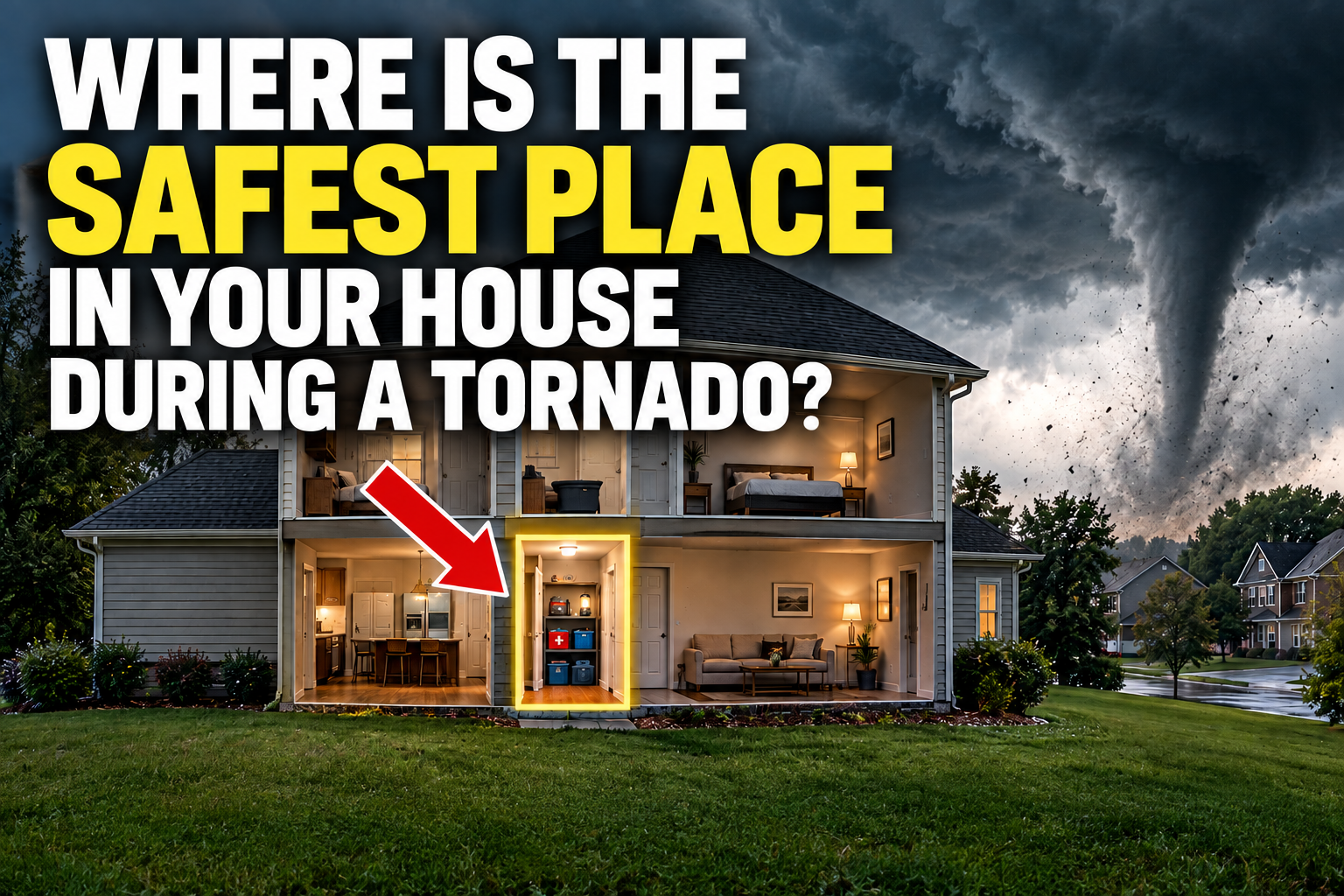
When a Tornado Warning is issued, you should not be trying to decide where to go. You should already know.
The safest location depends on how your home is built, but the basic rule is simple: get as low as possible, stay away from windows and exterior walls, and put as many walls as possible between you and the outside.
There is no completely safe place during a tornado. But some locations offer considerably more protection than others, especially from flying and falling debris. (CDC)
Short Answer
The safest place in your house during a tornado is a properly constructed storm shelter or safe room. If you do not have one, go to the interior portion of a basement. If your home has no basement, choose a small, windowless interior room on the lowest floor, such as a closet, bathroom or interior hallway.
Stay away from windows, doors and exterior walls. Once you are in your shelter location, get low and protect your head and body from flying or falling debris. (CDC)
The important part is choosing that location before severe weather arrives.
What Is the Safest Place in a House During a Tornado?
Think of tornado protection as a hierarchy.
- A properly constructed tornado safe room or storm shelter
- An underground storm cellar
- The interior portion of a basement
- A small, windowless interior room on the lowest floor
- An interior hallway on the lowest floor
A safe room designed to FEMA criteria provides the highest level of protection because it is specifically designed to resist extreme winds and wind-borne debris. FEMA describes properly designed safe rooms as providing near-absolute life-safety protection during extreme-wind events. (FEMA)
Most homes, however, do not have a dedicated safe room.
That means you need to identify the safest available location in the home you already have.
If Your House Has a Basement
If you have a basement, that is generally where you should go.
The Centers for Disease Control and Prevention identifies the interior part of a basement as the safest location in a typical home. (CDC)
But simply being somewhere in the basement is not the entire answer.
Choose an area:
- Away from basement windows
- Away from exterior doors
- As far inside the basement as practical
- Away from heavy objects located directly above you
- Under sturdy protection if available
For example, you probably would not want to shelter directly beneath a refrigerator, piano or other very heavy object on the floor above. If the structure fails, that object could fall into the basement. (CDC)
A sturdy workbench or the area beneath a strong interior stairway may provide additional protection from falling debris. (National Weather Service)
The basement is good. The protected interior portion of the basement is better.
If Your House Does Not Have a Basement
Many homes do not have basements, particularly in parts of the South.
In that case, go to the lowest floor and look for the smallest interior room you can find.
Good possibilities include:
- An interior closet
- A windowless bathroom
- A small interior hallway
- A protected space beneath an interior stairway
The ideal room has no windows and no exterior walls.
The National Weather Service recommends getting as low as possible and putting as many barriers between yourself and the outside as possible. (National Weather Service)
Imagine drawing a line from your shelter location to the outside of the house. The more walls between you and the outdoors, the more barriers flying debris must penetrate before reaching you.
That is why a small closet in the center of the house may be a much better choice than a large bedroom along an exterior wall.
Is a Bathroom or Bathtub Safe During a Tornado?
It can be—but a bathroom is not automatically a safe tornado shelter simply because it has a bathtub.
A small bathroom can be a good shelter when it is:
- On the lowest floor
- Near the center of the house
- Away from exterior walls
- Windowless
A bathroom with a large window on an outside wall may be a worse choice than an interior closet or hallway.
The National Weather Service specifically warns against assuming there is something inherently protective about climbing into a bathtub. What matters most is the location of the bathroom within the structure. (National Weather Service)
If your safest interior room happens to be a bathroom, the bathtub may offer some additional physical protection. But the tub does not turn a poorly located bathroom into a good tornado shelter.
Choose the room first. Consider the bathtub second.
Is a Closet Safe During a Tornado?
An interior closet can be one of the best options in a house without a basement or dedicated safe room.
Look for a closet that is:
- On the lowest floor
- Small
- Windowless
- Away from exterior walls
- Near the center of the house
Close the door when you shelter.
A walk-in closet along an exterior bedroom wall is not necessarily safer than a much smaller coat closet near the center of the house. Again, location matters more than the name of the room. (National Weather Service)
If an interior closet is going to be your family’s tornado shelter, make sure everyone can actually fit inside it. Clearing unnecessary storage out of the space before tornado season can make a surprisingly big difference when you need to get everyone inside quickly.
Is Under the Stairs Safe During a Tornado?
It can be.
The space beneath an interior stairway may provide a useful shelter location, particularly if it is on the lowest floor and away from windows and exterior walls. National Weather Service guidance includes stairwells and spaces beneath stairs among possible protected locations. (National Weather Service)
But the same rules still apply.
A stairway along an exterior wall surrounded by windows is not automatically safe just because there are stairs above it.
When comparing two possible shelter locations, favor the one that gets you:
lower, farther inside and farther away from glass.
What Rooms Should You Avoid?
Some locations in a house should move toward the bottom of your list.
Avoid:
- Rooms with windows
- Rooms along exterior walls
- Upstairs bedrooms
- Large open rooms
- Sunrooms
- Garages
- Rooms with large expanses of glass
Upper floors generally provide less protection than lower floors, and exterior rooms expose you more directly to wind and flying debris. (National Weather Service)
Do not waste time opening windows to “equalize the pressure.” That is an old tornado myth. Opening windows does not protect the house and costs you time that should be spent getting to shelter. (National Weather Service)
There is also no special “safe corner” of the house. Another old myth says the southwest corner is safest. The National Weather Service recommends a small interior room near the center of the building instead. (National Weather Service)
What If You Live in a Two-Story House?
Go downstairs.
If your two-story home has a basement, use it.
If it does not, identify a protected interior location on the first floor.
Do not choose an upstairs closet or bathroom simply because it is convenient to the bedrooms. Tornadoes do not always arrive when everyone is awake and downstairs.
If severe weather is expected overnight, make sure everyone in the house knows where the first-floor shelter is and how to reach it quickly in the dark.
Keep shoes and a flashlight nearby. Broken glass, nails and debris can make walking through a damaged home dangerous after the storm.
For a broader household tornado plan—including warning methods, overnight storms, children and pets—see our guide on How to Prepare Your Home for a Tornado.
What About a Mobile or Manufactured Home?
A mobile home requires a different plan.
Do not treat a bathroom, closet or hallway inside a mobile home as your tornado shelter.
The CDC advises people not to remain in a mobile home during a tornado. Even homes with tie-down systems can be overturned or destroyed by strong winds. (CDC)
Your tornado plan should identify a sturdier shelter you can reach before the tornado arrives, such as:
- A community storm shelter
- A nearby designated tornado shelter
- A sturdy building
- A nearby home with a basement or safe room
Because tornado warnings can provide very little time, deciding where you will go should happen long before the warning appears on your phone.
Make Your Safe Place Safer Before the Warning
Once you identify the best location in your home, turn it into a place you can use immediately.
Consider keeping these items there or close enough to grab without delaying shelter:
- Flashlights
- Sturdy shoes
- Blankets or other thick coverings
- A first-aid kit
- A battery-powered or hand-crank weather radio
- Phone charging capability
- Essential medications
- Supplies for children or pets
- Identification and important emergency information
Protecting your head and neck is particularly important because flying and falling debris is a major tornado hazard. CDC recommends covering your body when possible and protecting your head with whatever is readily available. (CDC)
If you choose to keep helmets in your shelter area, have them there ahead of time. Do not delay taking shelter because you are searching the house for protective gear after a warning has been issued. (CDC)
For a step-by-step household preparation list, use our Tornado Preparedness Checklist for Homeowners.
And because warnings may be your only notice that it is time to move, consider having more than one way to receive them. Our guide to NOAA Weather Radios for Tornadoes and Severe Weather explains the options.
Choose Your Safe Place Today
You do not need a perfect shelter to make a safer decision.
Walk through your house and ask four questions:
How low can we get?
How far can we get from windows?
How many walls can we put between ourselves and the outside?
Can everyone in the household get there quickly?
If you have a properly constructed safe room or storm shelter, use it. Otherwise, choose the best protected location your home provides: preferably the interior portion of a basement, or a small, windowless interior room on the lowest floor.
Then tell everyone in the household where it is.
When a Tornado Warning is issued, the safest room in your house should already be decided.