
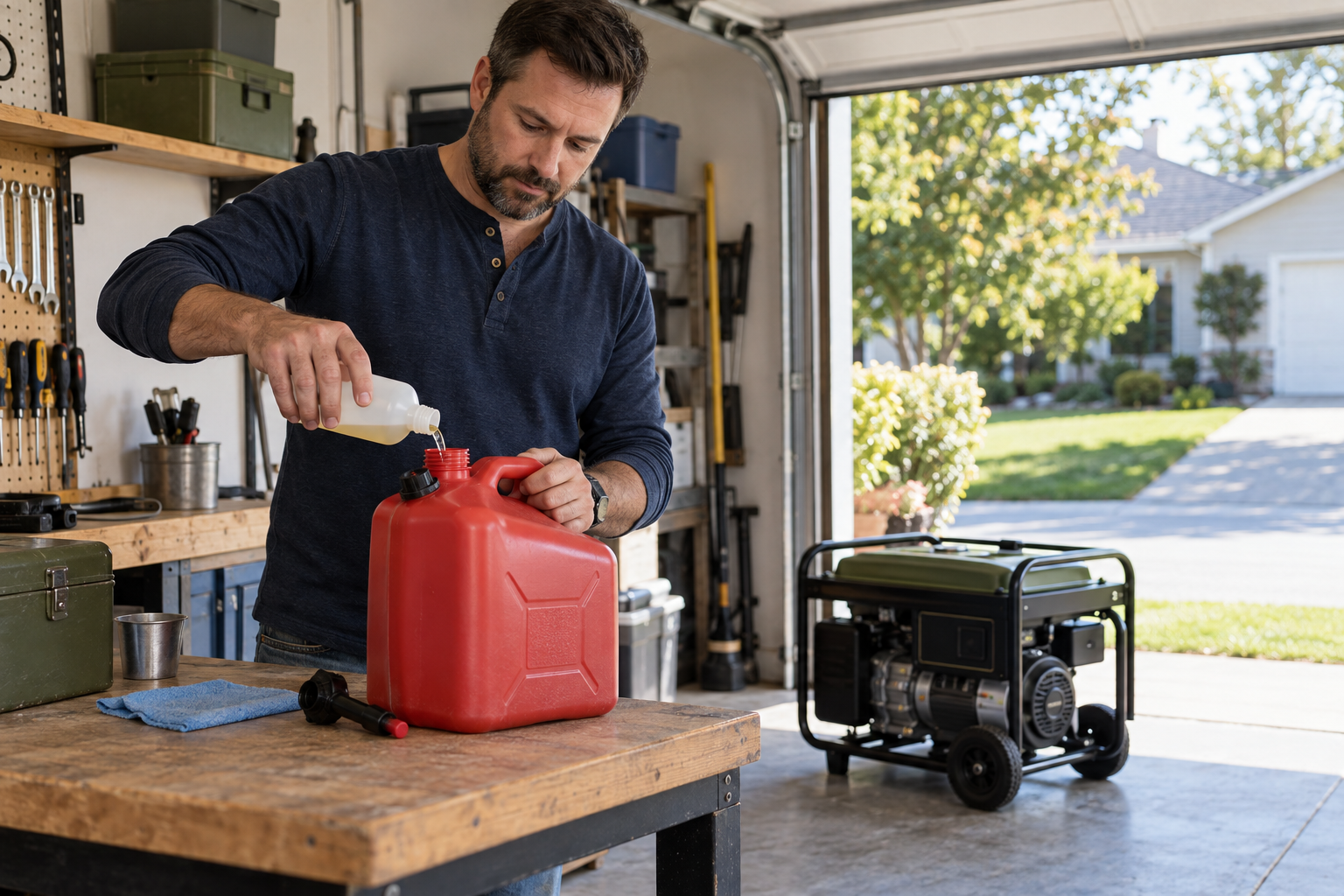
Fuel stabilizer is useful for many portable generators, but it is not magic in a bottle.
Added correctly to fresh gasoline, stabilizer can slow fuel deterioration while a generator sits unused. It cannot restore gasoline that has already gone stale, clean a clogged carburetor or replace the storage procedure in your generator’s owner’s manual.
The practical answer is simple: Use fuel stabilizer when you plan to keep gasoline for later use and your generator manufacturer allows that storage method. Use it correctly, circulate it through the fuel system and do not treat it as permission to forget the fuel indefinitely.
What Fuel Stabilizer Actually Does
Gasoline begins changing as it sits. Its lighter components evaporate, oxidation occurs and deposits can develop inside the fuel system. Heat, air and moisture can accelerate the process.
Fuel stabilizer is designed to slow that deterioration. It may help reduce the gum and deposits that contribute to hard starting, rough running and clogged carburetor passages.
What it does not do is equally important:
- It does not make old gasoline fresh again.
- It does not remove water from contaminated fuel.
- It does not clean an already clogged carburetor.
- It does not guarantee that gasoline can remain in every generator for the same length of time.
- It does not override the generator manufacturer’s instructions.
Honda specifically warns that fuel stabilizer will not reconstitute stale fuel. Its generator guidance also recommends draining the carburetor during longer periods of inactivity for certain models. See Honda’s generator fuel guidance.
When Stabilizer Makes Sense
Fuel stabilizer is usually worth considering when:
- You keep gasoline on hand for outages.
- Your generator may sit unused for more than a few weeks.
- You rotate stored fuel rather than buying it only when a storm approaches.
- Your owner’s manual permits storage with treated gasoline.
- You want fresh treated fuel available for periodic generator testing.
Adding stabilizer to the portable fuel container when it is filled is often more practical than waiting until the gasoline has been sitting for months. That way, you know when the fuel was treated and can use it in either the generator or another compatible gasoline engine during normal rotation.
When Draining May Be the Better Choice
Stabilizer is not always the complete storage answer.
Some manufacturers recommend draining the carburetor even when stabilized fuel remains in the tank. Others recommend emptying the entire fuel system for extended or indefinite storage. Instructions can also differ among models from the same manufacturer.
Honda, for example, provides different procedures depending on storage time. Generac also directs owners to consult the storage instructions for their particular generator and describes both treated-fuel and drained-fuel methods. See Generac’s portable-generator storage guidance.
This is why a universal rule such as “add stabilizer and forget about it” is unreliable.
If you do not know when the generator will be used again, or its manual calls for draining, follow that procedure. See our guide to storing a portable generator for the broader storage process.
How to Use Fuel Stabilizer Correctly
1. Start with fresh gasoline
Stabilizer works best when added before the gasoline has deteriorated. Pouring it into fuel that already smells stale or has been sitting for an unknown period does not reset the clock.
2. Follow the product label
Measure the amount specified for the volume of gasoline you are treating. More is not automatically better, and different products may use different treatment ratios.
3. Follow the generator’s manual
Check whether the manufacturer wants the tank filled, the carburetor drained or the fuel system emptied for your expected storage period.
4. Circulate the treated fuel
If the stabilizer was added after gasoline entered the generator, the treated fuel needs to reach the carburetor and fuel passages. Manufacturers commonly instruct owners to run the generator outdoors for several minutes after treatment. Use the exact time and procedure in your manual.
Safety First
Never run a generator in a garage, shed, basement, porch or other enclosed or partially enclosed space.
5. Date the fuel
Mark the fuel container with the purchase or treatment date. A small piece of tape and a permanent marker can prevent a surprising amount of confusion several months later.
6. Rotate it
Use stored gasoline while it is still suitable for compatible equipment, then replace it with fresh treated fuel. Stabilizer extends useful storage time; it does not make gasoline permanent.
Common Fuel-Stabilizer Mistakes
The most common mistake is waiting too long. Stabilizer should be added to fresh fuel, not used as a rescue treatment after a generator refuses to start.
Other mistakes include:
- Guessing at the treatment amount.
- Failing to circulate treated fuel through the generator.
- Leaving untreated gasoline in the carburetor.
- Assuming every generator has the same storage procedure.
- Losing track of when the fuel was purchased.
- Storing fuel near ignition sources.
- Keeping gasoline longer than the stabilizer label or equipment manual allows.
If a generator already has old gasoline in it and will not start, adding stabilizer is unlikely to solve the problem. Start with our guide to a generator that will not start after sitting.
What About Ethanol-Free Gasoline?
Ethanol-free gasoline may reduce some moisture-related concerns, but it still ages. If you plan to store it, you still need a deliberate storage and rotation plan.
Use the fuel type and ethanol limit specified in your generator’s manual. Do not assume that a more expensive fuel eliminates the need for proper storage.
Store Gasoline Safely
Fuel treatment does not reduce gasoline’s fire risk.
Use an appropriate, closed fuel container and store it in a cool, well-ventilated location away from children and ignition sources. Never keep gasoline inside the house or basement. See the CPSC fuel-container safety guidance.
Local fire codes may limit how much gasoline can be stored and where it may be kept.
The Bottom Line
Fuel stabilizer is a useful part of generator readiness when it is added to fresh gasoline and used according to both the product label and the generator’s manual.
It is not a substitute for draining the carburetor when required, rotating stored gasoline or testing the generator regularly. A bottle of stabilizer can help protect your fuel system, but the real protection comes from having a repeatable routine.
Treat fresh fuel. Date it. Circulate it properly. Store it safely. Rotate it before it becomes a problem.
That is much more dependable than hoping an old can of gasoline will still be ready when the power goes out.
Sources
- Honda Power Equipment — EU Generator Fuel Recommendations
- Honda Power Equipment — Generator Fuel Recommendations
- Honda — Generator Owner’s Manual and Storage Table
- Generac — Preparing a Portable Generator for Storage
- Generac — GP Series Multi-Fuel Owner’s Manual
- Briggs & Stratton — The Importance of Fuel Stabilizer
- U.S. Consumer Product Safety Commission — Fuel Container Safety