
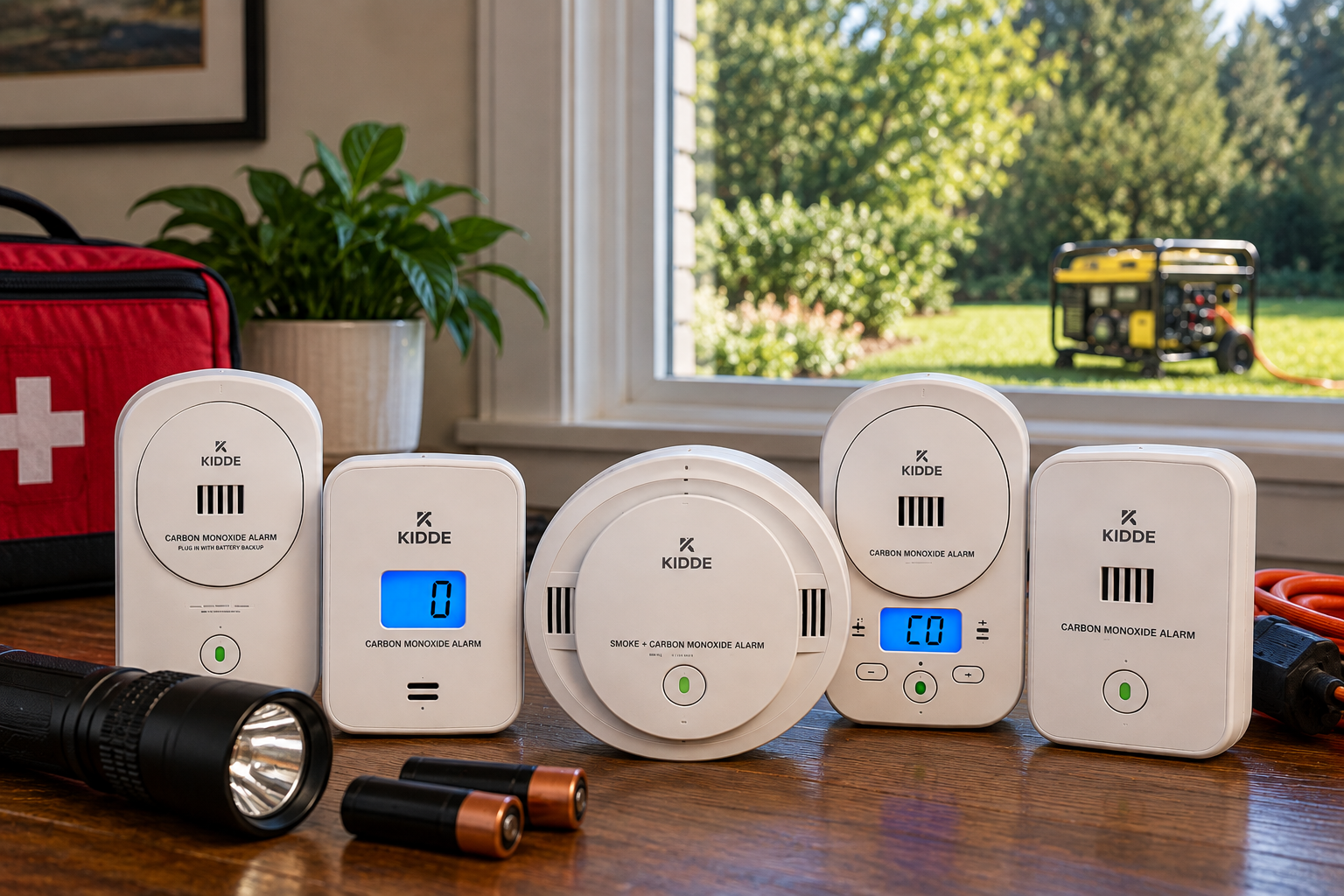
Carbon monoxide is one of the most serious hazards that can accompany a power outage.
Portable generators, furnaces, fireplaces and other fuel-burning equipment can produce carbon monoxide. Because CO has no color or smell, you cannot depend on your senses to know when it is accumulating inside your home.
That makes a working carbon monoxide alarm an important part of home emergency preparedness—especially if you own a portable generator.
The U.S. Consumer Product Safety Commission recommends battery-operated CO alarms or alarms with battery backup on every level of the home and outside sleeping areas. CPSC also recommends interconnected alarms because when one sounds, the others sound as well.
For power-outage preparedness, we think the power source matters almost as much as the features. A CO alarm that depends entirely on household electricity is not the alarm we want protecting a home during an extended outage.
Our Picks
- Best Overall: Kidde COPD
- Best 10-Year Battery Alarm: Kidde COBDL10
- Best Value Battery Alarm: Kidde COBD
- Best Smart CO Alarm: Kidde COPDW
- Best Interconnected Option: Kidde 30CUDR-VRF
As an Amazon Associate, Ready Chateau may earn from qualifying purchases at no additional cost to you.
Short Answer
If we were setting up a home specifically for power outages and generator use, our first priority would be battery operation or reliable battery backup.
The Kidde COPD is our best overall choice because it combines normal plug-in operation with AA battery backup and a digital display. When utility power goes out, the backup batteries keep the alarm operating.
If you would rather eliminate dependence on household power entirely, the Kidde COBDL10 is our favorite battery-only option. Its sealed 10-year battery, backlit digital display and low-level CO alert make it particularly attractive for emergency preparedness.
How We Chose These Carbon Monoxide Alarms
We did not laboratory-test these alarms ourselves, so we are not going to pretend that we did.
Instead, we compared current manufacturer specifications, CPSC safety guidance, power sources, battery backup, digital displays, alarm life, interconnection and features that are particularly useful during a power outage.
We gave extra weight to one question:
Will this alarm continue protecting the house when utility power is gone?
That matters because an outage is exactly when a homeowner may begin using a portable generator, fireplace or other fuel-burning equipment.
CPSC recommends choosing a CO alarm that meets the requirements of the current UL 2034 safety standard. It also recommends battery-operated alarms or alarms with battery backup for continued protection during a power outage.
For that reason, every alarm in our recommendations can continue operating without household electricity.
1. Kidde COPD — Best Overall
Check the Kidde COPD on Amazon
The Kidde COPD is the alarm we think will make the most sense for most homeowners.
Under normal conditions, it plugs directly into a household outlet. If utility power fails, AA backup batteries keep the alarm operating. That is exactly the kind of redundancy we want in a home prepared for power outages.
It also includes a backlit digital display that can be checked with the push of a button.
The plug-in design is convenient during normal everyday use, while the battery backup addresses our biggest concern: losing CO protection at the same time the household begins relying on emergency equipment.
Why we like it
- Plug-in operation with AA battery backup
- Continues operating during a power outage
- Backlit digital display
- Simple installation
- Good balance of useful features without requiring a smart-home setup
What we would change
You still have replaceable batteries to maintain. If you would rather eliminate routine battery changes, our 10-year battery pick may make more sense.
Ready Chateau verdict: This is our best all-around choice for a homeowner who wants a straightforward CO alarm that remains operational when the electricity goes out.
2. Kidde COBDL10 — Best 10-Year Battery CO Alarm
Check the Kidde COBDL10 on Amazon
The Kidde COBDL10 takes a different approach.
Instead of plugging into the wall and switching to backup batteries during an outage, it uses a sealed 10-year battery. Utility power therefore has nothing to do with its normal operation.
For emergency preparedness, there is a lot to like about that simplicity.
The COBDL10 also includes a backlit digital display and a low-level CO alert in addition to its standard emergency alarm. Kidde says the low-level feature is designed to provide notification of lower CO levels, which may be particularly useful in households with people or pets that can be more vulnerable to carbon monoxide exposure.
It can be wall-mounted or placed on a suitable tabletop according to the manufacturer’s instructions.
Why we like it
- Sealed 10-year battery
- No dependence on utility power
- Backlit digital display
- Low-level CO alert
- No routine battery replacement
- Flexible placement
What we would change
You pay for that convenience up front, and when the sealed battery reaches the end of its service life, you replace the alarm rather than simply replacing its battery.
Ready Chateau verdict: If you want to install a CO alarm and largely eliminate battery maintenance for the life of the device, this would be our choice.
3. Kidde COBD — Best Value Battery-Powered Option
Check the Kidde COBD on Amazon
Not every CO alarm needs Wi-Fi, a sealed battery or a long list of extra features.
The Kidde COBD is a straightforward AA-powered carbon monoxide alarm with a backlit digital display.
Because it operates entirely from replaceable AA batteries, a utility outage does not change the way the alarm operates. Kidde says its AA batteries normally need to be changed about once a year under normal operating conditions.
That simplicity can be an advantage when you need multiple alarms to cover a home properly.
Why we like it
- Completely battery powered
- Backlit digital display
- Simple installation
- Replaceable AA batteries
- No dependence on household electricity
- Straightforward features without smart-home extras
What we would change
You have to remember the batteries. If regular battery replacement is likely to be forgotten, spend more for the sealed 10-year model.
Ready Chateau verdict: A good choice for homeowners who want battery-powered operation and a digital display without paying for features they do not need.
4. Kidde COPDW — Best Smart Carbon Monoxide Alarm
Check the Kidde COPDW on Amazon
Smart features are not necessary for a carbon monoxide alarm to do its most important job.
But there are situations where remote notification is genuinely useful.
The Kidde COPDW plugs into household power, includes AA battery backup, has a backlit digital display and can send real-time CO notifications through the Kidde app.
That could make it particularly useful for a second home, an elderly family member’s home or another property you sometimes need to monitor while away.
More importantly for us, the smart features do not come at the expense of outage protection. The AA backup batteries keep the alarm itself operating when household power goes out.
There is an important distinction, though.
Battery backup keeps the CO alarm working. It does not necessarily keep your home’s internet connection working.
If your modem, router or internet service goes down during the outage, remote smartphone notifications may not be available. Never treat the phone notification as a substitute for the alarm inside the house.
Why we like it
- Plug-in operation
- AA battery backup
- Real-time smartphone notifications
- Backlit digital display
- Useful for remotely monitored properties
What we would change
It costs more than a conventional alarm, and many households simply do not need a connected CO detector.
Ready Chateau verdict: Buy this one because you have a real use for remote notifications—not because every emergency device needs an app.
5. Kidde 30CUDR-VRF — Best Interconnected Option
Check the Kidde 30CUDR-VRF on Amazon
For a larger or multistory house, interconnection may matter more than a digital display.
CPSC recommends interconnected CO alarms because when one alarm detects a hazard, alarms elsewhere in the house can also warn occupants.
The Kidde 30CUDR-VRF is different from our other recommendations because it is a combination smoke and carbon monoxide alarm.
It operates from replaceable AA batteries and uses wire-free interconnection with compatible alarms. Kidde says up to 12 compatible smoke or combination alarms can be interconnected. When one sounds, the compatible interconnected alarms sound as well.
It also provides voice alerts identifying whether the warning is for fire or carbon monoxide.
Because the system is battery powered, no household electricity or new interconnect wiring is required for the alarms to communicate.
Kidde states that the 30CUDR-VRF conforms to UL 217 for smoke alarms and UL 2034 for carbon monoxide alarms.
Why we like it
- Wireless interconnection
- AA battery operation
- Combination smoke and CO detection
- Voice alerts identifying the hazard
- Up to 12 compatible interconnected alarms
- No hardwired interconnect required
- Continues operating during a power outage
What we would change
This is more system than some households need. It makes the most sense when you plan to install multiple compatible alarms rather than purchasing one standalone unit.
It is also a combination smoke/CO alarm, so placement should satisfy the manufacturer’s requirements for both types of detection.
Ready Chateau verdict: If whole-house warning is your priority, this is the strongest fit in our lineup.
Which Carbon Monoxide Alarm Should You Buy?
For most homes, we would keep the decision simple.
Choose the Kidde COPD if you want plug-in convenience with battery backup and a digital display.
Choose the Kidde COBDL10 if you prefer a maintenance-light, battery-only alarm with a sealed 10-year battery.
Choose the Kidde COBD if you need straightforward battery-powered alarms and want to avoid paying for features you do not need.
Choose the Kidde COPDW if remote notifications would actually be useful.
Choose the Kidde 30CUDR-VRF if interconnected whole-house warning is your priority and a combination smoke/CO alarm fits your needs.
The best setup may also involve more than one type of alarm rather than buying the same model for every location.
How Many CO Alarms Do You Need?
CPSC recommends installing carbon monoxide alarms on every level of the home and outside sleeping areas.
For power-outage protection, the alarms should be battery operated or have battery backup. CPSC also says interconnected alarms are best because when one sounds, they all sound.
Follow the manufacturer’s installation instructions for the specific alarm you purchase. Placement requirements can vary, and a CO alarm should not be hidden behind furniture or draperies.
CPSC recommends testing alarms monthly. Replace batteries and alarms according to the manufacturer’s instructions and replacement schedule.
A CO Alarm Does Not Make an Unsafe Generator Safe
This point deserves its own section.
A carbon monoxide alarm is a backup layer of protection. It does not make it safe to operate a generator in a garage, basement, shed, porch or too close to the house.
CPSC says portable generators should be operated outside only, at least 20 feet away from the home, with the exhaust directed away from the house.
Never move a generator closer to the house because the weather is bad, the extension cord is too short or you have CO alarms inside.
Our guide to Portable Generator Safety covers generator placement, electrical hazards, refueling and carbon monoxide safety in more detail.
For a deeper explanation of how CO alarms fit into a backup-power plan, see Carbon Monoxide Detectors and Backup Power.
What Should You Do If a Carbon Monoxide Alarm Sounds?
Do not wander through the house trying to figure out where the carbon monoxide is coming from.
Get everyone outside into fresh air and call 911. Do not re-enter the home until emergency responders say it is safe.
Symptoms of carbon monoxide poisoning can include headache, dizziness, weakness, nausea, vomiting, sleepiness and confusion. Higher exposure can lead to loss of consciousness and death.
Final Thoughts
A carbon monoxide alarm is not an exciting emergency-preparedness purchase.
That is probably a good thing.
You install it, test it, maintain it and hope you never hear it for anything other than a test.
But if you use a portable generator or other fuel-burning equipment during a power outage, working CO alarms belong in the plan before the lights go out.
For most households, our first choice is the Kidde COPD because its combination of plug-in convenience, AA battery backup and digital display fits power-outage preparedness particularly well.
For homeowners who would rather eliminate dependence on household electricity altogether, the Kidde COBDL10 is an excellent alternative.
Whichever alarm you choose, install enough of them, test them regularly and replace them when required.
And remember: the alarm is the backup.
Keeping carbon monoxide out of the house in the first place is the real goal.