
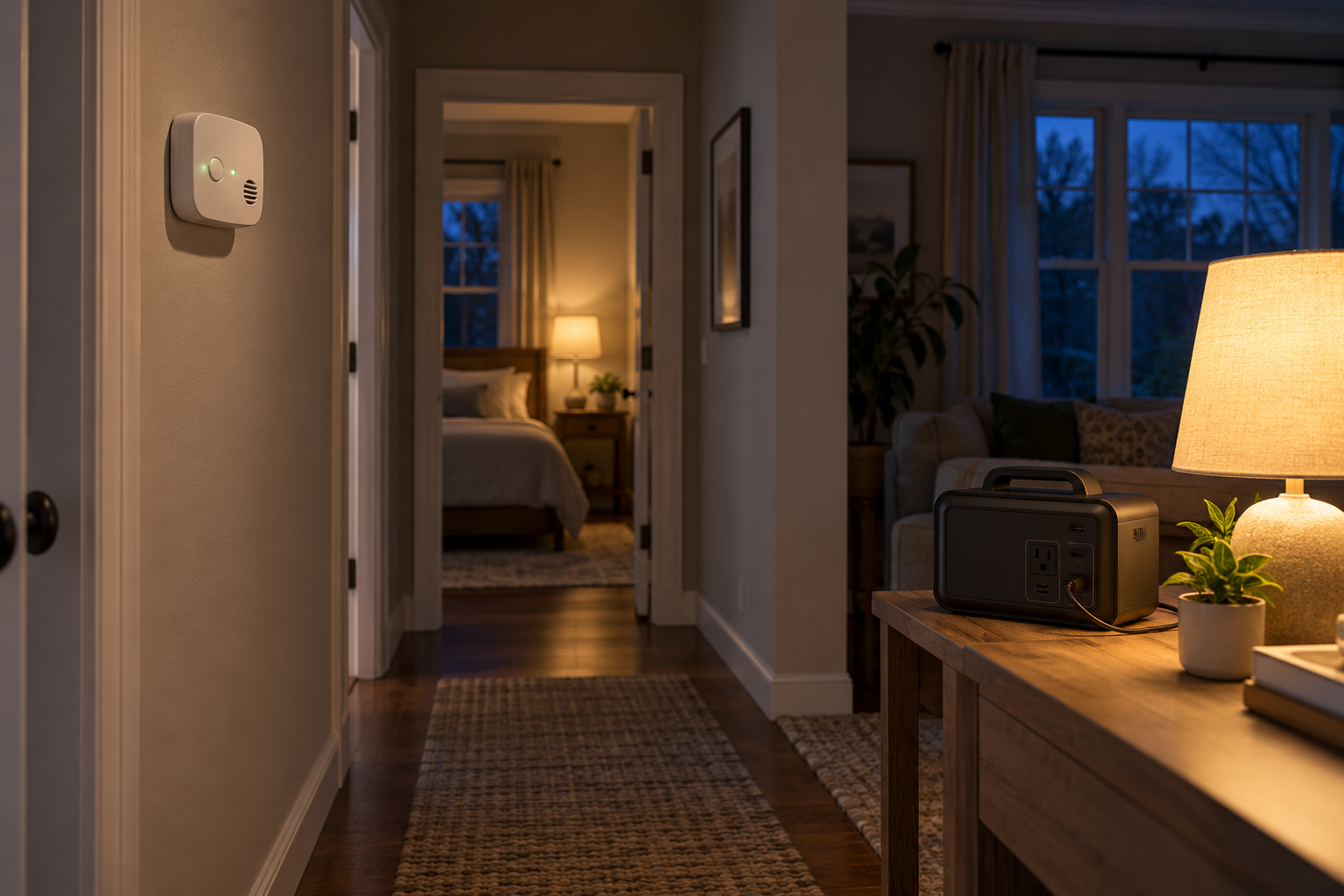
When the power goes out, many households focus on keeping the refrigerator, phones and lights running. Carbon monoxide protection belongs in that same plan—especially if anyone will use a portable generator or another fuel-burning device.
A carbon monoxide (CO) alarm is easy to overlook because it sits quietly most of the time. During an outage, though, a plug-in alarm without backup power may go quiet just when the risk rises. A working alarm gives your household another warning, but safe equipment placement is still the first line of protection.
Quick Answer
Put working, battery-operated CO alarms or alarms with battery backup on every level of your home and outside sleeping areas. Follow the alarm maker’s installation instructions and any local requirements. Test each alarm monthly and replace it when the manufacturer says its service life is over.
If you use a fuel-powered portable generator, run it outdoors at least 20 feet from the home and other buildings, with its exhaust pointed away from doors, windows and vents. Never run it in a garage, carport, porch, shed or basement—even with openings left open. A CO alarm is an added warning, not permission to move the generator closer.
What Makes an Outage Different?
Carbon monoxide is a poisonous gas you cannot see or smell. Fuel-burning appliances and engines can produce it, including furnaces, water heaters, fireplaces, grills and portable generators. Exhaust can enter through an opening or build up in an enclosed or partly enclosed space.
An outage may add a new source of CO if someone starts a generator or tries to cook or heat the home with unsuitable equipment. It may also remove electrical power from a CO alarm. That combination is why the power source of the alarm matters as much as its location.
A portable power station is a different kind of backup power. It stores electricity in a battery and does not create engine exhaust while operating. That does not make a CO alarm unnecessary: a home may still have a gas water heater, fireplace, attached garage or another source of CO. Keep the normal household alarm coverage in place.
Choose an Alarm That Works When the Lights Go Out
For outage readiness, the practical choices are a battery-operated CO alarm or a hardwired or plug-in alarm with a working backup battery. A plug-in unit that depends only on the wall outlet cannot be counted on after that outlet loses power.
Look for a CO alarm that meets the current UL 2034 safety standard. If you prefer a combination smoke and CO alarm, check that it is designed and certified for both hazards. Interconnected alarms are useful in a larger or multi-level home because one alarm sounding can alert people in other rooms.
Do not assume a home backup battery or generator will keep every outlet energized. The alarm’s own battery or battery backup provides protection even when the backup-power plan changes or fails. Check the exact alarm manual to learn what its backup does and how it signals low battery or end of life.
Where Should CO Alarms Go?
Start with at least one on every level and outside each sleeping area. If bedrooms are separated, make sure each sleeping area has coverage. Follow the manufacturer’s directions for the particular unit and check local rules, which may call for additional locations.
Do not guess at mounting height or place an alarm where curtains, furniture or a heating vent can interfere with it. CPSC also advises against placing CO alarms in kitchens or directly above fuel-burning appliances. The alarm manual is the best guide for exact spacing and placement in your home.
If someone sleeps behind a closed door or may not hear a distant alarm, consider whether an interconnected or additional alarm is needed. The goal is for everyone to hear the warning soon enough to leave, including during the night.
Check Your Alarms Before an Outage
A five-minute check now is more useful than searching for batteries after a storm.
Find every CO alarm. Note which are battery-operated, which are plugged in and which are hardwired. Confirm that plug-in and hardwired units have functional backup power.
Use each alarm’s test button according to its manual at least once a month. The test button checks the alarm circuitry; it does not prove that the sensor will accurately measure CO. Never try to test an alarm with vehicle or generator exhaust.
Replace user-replaceable batteries on the schedule in the manual, and replace a battery when the alarm gives a low-battery signal. A sealed-battery model does not have a user-replaceable battery; follow its replacement and end-of-life instructions.
Check the manufacturing, installation or replace-by date and the manual for each unit. CO alarms have a limited service life, which varies by model. If an alarm reaches its end-of-life signal, replace the whole unit rather than assuming a fresh battery will fix it.
If an alarm is missing, fails its test, has an unexplained trouble signal or cannot work during an outage, correct that before relying on a generator. Keep the manual somewhere you can find it so you can distinguish the full CO alarm signal from a maintenance chirp—but treat an uncertain signal as a reason to get outside and call for help.
Use the Generator Safely Even With Alarms Installed
The alarm is the backup warning. The main protection is keeping exhaust out of occupied spaces.
Run a portable generator outdoors only, at least 20 feet from the home and other buildings, with the exhaust directed away. Keep it away from doors, windows and vents. A garage with the door open, a covered porch, a carport and a shed are unsafe generator locations.
Do not shorten that distance because an extension cord will not reach. Use the correct outdoor-rated cord or have an appropriate home connection installed by a qualified electrician. Our generator extension-cord guide explains how to choose a cord without compromising placement.
A generator with a built-in CO shutoff can add protection, but the shutoff does not replace safe outdoor operation or indoor CO alarms. The same caution applies to grills, camp stoves and other fuel-burning devices: do not bring them inside to cook or heat the home.
What If the CO Alarm Sounds?
Get everyone outside to fresh air immediately. Call 911 or your local emergency services from outside. Account for everyone, including anyone who may have been asleep. Do not go back inside to look for the source or to silence the alarm; wait until emergency responders say it is safe to return.
Do not wait for a headache or dizziness before leaving. CO can cause weakness, nausea, vomiting, chest pain and confusion, and a sleeping person may not notice symptoms at all. If someone has symptoms even though an alarm has not sounded, get outside and seek emergency help; a silent alarm does not rule out exposure.
After responders investigate, have a qualified professional correct any problem they identify before using the equipment again. Do not restart a generator or fuel-burning appliance simply because the alarm has stopped.
A Simple Outage-Ready CO Plan
Before the next outage, walk through the house and answer four questions: Where are the CO alarms? Will each one work without household power? When was it last tested and when must it be replaced? Where can the generator operate at least 20 feet away with exhaust pointed clear of openings?
If you cannot answer one of those questions, you have found the next small preparedness task. Fixing the alarm or generator setup now is easier than making the decision in the dark.
CO protection works in layers: keep fuel-burning equipment in the right place, maintain the alarms, and know exactly what your household will do if one sounds.
Sources Consulted
U.S. Consumer Product Safety Commission — Carbon Monoxide Fact Sheet
U.S. Consumer Product Safety Commission — 2026 Generator and Hurricane Safety Guidance
Centers for Disease Control and Prevention — Carbon Monoxide Poisoning Basics
U.S. Consumer Product Safety Commission — CO Alarms