
A portable generator is only useful if you have fuel available when you need it.
That sounds obvious, but storing gasoline for an emergency creates its own set of problems. A five-gallon gas can filled with gasoline weighs more than 30 pounds. You may have to lift it beside a generator, position the spout over a relatively small opening, and control the flow without spilling gasoline on the generator or yourself.
Some gas cans make that job considerably easier than others.
For generator owners, we think a good fuel can should be stable, easy to handle when full, reasonably easy to pour, and designed to give you good control over the fuel.
After comparing the available options, these are our picks.
Our Gas Can Recommendations
As an Amazon Associate, Ready Chateau may earn from qualifying purchases at no additional cost to you.
Quick Picks
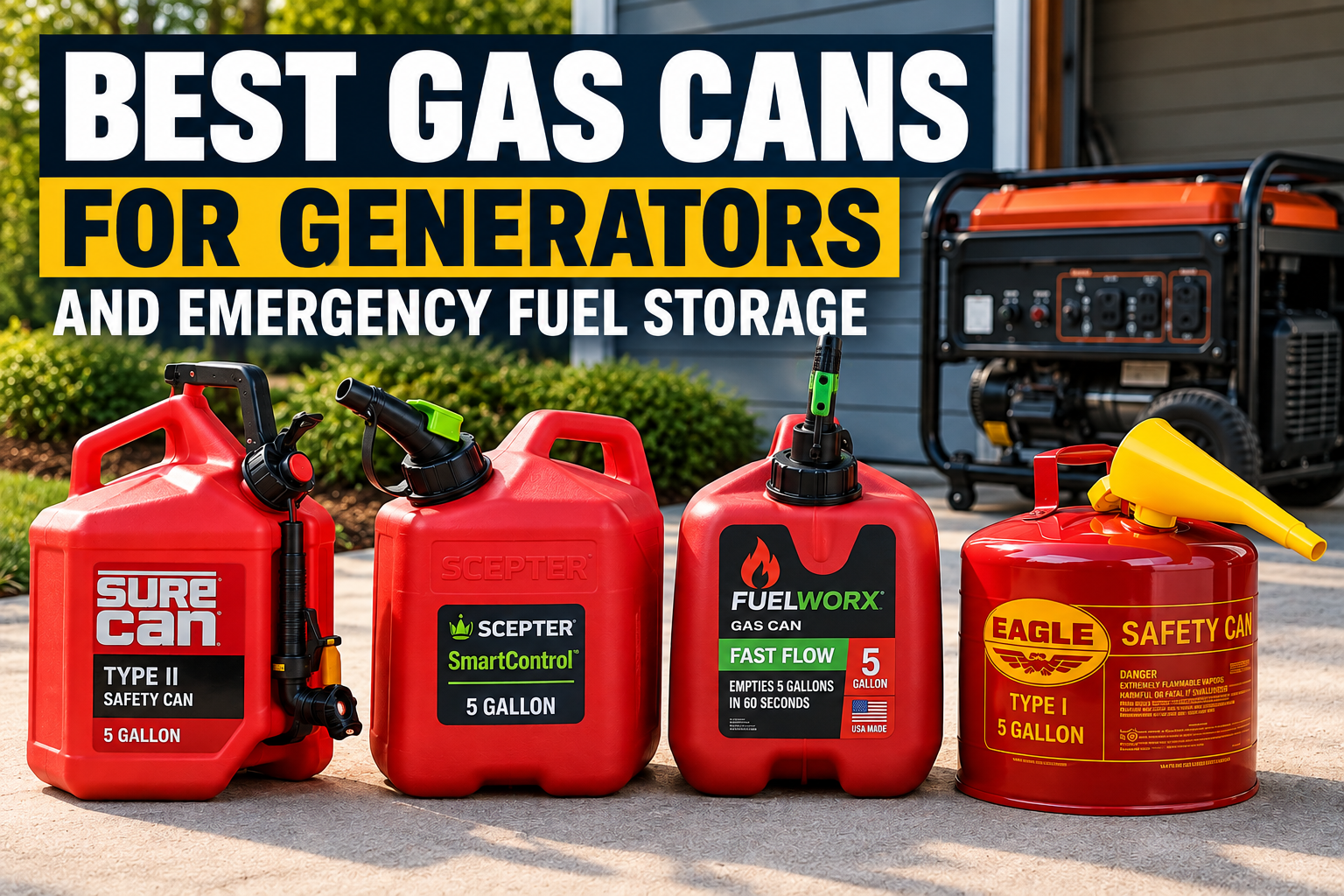
- Best Overall: SureCan 5-Gallon Gasoline Type II Safety Can
- Best Value: Scepter 5-Gallon SmartControl Gas Can
- Best Fast Fuel Transfer: Fuelworx 5-Gallon Fast-Flow Gas Can
- Best Heavy-Duty Steel: Eagle 5-Gallon Type I Safety Can
1. Best Overall: SureCan 5-Gallon Gasoline Type II Safety Can
Our top choice for most generator owners is the SureCan 5-Gallon Gasoline Type II Safety Can.
Check the SureCan 5-Gallon Type II on Amazon
What makes the SureCan different is where the fuel comes out.
Instead of putting the spout on top of the container and requiring you to tip the entire five-gallon can forward, SureCan places the dispensing spout near the bottom of the container.
The flexible spout rotates into position, and a thumb-control button lets you start and stop the fuel flow.
That design makes a lot of sense when you’re filling a generator.
You still have to lift the can, but you don’t have to hold more than 30 pounds of gasoline at an awkward angle while trying to line up a traditional top-mounted spout.
SureCan also gives you multiple handholds, a self-venting design and a flexible rotating nozzle. The gasoline Type II model is FM approved and carries several additional manufacturer-listed certifications.
What we like
- Bottom-mounted dispensing system
- Flexible rotating spout
- Thumb-controlled fuel flow
- Multiple hand grips
- Self-venting
- Particularly well suited to filling generators and other equipment
What we don’t like
- More expensive than a basic plastic gas can
- More moving parts than a traditional container
- Probably unnecessary if you only need a small amount of gasoline for occasional lawn equipment use
Ready Chateau Verdict
If we were buying one primary five-gallon gas can specifically for a portable generator, this is the one we’d choose.
The combination of positioning and fuel-flow control solves one of the biggest problems with a five-gallon container: safely getting the gasoline from the can into the generator.
2. Best Value: Scepter 5-Gallon SmartControl Gas Can
The Scepter 5-Gallon SmartControl gives you a lot of useful features without moving into the price range of the SureCan or a steel safety can.
Check the Scepter 5-Gallon SmartControl on Amazon
The SmartControl spout uses a squeeze-controlled system that lets you regulate the amount of fuel coming out of the container.
The five-gallon model we selected also has a rear handle, which matters more than it might seem. Once you put roughly 30 pounds of gasoline into a container, having good places to grip it becomes important.
The FSCG552 also incorporates a flame-mitigation device and is listed as EPA and CARB compliant.
What we like
- Good price for a five-gallon fuel container
- Rear handle helps when lifting and pouring
- Controllable fuel flow
- Flame-mitigation device
- Practical choice if you need several fuel cans
What we don’t like
- You still have to tilt the can to dispense fuel
- The squeeze-control system may take a little practice
Ready Chateau Verdict
The Scepter is our Best Value because it provides useful flow control and good handling without the premium price of our top pick.
It becomes particularly attractive if you’re buying several cans for emergency fuel storage.
3. Best Fast Fuel Transfer: Fuelworx 5-Gallon Fast-Flow Gas Can
If your priority is moving fuel quickly, take a look at the Fuelworx 5-Gallon Fast-Flow Gas Can.
Check the Fuelworx 5-Gallon Gas Can on Amazon
Fuelworx takes a different approach from the SureCan. Instead of minimizing how much you have to tilt the container, its design focuses on getting fuel out of the can quickly while still giving you control over the flow.
The 5-gallon 47905 uses a push-button fast-flow vent along with a flow-control trigger and a rotating nozzle. Product information for the 47905 states that it can empty five gallons in about 60 seconds.
That’s useful when you’re transferring larger amounts of stored fuel or refueling equipment with a reasonably large tank opening.
But faster isn’t automatically better.
When you’re pouring gasoline into a generator, control matters more than shaving a few seconds off the job. There’s no prize for being the fastest person to refuel a generator.
What we like
- Very fast fuel transfer
- Push-button fast-flow vent
- Flow-control trigger
- 360-degree rotating nozzle
- Dual-handle design
- Stackable container design
What we don’t like
- Fast flow requires more attention around smaller fuel openings
- Speed is less important than control when refueling a generator
- Traditional lifting and tilting are still required
Ready Chateau Verdict
The Fuelworx is our choice for Best Fast Fuel Transfer.
It makes the most sense for someone storing multiple cans or regularly transferring larger quantities of gasoline. For generator use, take advantage of the flow control rather than treating maximum flow rate as the goal.
4. Best Heavy-Duty Steel: Eagle 5-Gallon Type I Safety Can
For someone who prefers a traditional industrial-style steel safety can, our pick is the Eagle 5-Gallon Type I Safety Can, model UI50FS.
Check the Eagle UI50FS on Amazon
This is a very different product from the three plastic cans above.
The Eagle is made from 24-gauge galvanized steel and uses a self-closing, leak-tested lid and flame arrester. The UI50FS includes a funnel that makes it easier to pour into smaller fuel openings.
It meets OSHA and NFPA requirements and is UL-listed and FM-approved.
The tradeoff is weight.
Eagle lists the can at about 7 pounds empty and roughly 37 pounds when full.
That’s something to think about before choosing steel simply because it seems more durable.
What we like
- Heavy-duty galvanized steel construction
- Self-closing lid
- Flame arrester
- Pressure-relief design
- Funnel included
- Strong safety certifications
What we don’t like
- Heavier than plastic
- More expensive than many conventional plastic cans
- A full five-gallon can may be difficult for some people to lift and control
Ready Chateau Verdict
The Eagle is our Best Heavy-Duty Steel choice for someone who prioritizes rugged construction and traditional safety-can design over light weight.
For the average homeowner refueling a portable generator, however, we think the SureCan or Scepter will generally be easier to handle.
SureCan vs. Scepter: Which Would We Buy?
For most homeowners, we think the real decision comes down to the SureCan and Scepter.
If you’re buying one primary can for your generator, we’d spend the extra money on the SureCan. Its bottom-mounted flexible spout and controlled dispensing system are particularly useful when you’re trying to put gasoline into a generator.
If you’re building a larger emergency fuel supply, the economics change.
Buying several premium cans gets expensive quickly. In that situation, we could see using a SureCan as the primary refueling container and less-expensive approved containers such as the Scepter for additional fuel storage.
That gives you the easier dispensing system where it matters most without paying the premium price for every container you own.
How Many Gas Cans Do You Actually Need?
Don’t start by deciding how many cans you want.
Start with your generator.
Check the owner’s manual or manufacturer specifications to determine the generator’s fuel capacity and approximate fuel consumption at the load you expect to run.
Then work backward from the amount of generator runtime you’re trying to provide.
For example, if a generator consumed an average of half a gallon per hour under your expected load, a five-gallon supply would represent roughly 10 hours of runtime.
That’s only an example. Generator fuel consumption varies considerably with engine size, electrical load and operating conditions.
Our guide to choosing a generator can help if you’re still determining your backup-power requirements:
Portable Generators for Home Outages: Our Picks
There’s another side to this calculation that sometimes gets overlooked.
Ten five-gallon cans don’t just give you 50 gallons of gasoline.
They also give you 50 gallons of gasoline that must be stored safely and rotated properly.
More stored fuel isn’t automatically better.
Gas Can Safety Matters More Than the Brand
Gasoline is extremely flammable, and a portable fuel container should never be treated like an ordinary storage bin.
Federal requirements now require covered portable fuel containers to incorporate flame-mitigation technology designed to impede flame propagation into the container. CPSC says the mandatory standard took effect July 12, 2023.
That doesn’t make gasoline harmless.
Store fuel only in approved containers and follow the container manufacturer’s instructions. CPSC recommends keeping portable fuel containers in cool, well-ventilated areas, closed when not in use and away from ignition sources.
Never store gasoline in improvised containers.
And don’t assume that because a gas can fits somewhere, that’s an appropriate place to store it.
Never Refuel a Running or Hot Generator
This deserves its own section.
Never pour gasoline into a generator while the engine is running or hot.
Shut the generator down and allow it to cool before refueling.
A small spill that would merely be inconvenient under other circumstances can become extremely dangerous around a hot engine or ignition source.
If you own a portable generator, our generator safety guide covers the other major precautions you should know:
Don’t Forget About Fuel Rotation
Buying emergency gasoline and forgetting about it for several years isn’t a good preparedness plan.
Gasoline changes during storage, and your storage conditions, fuel formulation and equipment manufacturer’s recommendations all matter.
Rather than relying on a single universal storage-life number, establish a rotation schedule for your emergency fuel and follow the recommendations for your generator and any fuel stabilizer you use.
We cover that subject separately here:
Fuel Stabilizer for a Generator
And when the generator itself goes into storage:
How to Store a Portable Generator the Right Way
Plastic vs. Steel Gas Cans
Neither material automatically makes a fuel can the right choice for everyone.
Plastic cans are generally lighter and less expensive. For homeowners who need to lift a five-gallon container and pour fuel into a generator, that weight difference can matter.
Steel safety cans are heavier and typically more expensive, but products such as the Eagle offer rugged construction and safety features commonly used in commercial and industrial settings.
For most homeowners, we think handling and dispensing design should carry more weight than simply choosing plastic or steel.
Is Five Gallons the Right Size?
Five gallons has become a practical standard for generator fuel because it stores a meaningful amount of gasoline without requiring a large stationary tank.
But don’t underestimate the weight.
Gasoline weighs roughly six pounds per gallon, which means the fuel alone in a five-gallon can weighs around 30 pounds. Add the container and you’re generally lifting more than 30 pounds—and in the case of the Eagle steel can, about 37 pounds total when full.
If lifting that much weight safely is difficult, two smaller containers may be a better choice than one large one.
The best emergency equipment is equipment you can actually use.
Final Recommendations
For most generator owners, our first choice is the SureCan 5-Gallon Gasoline Type II Safety Can. Its dispensing system addresses the awkward part of using a five-gallon gas can better than the other models we considered.
For a less expensive option—especially if you’re buying several cans—we like the Scepter 5-Gallon SmartControl.
If rapid fuel transfer is important, the Fuelworx 5-Gallon Fast-Flow gives you a high-flow design while retaining start/stop control.
And if you prefer a heavy-duty steel safety can, the Eagle UI50FS is our pick.
Check the Eagle UI50FS on Amazon
Whichever can you choose, the container itself is only one part of emergency fuel preparedness. Safe storage, sensible fuel rotation and safe generator-refueling practices matter just as much.