
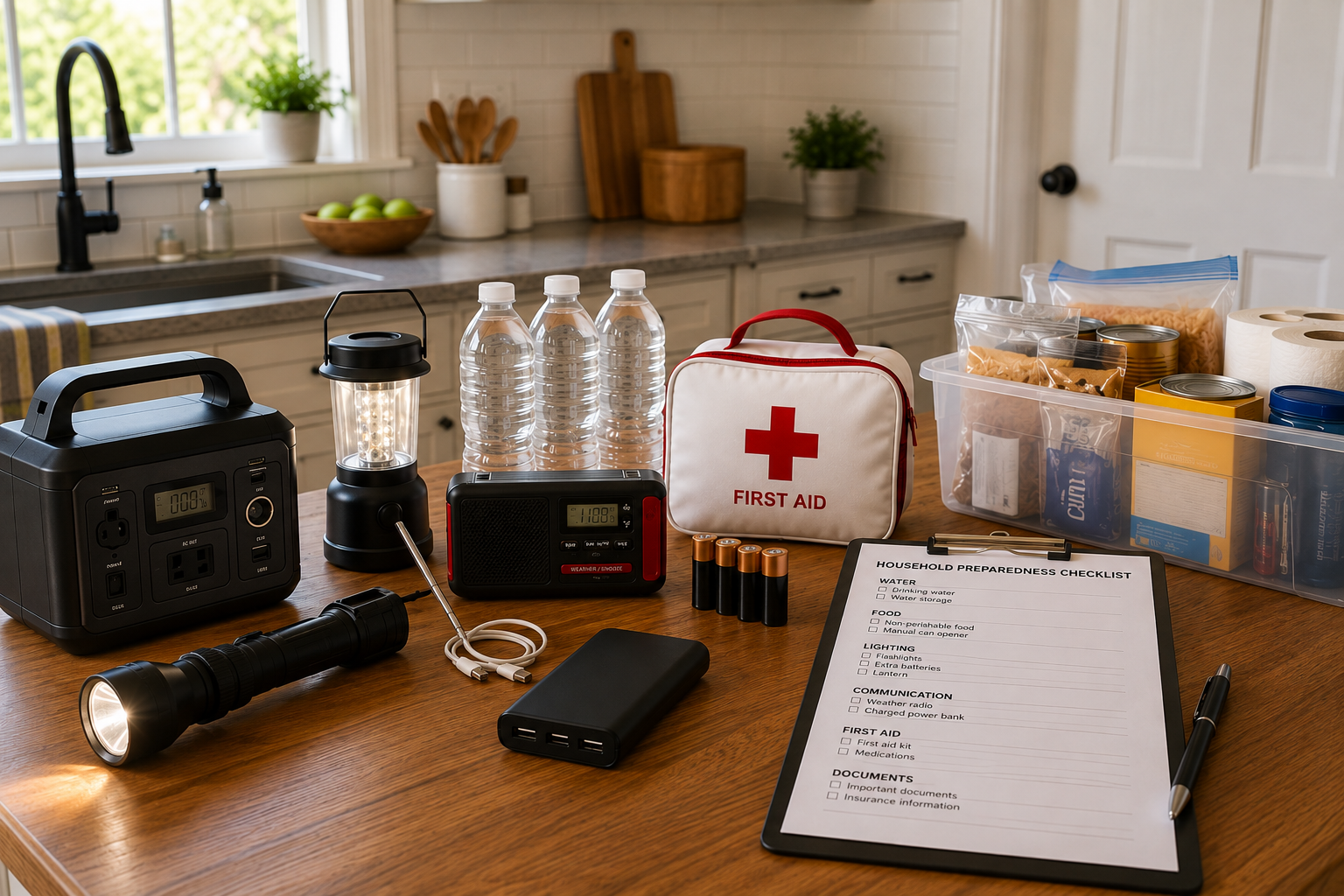
Preparedness can get complicated very quickly.
Search online and it won’t take long before you’re looking at enormous supply lists, expensive generators, buckets of emergency food and enough gear to make you wonder where you’re supposed to put it all.
You don’t need to start there.
Good preparedness begins with a simpler question:
What would your household need to get through a realistic disruption safely and with reasonable comfort?
A household facing hurricane season has different needs from someone living in a small apartment with limited storage. And someone with a garage full of emergency equipment may need less new gear and more time making sure what they already own actually works.
That’s why Ready Chateau doesn’t start with a shopping list.
We’ll start with who you’re preparing for, what you’re realistically preparing for and what you already have. Then we’ll figure out what’s actually missing.
The goal isn’t to prepare for everything at once. It’s to be better prepared tomorrow than you are today.
1. Start With the People in Your Household
Preparedness begins with people, not equipment.
Think about everyone who would depend on your household during a disruption—including children, older family members and pets.
Pay particular attention to needs your household can’t safely go without. That might include essential medications, refrigerated medicine, mobility equipment, electrically powered medical devices, infant supplies, dietary requirements or pet medications.
You don’t need to solve every problem today. First, identify the needs that are unique to your household.
A generic emergency checklist can’t know your household. You can.
Your First Step
Make a simple list of every person and pet you’re preparing for. Beside each one, note anything they would specifically need during a prolonged power outage, water interruption or evacuation.
Keep this list. We’ll use it as we work through the rest of this guide.
2. Know What You’re Preparing For
You don’t need to prepare for every disaster you can imagine.
Start with events that could realistically disrupt your household, such as:
- Power outages
- Severe storms
- Hurricanes or tornadoes
- Winter weather
- Flooding
- Extreme heat or cold
- Temporary loss of water
- Roads becoming impassable
- Stores being closed or difficult to reach
The disruptions most likely to affect you will depend on where you live.
Also consider how long a disruption might last. Three hours without electricity is inconvenient. Three days can become a serious problem.
We’re not trying to plan for every possible scenario. Start with disruptions that are both reasonably likely and capable of causing real problems for your household.
Apartment/Renter Note
Your risks aren’t necessarily smaller because you don’t own the building—they may simply be different.
You might have little control over utilities, elevators, heating or repairs, and you may face restrictions on generators, fuel storage or outdoor cooking.
Preparedness doesn’t require owning a house. It requires understanding the situation you actually live in and planning accordingly.
3. Take Inventory of What You Already Have
Before you buy anything, look around.
You may already have flashlights, bottled water, canned food, a first-aid kit, battery banks, blankets, coolers, tools, camping equipment or even backup-power equipment.
But owning something and being able to depend on it aren’t the same thing.
That flashlight isn’t useful if the batteries leaked two years ago. A power bank at 4% isn’t much of a backup. And don’t assume the generator that hasn’t run since the last hurricane will start during the next one.
For each useful item you already own, ask:
- Where is it? Can you find it quickly?
- Does it work? Test it rather than assume.
- Do I know how to use it? An emergency isn’t the best time to read the instructions for the first time.
- Does it need anything else? Batteries, fuel, oil, extension cords, charging cables or other supplies?
- When was it last checked? Food expires, batteries discharge, fuel ages and equipment deteriorates.
Already Own It?
Don’t replace useful equipment just because something newer is available.
First determine whether what you own is safe, functional and capable of doing the job you need it to do.
If it is, keep your money.
If it isn’t, you’ve identified a real preparedness gap—and that’s a much better reason to buy something.
What We’ve Accomplished So Far
We haven’t bought anything.
But we now know:
- Who we’re preparing for.
- What we’re realistically preparing for.
- What we already have.
- Whether we can depend on it.
That’s our foundation.
Next comes the first essential every household needs:
Water.
4. Water Comes First
Water should be one of your first preparedness priorities.
A good starting point is at least one gallon of water per person per day for three days. The CDC recommends trying to build toward a two-week supply when possible.
Some households may need more, especially in hot climates or when accounting for illness, pregnancy, pets or other individual needs.
For two people, a three-day supply starts at 6 gallons. For four people, it starts at 12 gallons.
If storing two weeks of water sounds impossible, don’t let the larger goal stop you from doing anything. Establish your three-day supply first and build from there as space and budget allow.
Storing Water
Commercially bottled water is the simplest option for emergency storage.
If you fill your own containers, use food-grade containers designed for water storage. Clean and sanitize them before filling, label them with the storage date, and keep them in a cool location away from direct sunlight and chemicals such as gasoline or pesticides.
The CDC recommends replacing water you’ve stored yourself every six months.
We’ll cover container selection, cleaning, sanitizing, storage and rotation step by step in our How to Safely Store Emergency Water at Home guide.
Apartment/Renter Note
Water gets heavy and takes up space.
If you live in a small apartment, don’t give up because a two-week supply isn’t practical. Establish your three-day baseline first, then add what your available storage reasonably allows.
Also consider where you store it. Several smaller containers may be easier to store and move than one very large container.
Don’t Buy It Yet
Water filters and purification equipment can provide valuable backup options, but they don’t eliminate the need for stored drinking water.
Start with water that’s ready to drink.
Then consider filtration or purification as another layer of preparedness.
5. Food You Can Actually Use
You don’t need a pallet of survival food to begin preparing.
Start in your own pantry.
Choose shelf-stable foods your household already eats and gradually keep enough on hand to get through several days without a trip to the store.
Then ask:
Could we still eat this if the power were out?
A freezer full of food isn’t the same thing as an emergency food supply.
During a power outage, keep refrigerator and freezer doors closed as much as possible. USDA guidance says an unopened refrigerator will generally keep food safely cold for about 4 hours.
A full freezer can generally maintain a safe temperature for about 48 hours, or about 24 hours if it’s half full, as long as the door remains closed.
Those numbers are useful—but don’t rely on the clock alone when deciding whether food is safe. Food temperature and condition matter too. We’ll cover that separately in our Food Safety During a Power Outage guide.
For now, make sure some of your emergency food doesn’t depend on refrigeration.
And think about how you’ll actually open and prepare it.
A few ordinary items can make a big difference:
- Shelf-stable foods your household already eats
- A manual can opener
- Coolers
- Frozen gel packs or other cold sources
- A safe way to prepare food if normal cooking appliances aren’t available
Already Own It?
Look in your pantry before shopping for emergency meals.
Canned foods, peanut butter, crackers, cereal, dried fruit and other familiar shelf-stable foods may already give you the beginning of an emergency food supply.
Build around food you’ll actually eat.
Buying specialized emergency food can come later—if you determine you actually need it.
Safety First
Never use grills, camp stoves or other fuel-burning cooking equipment indoors simply because the power is out.
Carbon monoxide can build up quickly and cannot be seen or smelled.
We’ll cover safe emergency cooking methods in a dedicated Ready Chateau guide.
6. Light, Communication & Information
When the power goes out, you need to be able to see, communicate and know what’s happening.
Start with dependable flashlights or battery-powered lanterns.
Find the ones you already own. Turn them on. Check their batteries or charge level and make sure everyone knows where they’re kept.
Battery-powered lighting is generally a better emergency choice than candles, which introduce an unnecessary fire hazard.
Your phone will probably remain your primary communication tool, so have at least one way to recharge it without household power.
For a relatively short outage, that may be nothing more complicated than a charged battery bank.
But don’t make your phone your only source of emergency information.
Cell service can become unreliable, batteries eventually run down and internet access may be interrupted.
A NOAA Weather Radio provides another way to receive official weather warnings and emergency information.
If you’re buying one, look for features such as SAME alerts and battery backup. SAME allows compatible radios to be programmed for alerts affecting specific geographic areas, while battery backup keeps the radio operating when household power is unavailable.
We’ll cover choosing and setting up a weather radio in a separate Ready Chateau guide.
If you’re dealing with an outage now, our complete power outage guide walks you through what to do first and how to manage the outage safely.
Already Own It?
Find your flashlights, lanterns, battery banks and emergency radio today.
Turn them on.
Charge what needs charging. Replace bad batteries. Make sure the correct cables are with the equipment.
A flashlight you haven’t checked in three years isn’t part of your emergency plan until you know it works.
7. Basic Backup Power
Backup power is one of the easiest places to spend a lot of money solving the wrong problem.
So don’t start with:
What generator should I buy?
Start with:
What absolutely needs electricity during an outage?
Make a short list.
For one household, that might be phones, a few lights and a refrigerator.
Another household may need to consider a well pump, medical equipment, heating or cooling needs, or other critical electrical loads.
Someone in an apartment may need little more than phone charging, lighting and enough power for a few essential devices.
Once you know what needs electricity, determine how much power it requires and how long you need to run it.
Only then should you compare solutions.
Those might include:
- Battery banks
- Portable power stations
- Solar charging
- Portable generators
- Other backup-power systems
Already Own It?
If you already own a generator, power station or other backup-power equipment, start there.
Make sure it works. Check its condition, charge level, fuel or other operating requirements, and any accessories needed to use it safely.
Then ask whether it can actually power the things you’ve identified as essential.
Don’t replace working equipment simply because newer or larger equipment is available.
If what you already own safely meets your needs, maintain it, test it regularly and keep using it.
Don’t Buy It Yet
Before buying backup-power equipment, decide what you actually need to keep running during an outage.
A refrigerator and a few lights require a very different solution from central air conditioning, a well pump or several large appliances.
Start with the load, then choose the equipment—not the other way around.
We’ll walk through that process separately in How Much Backup Power Do You Actually Need?
Safety First – Portable Generators
Portable fuel-burning generators require special precautions because they produce carbon monoxide, an odorless and potentially deadly gas.
Never operate a portable generator inside a home, garage, basement, crawlspace, shed or other enclosed space—even with doors or windows open. Operate it outdoors at least 20 feet from the home, with the exhaust directed away from windows, doors and vents.
A garage with the door open is not a safe generator location.
Homes using combustion equipment should also have working carbon monoxide alarms. Follow current safety guidance and the generator manufacturer’s instructions for installation, placement, operation and maintenance.
And don’t wait until the power goes out to discover whether your generator works.
Start it, maintain it and test it according to the manufacturer’s recommendations.
A generator that won’t start during an outage isn’t backup power.
For step-by-step guidance during an actual outage, see our complete guide to what to do when the power goes out.
Apartment/Renter Note
A fuel-burning portable generator may be impractical—or prohibited—where you live.
Never operate one indoors, on a balcony, on a porch or in another unsafe location simply because you don’t have access to an appropriate outdoor operating area.
Depending on your electrical needs, battery banks or portable power stations may be more practical alternatives.
8. Health, First Aid & Sanitation
Emergencies don’t make everyday health needs disappear.
Start with the things your household already depends on: prescription medications, medical equipment, glasses or contacts, basic first-aid supplies, hygiene products and anything else that would be difficult to replace during a disruption.
A first-aid kit should be easy to find and appropriate for the people in your household.
But owning one isn’t enough.
Open it.
Make sure supplies haven’t expired or been used up, and make sure you know what’s actually inside.
Medications
If someone depends on prescription medication, think about what would happen if the pharmacy were closed, roads were blocked or you had to leave home unexpectedly.
How much medication you can safely keep available will depend on the prescription and individual circumstances. Don’t change doses or stockpile prescription medication on your own.
Instead, talk with your pharmacist or healthcare provider about appropriate emergency planning for essential medications.
Pay particular attention to medications that require refrigeration or other special storage.
Medical Equipment
If someone in your household depends on electrically powered medical equipment, don’t wait for an outage to figure out the backup plan.
Know how long any backup battery will operate, what to do if normal power is lost and whom to contact if power isn’t restored.
Follow the equipment manufacturer’s instructions and guidance from the person’s healthcare provider.
Sanitation Matters, Too
A prolonged water outage creates problems beyond drinking water.
Think about basic hygiene, hand cleaning, toilet needs, feminine hygiene, diapers where needed, garbage disposal and cleaning supplies.
You don’t need an elaborate sanitation system to get started.
You do need to ask:
What would we do if the faucets or toilets didn’t work normally for several days?
We’ll address emergency sanitation in more detail in a separate Ready Chateau guide.
Already Own It?
Check your first-aid supplies before buying another kit.
You may need replacement bandages, antiseptic or other individual supplies—not another plastic box containing duplicates of things you already own.
9. Important Documents & Information
Some of the hardest things to replace after an emergency aren’t supplies.
They’re information.
Make sure you can access the important records you might need if you had to leave home quickly or couldn’t access your normal files.
Consider copies of:
- Identification
- Insurance policies and contact information
- Medication lists and important medical information
- Emergency contacts
- Birth certificates and passports
- Property records or your lease
- Important financial and account information
- Pet records where appropriate
You don’t necessarily need to carry every original document around in an emergency kit.
The goal is secure access to the information when you need it.
That may mean protected physical copies, secure digital backups or a combination of both.
Keep digital copies securely protected, and don’t leave sensitive account credentials, passwords or PINs in an unsecured emergency file.
Whether you keep paper or digital copies, store sensitive personal and financial information securely and limit access to people who may actually need it.
Don’t Forget the Low-Tech Backup
Your phone contains an enormous amount of useful information—until it’s lost, damaged, discharged or inaccessible.
Keep a printed list of essential phone numbers and emergency contacts somewhere you can find it.
A few pieces of critical information on paper can be surprisingly valuable when technology isn’t cooperating.
10. Home & Fire Safety
Some of the most important preparedness equipment in your home isn’t stored in an emergency kit.
It’s already mounted on your walls.
Check Your Alarms
Make sure you have working smoke alarms on every level of your home, inside each bedroom and outside sleeping areas.
Carbon monoxide alarms should be installed on every level and outside sleeping areas.
Test smoke and CO alarms monthly. Follow the manufacturer’s instructions for battery replacement and for replacing the alarms themselves.
Don’t wait until you hear the low-battery chirp at 2 a.m. to remember they exist.
Know How to Get Out
Every household should have a simple fire escape plan.
Identify two ways out of every room when possible, and make sure doors, windows and other escape routes aren’t blocked.
Choose an outside meeting place where everyone knows to go after leaving the home.
Make sure everyone in the household understands the plan, including how children, older adults, people with disabilities and pets will be handled during an evacuation.
Then practice it.
A fire escape plan you have never practiced is still partly a theory.
Know Your Home
Learn where important utility controls are located, including the electrical panel and appropriate water or gas shutoffs where applicable.
But knowing where something is doesn’t automatically mean you should operate it.
Follow utility and local emergency instructions, and don’t attempt procedures you’re not trained or equipped to perform.
Fire Extinguishers
A fire extinguisher can be useful for a small, contained fire—but only when it’s safe to use one.
Make sure everyone else is getting out, make sure someone has called 911, and keep a clear escape route behind you.
If the fire is spreading, the room is filling with smoke or you’re unsure whether it’s safe to use the extinguisher, get out.
An extinguisher is a tool for controlling a small fire, not a reason to stay in a dangerous situation.
11. Make a Simple Household Plan
Supplies are useful.
But if nobody knows where they are, what to do or how to reach each other, you don’t really have a plan.
Keep yours simple.
Everyone in the household should know:
- How you’ll communicate if you’re separated
- Where you’ll meet if you can’t return home
- Who your primary emergency contacts are
- What you’ll do if you need to evacuate
- What you’ll do if you need to remain home
- How pets will be handled
- Where important supplies are kept
- Who may need additional help
Pick an Out-of-Area Contact
Consider choosing a trusted relative or friend outside your immediate area as a common contact.
Make sure everyone has that person’s information—not just stored in a phone.
Plan for Leaving, Too
Preparedness isn’t always about staying home.
Think through what you would take if you had to leave with little notice: medications, identification, important information, phones and chargers, necessary supplies for children or pets, and other household essentials.
Apartment/Renter Note
Know your building’s exits and emergency procedures.
Don’t assume elevators will be available during a fire, power outage or other emergency.
If someone in your household has mobility limitations, determine before an emergency what assistance or alternative arrangements may be necessary.
Your First Step
You don’t need a complicated binder to create your first household plan.
Sit down with the people you live with and answer four questions:
- How will we contact each other?
- Where will we meet?
- What would make us leave?
- What would we take?
Write down the answers.
A simple plan everyone understands is more useful than an elaborate plan nobody remembers.
12. Fill the Gaps in Priority Order
By now, you know who you’re preparing for, what could realistically disrupt your household, what you already own and where the weaknesses are.
Now you can decide what—if anything—you actually need to buy or improve.
Don’t try to fix every gap at once.
Put each one into one of three categories:
NEED NOW
These are deficiencies that could materially affect your household’s basic safety or ability to manage a realistic disruption.
Examples might include having too little drinking water, no dependable lighting, missing essential medications or household health supplies, nonworking smoke or carbon monoxide alarms, or no practical way to meet a critical electrical need.
Keep your Need Now list focused on genuine essentials.
Start here.
IMPROVE NEXT
These are improvements that make your household more capable or comfortable once the essentials are covered.
Maybe you already have enough flashlights but could use better area lighting. Perhaps you have a three-day water supply and want to gradually increase it. Maybe you have a small battery bank but would eventually benefit from additional backup power.
These are worthwhile improvements—but they don’t need to compete with more important gaps.
NICE TO HAVE LATER
This is where upgrades, additional capacity and specialized equipment belong.
There’s nothing wrong with buying equipment that makes preparedness easier or more convenient.
Just make sure you’re not spending money on the third-best problem while the most important one is still unsolved.
Don’t Buy It Yet
Before purchasing something, ask:
- What specific problem will this solve?
- Do I already own something that can do the job?
- Is this a need now, an improvement for later or simply nice to have?
- Do I know where I’ll store it?
- Am I prepared to maintain and test it?
If you can’t answer those questions, you’re probably not ready to buy it yet.
Preparedness doesn’t have to be expensive.
It needs to be deliberate.
Address the biggest gaps first, then improve your household one useful step at a time.
13. Maintain What You’ve Built
Preparedness isn’t finished when the package arrives.
Water gets used. Food ages. Batteries discharge. Medications and some first-aid supplies expire. Household needs change over time. Equipment that worked last year may not work today.
That’s why maintenance is part of preparedness.
A practical starting point is to give your preparedness supplies and equipment a thorough review about every six months. Some equipment may need to be inspected, charged, serviced or tested more frequently, so always follow the manufacturer’s instructions.
During your review:
- Test flashlights, lanterns, radios and other important equipment.
- Recharge battery banks and portable power equipment.
- Check stored food and water and rotate or replace it where appropriate.
- Inspect first-aid and health supplies for expired, damaged or missing items.
- Check batteries for leakage, damage or loss of charge.
- Inspect generators and other backup-power equipment according to the manufacturer’s maintenance instructions.
- Review stored fuel and fuel-storage practices where applicable.
- Confirm that important documents and emergency contacts are still current.
- Replace equipment that is damaged, unreliable or no longer appropriate.
- Review your household plan and make sure everyone still understands it.
And don’t forget to actually use your equipment occasionally.
If you’ve never started the generator, programmed the weather radio, connected the power station or used the manual can opener, an emergency is a poor time to learn.
Already Own It?
Maintenance can save you money.
Before replacing something because it’s old, determine whether it’s still safe, reliable and capable of doing what you need.
If it is, maintain it and keep using it.
If it isn’t, replace it for a reason—not simply because something newer is available.
The Ready Chateau Equipment Rule
When you add equipment to your preparedness plan, the process shouldn’t end at Buy.
Choose → Buy → Learn → Store → Maintain → Test → Use
You should know what the equipment does, where it is, how to operate it, what it needs to keep working and whether you can depend on it.
That’s what turns equipment into preparedness.
Your Start with the Basics Checklist
You don’t need to finish everything today.
Use this checklist to identify where you are and what deserves attention next.
- List the people and pets you’re preparing for and identify their specific needs.
- Identify the disruptions most likely to affect your household.
- Take inventory of useful supplies and equipment you already own.
- Test important equipment instead of assuming it works.
- Establish at least a basic emergency drinking-water supply.
- Keep several days of shelf-stable food your household can actually eat and prepare.
- Make sure you have dependable emergency lighting.
- Have a way to charge essential phones and small devices during an outage.
- Have a backup way to receive emergency information.
- Identify what absolutely needs electricity during an outage before shopping for backup power.
- Check first-aid supplies, essential medications, hygiene needs and sanitation supplies.
- Make important documents, emergency contacts and critical information securely accessible.
- Check smoke and carbon monoxide alarms and review basic home and fire safety.
- Create a simple household communication and evacuation plan.
- Put remaining preparedness gaps into Need Now, Improve Next and Nice to Have Later.
- Address the most important gaps first.
- Set a regular schedule to inspect, maintain and test what you’ve built.
Your First Preparedness Goal
You now have a starting point.
And if you worked through this guide carefully, you probably know something much more useful than what’s on somebody else’s list of 100 emergency supplies.
You know what your household needs.
You know who you’re preparing for.
You know what could realistically happen.
You know what you already have.
You know whether you can depend on it.
And you know what’s actually missing.
That’s preparedness.
Not owning everything.
Not preparing for every imaginable disaster.
And not filling a garage with equipment you don’t know how to use.
Start with your biggest gap.
Fix it.
Then move to the next one.
Don’t try to prepare for everything this weekend.
Make your household meaningfully better prepared than it was yesterday—and maintain what you build.