
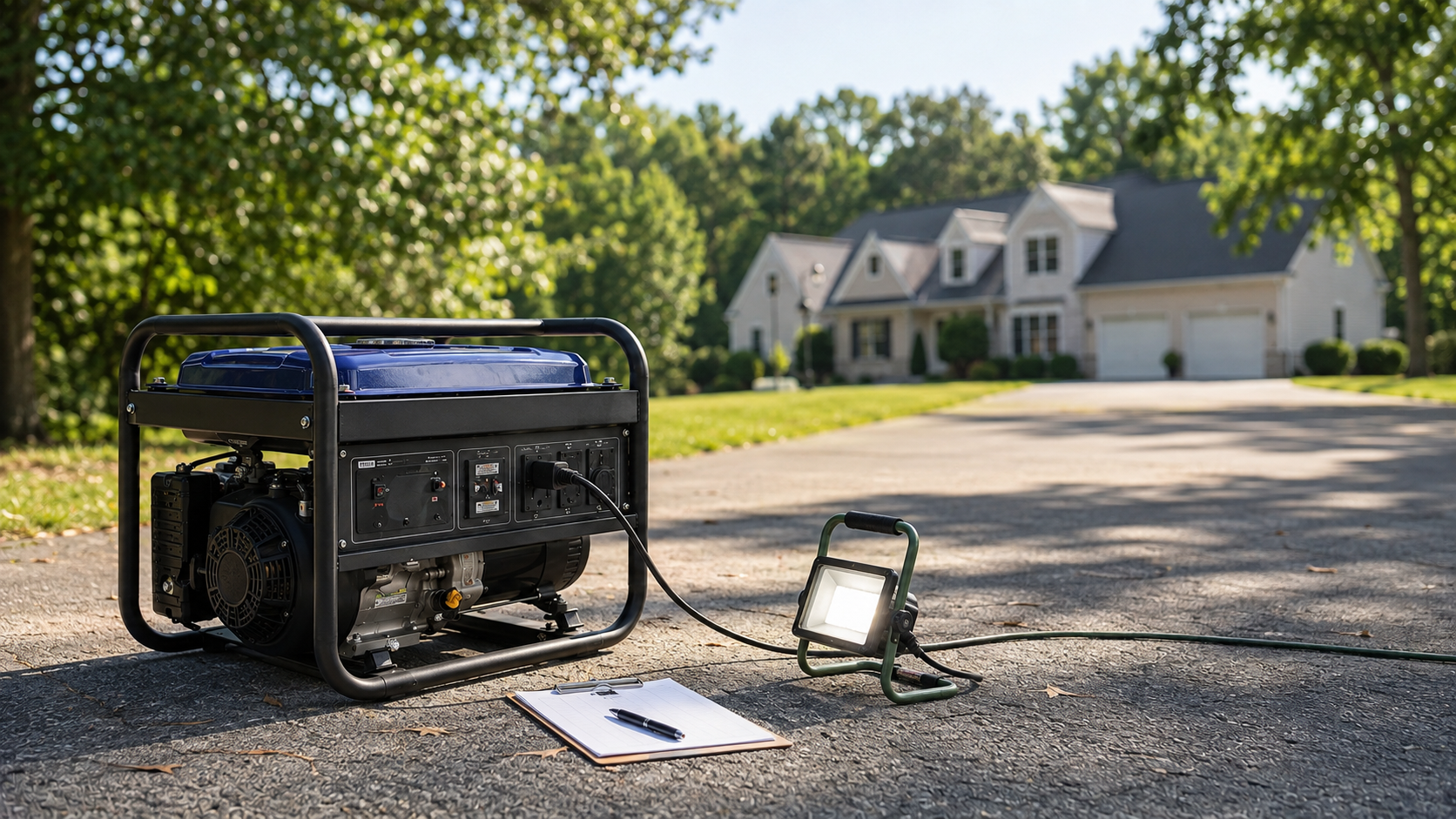
A portable generator can sit quietly for months and still look ready. The fuel tank may be full, the oil may be clean and the extension cords may be stacked beside it. None of that proves the generator will start when the power goes out.
Running it on a regular schedule gives you a chance to find problems while the lights are still on and replacement parts, fresh fuel and help are easier to find.
The short answer is that once a month is a practical starting point for many portable generators—but your owner’s manual controls. Manufacturers do not all prescribe the same interval, run time or storage method. The correct schedule depends on the generator, fuel system, battery and the way the manufacturer expects it to be stored.
Start With the Manual, Not a Universal Rule
Honda advises owners to run a portable generator at least once a month. Generac also discusses monthly running, but says that when monthly operation is not possible, the generator should be run at least every three months for 30 minutes.
Those examples show why “run every generator for exactly 30 minutes each month” is too broad. A manufacturer may specify a different interval, a particular startup and shutdown sequence, whether loads should be connected and how the fuel system should be prepared between uses.
Find the exact manual for your model. If the paper copy is missing, locate the model number on the generator’s identification label and search the manufacturer’s official support or manuals page. Confirm that the model number on the manual matches the machine before following it.
Portable and Standby Generators Are Not the Same
This article focuses primarily on portable generators—the machines homeowners move outside, fuel and connect when needed.
A permanently installed standby generator usually has an automatic exercise cycle controlled by its own system. Depending on the model, that cycle may run weekly, every two weeks or monthly. For example, some Generac standby models allow weekly, biweekly or monthly exercise schedules.
Do not replace or override a standby generator’s programmed schedule with generic portable-generator advice. Check its controller, owner’s manual and service requirements. If an automatic exercise does not occur when expected or the unit displays a warning, address that problem rather than assuming the generator is ready.
What Regular Exercise Actually Accomplishes
Regular operation is useful because it can:
- Confirm that the engine starts
- Circulate engine oil
- Move fuel through the system when the generator is stored with fuel as permitted by the manufacturer
- Help maintain the starting battery on models designed to charge it while running
- Reveal fuel leaks, oil leaks, unusual sounds or unstable operation
- Confirm that the generator is producing usable electrical power
- Give you practice with the correct startup and shutdown procedure
The last two points are easy to overlook. Hearing the engine run is encouraging, but the generator’s purpose is to produce electricity. A meaningful test should confirm more than the sound of the engine.
Should You Test the Generator Under Load?
If the owner’s manual permits it, testing with a modest, known electrical load gives you more information than letting the engine idle with nothing connected. It helps confirm that the outlets, circuit protection and power-producing side of the generator are functioning.
That does not mean connecting every appliance you hope to use during an outage. Follow the manufacturer’s loading procedure and remain within the generator’s rated capacity. Start with electrical loads disconnected or switched off if the manual requires it, allow the engine to stabilize and then add the test load as directed.
A simple load might be a suitable work light or another device whose power requirement is known and comfortably within the generator’s capacity. Do not use sensitive or expensive electronics as the first test device, and do not improvise a connection to household wiring.
If the generator supplies home circuits through transfer equipment, follow the operating instructions provided for that system. Transfer equipment should be installed by a qualified electrician. Never connect a generator to a wall outlet or use a cord with male plugs on both ends.
A Practical Monthly Generator Check
Use the schedule and procedure in your manual. For a portable generator that calls for regular exercise, the following routine provides a practical framework.
1. Choose a Safe Day and Location
Do not run a fuel-burning generator inside a garage, shed, basement, porch, carport or other enclosed or partially enclosed space—even for a short maintenance test.
Move it to the same safe outdoor location you plan to use during an outage. The U.S. Consumer Product Safety Commission says portable generators should be operated outside only, at least 20 feet from the home, with the exhaust directed away. Keep doors and windows closed near the exhaust path.
Choose dry conditions and a firm, level surface. If you cannot keep the generator dry while meeting its outdoor clearance requirements, postpone the test rather than moving it into an unsafe location.
2. Inspect Before Starting
Before every test, look for:
- Fuel or oil leaks
- Cracked or deteriorated fuel lines
- Loose or damaged components
- Debris or pest nests around air inlets and the exhaust
- Damaged receptacles
- Frayed cords or broken plugs
- Correct oil and fuel levels
- Maintenance that is due
Do not start a generator that is leaking fuel or shows electrical or mechanical damage you do not understand.
3. Follow the Correct Startup Procedure
Use the sequence in the manual. Control positions, choke operation, fuel valves, battery switches and circuit breakers vary among models.
Start with electrical loads disconnected or off when instructed. Allow the engine to warm and stabilize before applying a load. Pay attention to difficult starting, surging, smoke, unusual vibration or warning lights.
4. Run It for the Specified Time
Use the run time stated by the manufacturer. If the manual recommends monthly exercise but does not give a duration, contact the manufacturer for model-specific guidance rather than treating an internet rule as authoritative.
The purpose is not to burn fuel for its own sake. The generator should reach normal operation long enough for you to observe how it runs and, when permitted, verify electrical output with a suitable load.
5. Shut It Down Correctly
Remove or switch off electrical loads as instructed before stopping the engine. Follow the manufacturer’s cooldown and shutdown sequence, close the fuel valve or vent when required and allow the generator to cool before moving, covering or refueling it.
Record the date, run time, hour-meter reading and anything unusual. A simple log makes scheduled maintenance easier and helps you notice a generator that is becoming harder to start.
Running the Generator Does Not Fix Old Fuel
Regular exercise and proper fuel storage are related, but they are not interchangeable.
Starting the generator every month does not make deteriorated gasoline fresh again. It can instead move poor fuel through the carburetor and engine. Fuel treatment, draining and storage instructions vary by model, fuel type and expected storage period.
Honda’s guidance for several inverter models says that when the generator will be operated less than once a month, the carburetor should be drained. Generac recommends draining the fuel tank and running the carburetor dry when some portable models will be stored for more than 30 days. Your generator may have different requirements.
Decide which storage method you will follow before filling the tank. Do not add stabilizer automatically, leave fuel in the carburetor or drain a system based only on general advice. Use the fuel type, treatment method and storage procedure specified for your generator.
If your generator has already sat with old fuel and will not start, review why a generator may not start after sitting before repeatedly pulling the starter or adding more fuel.
Do Not Forget the Starting Battery
An electric-start generator can run perfectly and still leave you with a dead starting battery months later.
Some generators charge the battery while operating, but a short exercise may not restore a deeply discharged battery. Others require a charger or maintainer during storage. Honda recommends keeping electric-start generator batteries fully charged for maximum service life.
Follow the battery-charging instructions for your model. Inspect terminals for looseness or corrosion, and do not assume that monthly engine operation replaces every battery-maintenance requirement.
If the generator also has a recoil starter, practice using it while conditions are calm. Knowing that a backup starting method exists is different from knowing you can operate it correctly.
Exercise Is Not the Same as Maintenance
A successful monthly start does not mean maintenance can be ignored. Oil, air filters, spark plugs, batteries, fuel systems and valve clearances may be serviced according to operating hours, calendar time or both.
Check the maintenance table in the manual and use the hour meter if the generator has one. Record outage use as well as exercise time. A generator that runs for several days during an outage may reach a maintenance interval long before the next calendar reminder.
Regular testing should reveal whether maintenance is due—not replace it.
Test the Entire Setup, Not Just the Engine
At least before the season when outages are most likely, review the equipment that makes the generator useful:
- Approved outdoor-rated extension cords
- Plugs and receptacles
- Transfer equipment, if installed
- Carbon-monoxide alarms and their backup batteries
- Weather protection allowed by the generator manufacturer
- Approved fuel containers
- The correct oil and basic maintenance supplies
- The load plan showing what you intend to power
Our portable generator safety guide explains the placement, carbon-monoxide, electrical, weather and refueling rules that apply during a test just as they do during an outage.
A generator that starts but cannot be placed, connected or fueled safely is not fully ready.
When Should You Test More Often?
A regularly scheduled exercise is the baseline. An additional test may be sensible:
- Before hurricane, winter-storm or severe-weather season
- Before a forecast event likely to cause outages
- After maintenance or repair
- After changing the fuel-storage method
- After the generator has been transported
- After unusually long storage
- After any test that produced difficult starting, surging, leakage or warning indications
Do not wait until the storm is close enough that testing creates a rush for parts or fuel. Give yourself time to correct a problem safely.
When to Stop Testing and Get Help
Shut the generator down if you notice a fuel leak, oil leak, electrical arcing, smoke that is not normal for startup, strong fuel odors, repeated breaker trips, unstable engine speed or unusual mechanical noise.
Do not keep restarting a damaged or leaking generator to see whether the problem clears itself. Consult the correct manual, the manufacturer or a qualified service professional.
If a carbon-monoxide alarm sounds or anyone develops a headache, dizziness, weakness, nausea, chest pain or confusion while a fuel-burning generator is operating, move everyone to fresh air and call 911. Do not re-enter until emergency responders say it is safe.
The Ready Chateau Generator Test Schedule
For many portable generators, a monthly calendar reminder is a sensible place to begin. The reminder should say more than “start generator.”
Use it to:
- Review the manual’s exercise requirement.
- Inspect the generator and cords.
- Move the generator to its safe outdoor location.
- Start and run it for the required time.
- Verify electrical output with an appropriate load when permitted.
- Shut it down and store it correctly.
- Record the test and any maintenance that is due.
If your manufacturer specifies a different interval or procedure, follow that instead.
The goal is not to run the generator simply because another month passed. The goal is to know that the generator, fuel, battery, cords and operating plan are ready before the next outage turns a small problem into an urgent one.